Tag Archives: word tasting notes

reflection

We do so many things by reflex these days, and so seldom pause for reflection. We are too often too likely to view things through a single lens, and not to put them in perspective.

Let us reflect on reflection. The word reflection is formed by derivation (not inflection) from reflect, which comes from Latin re plus flectere ‘bend’: a reflection bends – or bounces – light back. A mirror is, semiotically, as Umberto Eco has explained, a prosthesis, not a sign in itself. Any object that reflects does not contain the image it reflects; what you see in it depends on your position. The reflection of a tower in a pool of water is just your line of sight reflecting to the tower in that position, and seeing the tower scattering light that was scattered onto it from countless molecules of atmosphere and surrounding matter, starting at some point with the sun: a myriad of reflections. That glowing glass building shining with the sun only shines it there for you because your line of sight bounces off it at that point towards the sun. The sun’s rays are bouncing equally off all parts of the building that face it; every square metre is glowing brightly for some eye in some location, but you only see the part that glows for your position. Reflection may lead to illumination, but what is illuminated depends entirely on your personal viewpoint.

Which is your personal perspective, of course. Perspective is simply a geometrical consequence of a single point (an eye or other lens) gathering reflected light from all around, and interpreting the diverging (or converging) lines of sight as parallel. It helps us gain a sense of the relative size of things, but what helps even more is binocular vision: add a second eye and the lines of sight converge slightly differently, and allow depth perception. When we talk about putting things in perspective, we really ought to talk about putting them in parallax.

Parallax is how a rangefinder camera – such as a Leica M-series camera, or the Ricoh that was my first camera – allows the user to focus: you line up two images at the point you want in focus, as your eyes do. On the other hand, an SLR allows through-the-lens focusing: the image bounces off a mirror onto a screen that is the same distance from the lens as the film or sensor, and you see on the screen what is in focus. This is why it’s an SLR: single-lens reflex. Reflex because the light reflects. Off the mirror.

That’s not a joke or a pun; that’s what the word reflex means: bounce-back. Some stimulus affects your nerves; you give a response automatically, like a mirror – or those Newton balls. Tack, tack; tack, tack; tack, tack…

I don’t use an SLR anymore (though I do have one). I don’t usually use a rangefinder camera, either (though I do have one). I use a camera (two of them, in fact) that shows on a screen on the back the image that is striking the sensor. This makes it smaller and lighter – quieter too (the mirror doesn’t have to flip up and down). It also means I don’t have to hold it up to my eye. Which is good because I wear glasses, but also good because when you hold a camera to your eye people react to it: they see your specular act with the prosthetic of the camera and they flinch, or turn away, or stare, or grin senselessly. The act of seeing is presented as not a passive reception but an active taking, and there is a reflex response to that.

When I hold a mirrorless camera at waist or chest level, especially a smallish one, it simply receives; few people take any notice of it. But it is still a prosthetic for my eyes, a single-lensed prosthetic giving me a different perspective from what my eyes see – different because lower, but also because it has a different angle of view, wider or narrower depending on the lens. I see things not just in perspective (as one always does) but from a different perspective. I see reflections – light bounced once or many times from its source or sources (and at night there are so many sources!), objects showing their positions because they reflect not smoothly but roughly, diffusing, scattering the light that comes to them, and shiny objects that do reflect smoothly, letting my position dictate what I see. You must know the position of what is being reflected before you can know with certainty the position of the reflector… unless there are points of opacity and diffusion on the reflector, which will allow your parallax to fix them.

When we pause for reflection, we do so to become more aware of our position and the positions of others. We do it to stop acting by reflex. Which means that, really, we pause for diffusion. And to put things in parallax, or at least to see them through another lens.

scitur

Some people learn a thing, know it, and act like they know it. They apply the knowledge scrupulously. Others learn a thing and, as soon as they think no one is going to be checking up on them, stop acting like they know it. They do whatever they want and expect others to accommodate them.

My two favourite examples of this split are driving and bibliographic citations. I think we all know that there are many people who stopped paying attention to basic traffic laws the day after they got their licence. Editors – most if not all – know too that there are many university-educated people who must have learned how to do a proper bibliographic reference according to a standard style, but who, the moment they weren’t being graded, stopped caring, even if they’re writing things that require references. They might give the last name and the date and nothing more, or they might just paste in a link. Occasionally an editor will get a gem of the order of “Google search.” The only questions remaining for the editor on such occasions are “How do I clean up the author’s blood and where should I bury his body parts?”

Any user of bibliographic references – a person who actually looks up the works cited (the normal term for this kind of person is “grad student”) – will come to detest the lazy citations Op cit. and perhaps even Ibid., especially if all the bib refs are in footnotes and not in a References section. And yet there is something enviable about such insouciance or chutzpah. An editor who has spent hours tracking down the full details of articles sloppily cited will surely wish she or he could just put “It is known.”

Well, why not? Of course, everything is better in Latin, at least when you’re trying to impress. If you say something in Latin, the ordinary person will ask what you mean, but scholars – the people who would actually bother seeing the bib ref in the first place – may be afraid to admit they don’t know what it means. So I present to you, for use on special occasions, the Latin for “It is known”: Scitur.

Yes, one word: Latin has passive inflection available. Latin conjugations are a wonder. You can even use a third-person future imperative passive: scitor. It’s very difficult to translate into English, but a hack job would be “I command that it come to be known.”

Your next question may be how this word scitur is pronounced. Well. Latin has several different standards. It was a living language for quite a long time, and changed during that time; then it became a semi-living language, an enforced second language for many people with divers first languages; then it came to be taught in schools to pupils who were eager to forget it as soon as they could, and the pronunciations came under the spell of the phonotactic perversities of the first language of the teachers. Add to all this the fact that the i in scitur is long (and so is often written with a line over it in texts). So…

If you want the classical pronunciation, it’s somewhere between “skeeter” and “ski tour.” The c was hard in classical Latin, and the u was like in put.

If you want the vulgate pronunciation, it’s as above but with “she” in place of “ski” – the “sk” before a high front vowel softened to become “sh” (by the way, there was no point at which it was “s-ch”; the change of “k” to “ch” happened at the same time as the change of “sk” to “sh,” not prior to it).

If you want the Mister Chips pronunciation – the pronunciation of the British classicists for centuries up to the early 20th, following the same sound changes as the English language suffered in medieval times – I think it would be “sigh tur.” The i is long, as I said, and the Mister Chips version interprets that as an English “long i,” which is really a diphthong.

You could also go with a modern compromise and say it like “seater.”

Or you could not say it at all. It’s text. Let it speak for itself.

Which reminds me of the other perfect bibliographic citation for lazy people: Res ipsa loquitur. It’s a term used normally in law, but if lawyers can use it, why not scholars too? It actually uses the passive conjugation; a calque would be “[the] thing for itself is spoken.” But idiomatic English is “the thing speaks for itself.”

Yes, yes it does. It is known.

yark

One of the pleasures of the Oxford English Dictionary is that it doesn’t throw old words out. A word that may not have been used this half-millennium is still sitting there with an obelisk for tombstone and moldering citations for its epitaph. But, like a story taken off a shelf, it is still alive when you read it, even if it has no currency in everyday usage anymore.

Take for example yark. This is a perfectly good word that we could still be using, but we have preferred a Latin-derived word come to us by way of French (as we have done for so much of our modern vocabulary). Admittedly, it sounds rather abrupt, even yokel-ish, but this is because we associate the sounds of our old Germanic language with a more basic level, and the sounds of French with a more sophisticated level, thanks in no small part to the Norman conquest (which was when a bunch of boring guys named Norman came in and said French was a classier language and we should use it). We still use short words – four-letter ones at that – for more expressive senses, and so when we see an unfamiliar one we are likely to interpret it in terms of what its sound might express. Hmm: yark. Like yank? Jerk? Or dork? Perhaps yokel?

But why should that work? Do we read work that way? We do not; if we did, it would probably seem like a word for the sound a metal baking sheet makes after a few minutes in a hot oven. Hark would be the sound a dog makes when hacking up a bit of indigestible food. Yard would be… hmm… the sound of a long, thin piece of wood vibrating? An abruptly truncated yawn?

So it goes. The speakers and writers of centuries long past prepared a word; they did their work and they worked it into their prose and made it work, and we – or our forebears – got used to it. And then, after time and tide and various changes happened, circumstances ordained that it finally stopped being used. Such is this word: originally gearc, which in Old English pronunciation sounded pretty much like we would say yark, which is its last known spelling. It survived in dialects of northern England longer than in the south, but it seems to have been gone by the 1800s. In its place, we have prepare – and a few other turns of phrase.

Yes, yark meant ‘prepare’. It also meant (per Oxford) “to ordain, decree, appoint; to grant, bestow,” and “to put in a position; to set, place.” Yark to meant ‘close’ and yark up meant ‘open’. Yes, that’s right, the up version meant ‘open’, not ‘close’.

So on a given day, if you’re a baker, when you yark up your shop for the day, a customer might yark (order) a cake, and you will yark your implements and yark the cake. If the customer doesn’t come for it, you could yark it in the display case and hope someone buys it before you yark to.

A bit much, to be sure, especially for the unyarked. But think: next time you’re in the kitchen and someone asks what you’re doing, you can say “I’m yarking dinner.” Don’t be surprised if they don’t grok it the first time, though…

tiff

It’s tiff time in Toronto.

No, no, not time for petty spats. Well, maybe those too, but not just those, and not mainly those. It’s an annual tittup for theophanies from the film firmament to titivate and do tipples over tiffin (or breakfast whether or not at Tiffany’s), and for hoi polloi to seek and watch and adulate. Yes, it’s the Toronto International Film Festival, or TIFF for short – or, as their wordmark has it, tiff. It’s a breeze blowing through Toronto for a week and a half – a breath of fresh air? More like a gust of glamour, a puff of applause… a mistral of massive lines, a piteraq of paparazzi-ism…

You go to see motion pictures, of course. I think it’s best to see things you can’t see any other time. Why spend so much more money and stand in a huge line to see a film that will be in your local theatre in three weeks? Yes, yes, there’s the Q&A with the director, if you happen to be at a screening where that’s included. And you might glimpse a star. But really, you can get Q&A at a showing of a movie that won’t be in your local theatre next week, or ever. And how, exactly, is seeing actors walking fifty feet away while assorted adolescents scream in your ears better than seeing them on screen doing what they do best? Well, if you want it, you know where to get it. I prefer watching the people who are there to watch the people. And watching the movies.

Tiff is not such a bad word for it. When it started, it was called the Festival of Festivals (because it was to be the best films from other film festivals); in 1994, it got its present name. It may be a name that brings to mind petty fights – the word tiff meant ‘spat’ or ‘dispute’ probably comes from imitation of a puff of air – but it had other senses too, mostly no longer used. It could mean ‘dress up nicely’ – related to titivate. It could also mean ‘have a light drink’ or ‘sip a drink’ or, as a noun, ‘weak liquor’; it is probably from this, in particular from tiffing, that the English of India and environs got the word tiffin, meaning ‘lunch’. So yes: titivate and do tipples over tiffin. As the stars do.

We’ve seen one movie so far, and will see a few more. But while it’s nice to take in pictures, I also like taking pictures. Not of stars, but of planets: everyone and everything in orbit around the stars (and mooning over them). People can be so interesting to look at. TIFF is a great place for taking pictures of people taking pictures of people. Here’s a photo album I’ve started on Flickr: https://www.flickr.com/photos/sesquiotic/albums/72157658469724426

Here are a couple of photos from it of people standing around in the rain hoping to see a star of the silver screen:

to the nines

Today has been the ninth day of the ninth month. Three squared squared. If it weren’t for the generally inopportune timing (beginning of academic year, just after Labour Day, weather rather variable), I’d say it’s a good day to have a formal dress event. You know, so you could dress up to the nines.

Why to the nines, now? Where, in fact, are the nines?

Some people (notably Walter Skeat, first editor of the Oxford Etymological Dictionary, as Michael Quinion tells us) have suggested that it comes from Middle English to then eyen – at that time eyen was a normal plural for eyes. So if you can be armed to the teeth, you can be dressed to the eyes. The problem is just three things: first, there are no known printed usages of the phrase to the nines before the 1700s (several centuries too late); second, people who are dressed to the nines often have a hat, which is above the eyes; third, the first known usages don’t refer to dressing.

The first citation in the Oxford English Dictionary is from 1719: “How to the nines they did content me.” Two more early usages are from Robert Burns in the 1790s: “’Twad please me to the Nine”; “Thou paints auld nature to the nines.” In fact, we don’t see the phrase dressed to the nines in print as such until 1837, and even a century later to the nines (or sometimes to the nine) is seen with other things to mean ‘the utmost degree’.

Which is to say, the whole nine yards. Which used to be the whole six yards, but then, you know, inflation. Well, nine is more ultimate than six, isn’t it? So to a lesser degree is seven, as in seventh heaven, but that rhymes, so there’s no reason to go to ninth heaven. (Meanwhile, the third degree is a reference to a specific Masonic examination, so it has never advanced. Well, not never – you can find Google hits for the ninth degree.)

That’s actually as much as we know for sure about the origin of to the nines: it uses the highest single-digit number as an expressive. Perhaps it has something to do with the fact that it sits high forward with the /n/ sounds and has that vowel closing on high front, as though the tongue is dancing eagerly on its tip. Perhaps it really is intended to be penultimate. Somehow to the tens doesn’t quite sound as fine, does it?

I like dressing up. It’s true that the quality of your dress has no relation to the quality of your personality, but why not please the eyes? Indeed, if you what’s inside the package is not so great, it’s at least something if the outside is pleasing. Trooper may have scorned the three dressed up as a nine, but I am more inclined towards the Split Enz view, from “Ships” (which somehow no one has posted on YouTube):

Some people pop a pill, when they feel exposed
Long as I’m dressed to kill
I’ll make sure no-one knows
Disguised in fancy-dress
Deep down, messed up
Hit town dressed up
To the nines, to the nines, to the nines, my disguise

It’s not the be-all and end-all, but it’s better than nothing, no?

The be-all and end-all? In numerology, 9 is sometimes thought of as the number of ending. After it, the cycle starts again at 1. But really, that makes it the number of being all and preparing to begin yet again – to end the ending. And 9 is particularly fascinating precisely because it is 1 less than 10, and we write numbers in columns of multiples of 10. Add 9 to anything and the digits still add up to the same thing: 23+9=32 (2+3=3+2); 76+9=85 (7+6=8+5).

This is because you add ten and subtract one, so you reduce the ones column by one as you advance the tens column by one, and the total stays the same. Every multiple of 9 has digits that add up to 9 or (for larger numbers) a multiple of 9, for the same reason: every time you increase one digit by 1, you decrease another by 1… and the basis of all that is adding on 9, so it stays at 9.

This also means that if you multiply anything by 9, the digits will always add up to 9 or a multiple of 9: 3×9=27 (2+7=9); 7×9=63 (6+3=9); 64×9=576 (5+7+6=18… and 1+8=9). As the nine gives, it takes away.

So nine is agreeable; you can add it anywhere and it fits in. But when things multiply, it prevails. So too when you are dressed to the nines: You are ready to glide in anywhere, but if matters take a turn, you are suited to prevail. But always with grace, of course, and pleasingly to then eyen.

blatant

Blatant! It’s like a blunt blast from a blaring horn, something so obvious it’s a blow to the eyes and ears. It’s the exact opposite of latent, and the difference is made with the simple addition of the punch-to-the-head /b/ at the start. It’s like so many other things that start with an obstruent (b, f, g) plus a liquid (r or l) and the “long a” sound /eɪ/ in a trochaic word: blazing, glaring, flagrant, flaming, brazen

The things most often described as blatant include discrimination, racism, prejudice, hypocrisy, and violation and disregard of various things (laws, codes, sanctions, shareholders…). There is clearly a typical sense of a shameless display of blameworthy behaviour. It’s a word for the sort of person who will lie openly… to your face… about you.

But where did we get this word? Did it slip in the backdoor, evolve from somewhere, undergo a gradual change of meaning? Perhaps it’s formed on bleat as an alternative to bleating? Or perhaps it comes from Latin blatire to babble?

There are theories and claims. But we do know exactly when it first appeared in the English language. Wander over to your bookshelf and, with both hands, heft down your copy of Edmund Spenser’s Faerie Queene, that epic poem published in the 1590s. In it, Spenser creates a character he calls the blatant beast (or blattant beast – he spells it two ways, and we can see he probably meant it to have a “short” a). It is a thousand-tongued monster, the offspring of Cerberus and Chimaera, and it symbolizes slander. The word blatant from that came to mean ‘noisy, obtrusive, clamorous’ and thence the modern sense. Somewhere in there the a became the “long” diphthong it is now, no longer just noisy but pointed.

Still, where did Spenser get the word from? Did he just blatantly make it up? He might as well have. At this point, it matters little; it is known by its sound and by the company it keeps. And it does not even pretend otherwise.

tirade

You know what it is when someone launches into a profanity-laced torrent of irate verbiage, an oral rampage of outrage, against someone or something. Oh yes. What does one launch into? What is always against someone or something and often profanity-laced? Yes, when someone is fit to be tied and makes a verbal raid on some subject, it’s a tirade. Alas, the person on the receiving end is so rarely the one responsible for the provoking state of affairs. Hey, as they say in French, ne tirez pas sur le pianiste! Don’t shoot the piano player!

Funny, isn’t it: in English it’s shoot but in French they say tirez sur, which literally translates to ‘draw on’ or ‘pull on’ – or, more figuratively, aim at or shoot at. From that, a volley or shot is a tirade (which in French sounds sort of like English “tea rad”): literally something pulled, but actually something let fly. A salvo. Figuratively, it’s also a long passage of prose or a speech. In English, it has a specialized use referring to a passage of poetry, but in ordinary use it always includes a sense of vehemence. A tirade is like a harangue. Long.

Just like the vowels in it. Well, they’re what we call “long”; actually, they’re diphthongs now, not lengthened versions of their “short” counterparts. They start with the mouth wider open, and then it narrows down, like biting. This seems to make the word tenser, wilder, more expansive and more aggressive. It also gives a stronger echo of other angry words. Just as the words rampage and outrage, which come from French and have the same –age suffix as garage and garbage, express their tension and resemblance to rage with the turning of a reduced “short” vowel into a full-value diphthong, tirade sounds more irate and more like I rage and I hate when the original French vowels are reinterpreted according to English orthography. Though she might tell tales at length, Scheherazade would not launch into a tirade – but a pirate might, or a raider, or a tyrant… unleashing it on his poor tired aide.

from time to time, time after time

These are both phrases I see from time to time. I don’t know that I would say I see them time after time. But they are familiar to me, and have associations for me.

They’re also highly idiomatic. I hadn’t really thought much about how anomalous they are in form until I saw where a non-native speaker of English had written from a time to a time.

Well, why not? What are we saying, in fact? From this time to that time? Not exactly, nor from time A to time B, nor some recursive operation on one axis of a space-time graph. Somehow the times are implicitly specified and iterative. If something changes from day to day, that means it’s different every day. We can do this with place too: from place to place. We can say we went from house to house. Indeed, if I say I was at the cat show and I went from cat to cat petting them, you have a clear picture of me stopping at every next cat I came to and petting it.

So is it that from time to time gives us a picture of something occurring at every next time? Rather not. It is much more desultory. It’s not like going from town to town, from day to day; it’s just here and there, now and again. It’s relaxed, insouciant. Occasional. Not at all from moment to moment. Just, you know, from time to time.

Time after time, on the other hand, is incessant. It matches other uses of the same form: cat after cat, he petted them obsessively; beer after beer, he shotgunned it and stuck the can in a chicken for roasting (and chicken after chicken, he stuffed a beer can up its backside). Day after day, week after week, month after month: it’s a clear picture of an incessant procession. It’s atypical because it specifies the nouns involved without a definite or indefinite article or possessive. But at least it’s consistent.

Except that time is not something that occurs at regular intervals. It’s a continuum. We’re using time here to refer to moments – just as we do in this time and one chicken at a time and so on – and we’re implying a procession of regular intervals. We use time similarly in from time to time, except it doesn’t have the tight insistence that other things in that phrase form have.

Well, it doesn’t anymore. Although the ‘now and again; occasionally’ sense has been with it since its first appearance (in the 1400s), from time to time was used for a time (note that time in for a time refers to an extent of time, not an instance) to mean ‘continuously’. Which may explain the phrase I associate with it.

I’ve known from time to time since I was young, but since I’ve been regularly exposed to Anglican liturgies, I have from time to time encountered it, in the General Confession from the Book of Alternative Services (an updated version of the Book of Common Prayer): “We acknowledge and confess our manifold sins and wickedness, Which we from time to time most grievously have committed, By thought, word and deed, Against thy divine majesty.” We can leave aside my association of manifold with auto mechanics. It’s that from time to time that seems so out of keeping to my modern ears. It’s as though someone said to me, “Have you committed any sins or wickedness?” and I said, with a shrug, “Eh, from time to time.” You know, a sin here, a wickedness there. But when it’s in this self-denunciatory common enunciation, we learn that from time to time can be sterner.

Still, wouldn’t it be better if it were “which we, time after time, most grievously have committed”? I think that puts it across much better to the modern ear. There is an impatient insistence to it. It’s also fresher. Although time after time was in use as early as from time to time, it doesn’t show up in Shakespeare or the King James Bible, as from time to time does (and, incidentally, mostly has our modern meaning in those contexts).

I’ll tell you where it does show up, though, and what is my first association with it. It’s an instance where it’s insistent but not impatient. It’s this song, that I return to on occasion and yet with a guarantee that I will return to it again – in other words, I return to it from time to time, but I will always return to it, time after time:

deuteraesthetic

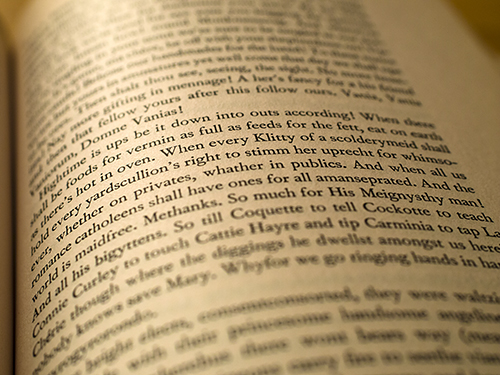
Don’t pretend you don’t sniff books. We all do.

The smell of a book may not have anything to do with the quality of the contents, but it is a part of the reading experience. I love the smell of a library; it tells me I am swimming in books. I love the smell of an art gallery, too, that olio of old oil, decaying latex, aging canvas and paper, mixed with the wafting scents of coffee and quiche from the cafeteria. My wife loves the smell of an ice rink; I love the smell of a theatre backstage (dilute latex paint and a bit of wood).

And who doesn’t love the smell of a new car? For that matter, who doesn’t pay attention to the sound of their car? High-end sports car manufacturers (Porsche, Ferrari, Lamborghini) put a lot of effort into getting just the right engine sound, the one that distinguishes them from the others. It’s a mark of the mettle of the metal, the machismo of the machine. Meanwhile, vacuum cleaners have long been far louder than they need to be, just because people wouldn’t believe they worked if they were too quiet (this is changing, which pleases me; I won’t say that, like nature and cats, I abhor a vacuum, but I sure hate the sound of one).

Pick up a new wine glass. What’s one of the first things you’re likely to do to it? If you’re like me, you’ll flick it with your finger to hear the “ting.” If I see a silver coin I will drop it just to hear its higher ring when it hits. I can only assume gun owners pay attention to the sound their gun makes when it’s cocked – I know that different guns can be identified by the sound they make when being fired (AK-47s apparently have a distinctive sound unlike American equivalents; I assume an Uzi has its own resonance too; and so on). Photo equipment buffs always pay attention to the shutter sound, whether they admit it or not. One photographer I chatted with said she loved the Mamiya 7 (one of the best cameras ever made, by common opinion) but couldn’t get over the light, almost flimsy-sounding click of its shutter. (It’s also ugly. A camera only a results-oriented person could love.) Any Leica freak will have clear attachments to the sound of a Leica’s focal-plane shutter; go to Steve Huff’s website and check his videos in his reviews of Leicas and other new cameras – he never misses trying the shutter sound and comparing it to other models.

Heck, people are so attached to the sound of a shutter that digital cameras that have no mechanical shutters will come with a fake “shutter” sound – or a choice of several. But I’m not here to talk about skeuomorphs today. I’m here to talk about genuine sounds and sights and smells that are secondary to the ostensible principal function of a thing. These sensations are associated with the valued thing and so gain a glow of that value, but in many cases they also tell us something extra about the quality of the thing. How well-built is the car, the camera, or the gun? How pure is the glass or crystal, or the silver in the coin? What sort is the paper and ink in the book or magazine?

We taste reality like many of us taste wine. Why does the colour of a wine matter? What difference does it make if this pinot noir has a light ruby glow while that one bleeds like borshch? In the end, it’s the taste that matters, right? Well, let’s be honest: few of us would drink as much of it without the alcohol. But if it’s not just the alcohol that matters, why should it be just the alcohol and taste that matter? Why not appreciate the look of it? Why not appreciate the label on the bottle, too? Many people do. As well they should. Why not look for reasons to enjoy things?

Many people pretend to taste and discernment but spend their time looking for reasons not to enjoy things. It’s evident that their primary enjoyment comes from feeling themselves of superior discernment, a discernment that means knowing which few things are good and which many things are not. I do not think this is a very effective way of enjoying life. It is true that there are many things a given person will not enjoy, and that things that seem wondrous to you when you first start in a pursuit may seem trite when you know the subject better. But if you want to enjoy what you experience, why on earth would you not look for more ways and reasons to enjoy things? Why would you look only for reasons not to enjoy things? This just increases the number of things you don’t enjoy. I don’t like the look of that balance sheet.

When we appreciate secondary aspects of things – their sounds, their smells, their appearances (I’ve barely mentioned the look of cars and cameras and so on; somehow we all take it for granted that that’s important, though it has little to do with function) – we are appreciating reality as we appreciate wine. And, of course, words.

But what is the name for these sensations, these secondary aesthetic qualities? I’m not familiar with an established formal-sounding term (though perhaps someone will toss one my way), so I’ve decided to confect one from the usual classical bits. It’s the word you’ve been waiting for me to get to: deuteraesthetics (with or without the final s, as needed), from deuter, meaning ‘second’ or ‘secondary’, and aesthetic, referring to sensations. The deuteraesthetic aspects of a thing are the sound of a shutter, the smell of a book, the look of anything that has a primary function unrelated to appearance.

At base, of course, they are all sesquiotics: semiotics, but three times as good.

Denali

The late kerfuffle over the official recognition of Mount McKinley as Denali has taken me by surprise. I had actually thought that the name had been officially recognized ages ago. It turns out that while the national park surrounding it has been called Denali since 1980, the mountain itself has remained McKinley because of objections… from Ohio.

As you may know, Denali is not in Ohio. In fact, Ohio has no mountains. Why would Ohio wish to bend distant Alaska to its will like some alien Svengali? Just because Ohio happens to have the birthplace of President William McKinley. McKinley never visited Denali, but he was assassinated in 1901 and it was decided officially by the federal government in 1917 to name the mountain after him, following a tradition that had been started by a prospector who called it that when McKinley was still running for president. It had also been called Densmore’s Mountain.

Well, why would they ask the local Koyukon Athabaskan people what they had been calling it since time immemorial? They had a name for it, after all. It may not have been nailed on a sign, or somehow inlaid in the stone, but maybe someone could have asked them…?

The name, of course, was Denali, which means ‘the great one’ or ‘the big one’ (not, though it may sound appropriate, ‘the gnarly’). The Russians (who colonized Alaska for a while) had called it Bolshaya Gora, which means ‘big mountain’ and may have been a translation; anyway, it was more or less aligned with Denali. It is a big mountain; hard to deny that.

But when explorers explore and discoverers discover, they want to name things! It’s like when we were kids. We come to a new place and we discover a new playground. No one has ever seen this playground before! We just discovered it! I was the first here ever! Yeah? Well I was here two steps ahead of you, so I was the first here everer! Shut up, you two, I touched the swings first, so I was the first here everest! So what are we gonna call it?

Except, of course, we eventually learn that someone, in fact, built this playground, and lots of people have been there before. But if we’re adults in a new land, we conveniently ignore the people who were there before. They’re just this tribe we discovered! What shall we name them?

But you can’t ignore them forever. And indeed, the people of Alaska – even the non-indigenous ones – have been calling the mountain Denali for quite a long time. This isn’t some Democrat-versus-Republican issue; the politicians from Alaska who have been pushing for officialization of Denali include many Republicans.

But why would the people who live there matter, when we have this glorious tradition of honor to uphold? It’s America’s tallest mountain! It was named after an assassinated president! It’s cultural heritage! It’s always been that way!

For nearly a century, anyway. In the mouths and books of people who have never visited it and will never visit it. A change to the name is “insulting to all Ohioans!” Never mind that having Ohioans dictate what Alaskan mountains are called is insulting to Alaskans. It would be more sensible to name something in Ohio after McKinley, no?

It’s just like those fake “rules of English” (or social norms, or or or) that many people adhere to. They remember it being that way when they were kids, and maybe someone told them that was the rule, so that means it’s the great universal tradition from the golden ages and for all times. Anything else is a gross abuse and innovation.

And so we have the recent news headlines. Here’s one from The New York Times: “Mount McKinley Will Again Be Called Denali.” (Actually it never stopped being called that; it’s just being officially recognized.) But then here’s one from ABC News: “White House Renames Mount McKinley as Denali on Eve of Trip.”

Perhaps, after “renaming” the mountain what it was always called by people who had some connection to it, Obama can create a new state in honour of those who think McKinley was the original name and the local people don’t count. He can call it Denial.