Yearly Archives: 2022

butterfly, part 2

The butterfly of Romance: papilio, papillon, farfalla, mariposa, borboleta, fluture

The Romance languages – so called not because they’re romantic but because they come from Roman – have a surprising assortment of words for ‘butterfly’. 

Usually words for the same thing in the different Romance languages tend to resemble each other: for example, the words for ‘bread’ (Latin panis) are French pain, Italian pane, Spanish pan, Portuguese pão, and Romanian pâine(and there are similar words in Catalan, Provençal, and other related languages). Given that the Latin word for ‘butterfly’ is papilio, French papillon is unsurprising, but what about Italian farfalla, Spanish mariposa, Portuguese borboleta, and Romanian fluture?

Let’s start with why the Latin word is papilio. Every word comes from some previous version, all the way back into the mists of time and beyond; we can’t see into the mists of time, but we can sometimes guess what’s in them by the noises coming out of them and what emerges from them, sort of like a fight in a foggy forest. So scholars have done a lot of work reconstructing Proto-Indo-European, the language that is the great ancient ancestor of the Indo-European languages, a huge set that includes tongues such as Spanish, Gaelic, English, Swedish, Russian, and Hindi. And their best guess is that papilio comes from the root *pal- (the asterisk means it’s reconstructed from evidence, like museum dinosaurs), meaning ‘touch, tap, pat, feel, shake’, things like that. But the *pal- is reduplicated, as if they had decided to call a butterfly a papatty or tatappio. Why? I mean, I don’t know, but hey, look at butterflies!

So anyway, French didn’t change papilio much, just added the nasalizing n to the end as it did to assorted other words and gliding the l. But Italian, which usually keeps things recognizably close to the Latin, managed to come up with farfalla. Where the heck did that come from? It may have been something as simple (so to speak) as a Tuscan consonant shift that turns voiceless stops into fricatives: casa, ‘house’, is pronounced as “hasa” in Tuscan, for instance, and a similar thing could have happened to the p’s in papilio. But it’s not obvious what local perturbations would cause it to change this word in particular in standard Italian and not so many others. There’s also the question of where the r came from, though Provençal and Lombardy also got an r in their versions (parpalhosparpaja). It may instead be that it all happened under Arabic influence; there’s a Tunisian Arabic word for ‘butterfly’, farfaṭṭu, that shows up as farfett in Maltese. A borrowing or cross-influence isn’t too far-fettched… though we don’t know for sure.

At this point you may look at Portuguese borboleta and think, hmm, just change those f’s to b’s – and “b” is as easily gotten from “p” as “f” is, in historic sound changes – and adjust the vowels a bit and Bob’s your uncle. And that might be what happened. But then again, it might not. Instead of papatty, it could be bebeauty – that is, Latin bellus ‘beautiful’ might have become *belbeleta in Old Portuguese, which easily enough changes to borboleta over the years. But, again, we’re not sure…

And how about Spanish mariposa? Does that seem a bridge too far to flutter across from papilio? It is. The Spanish descendant of papilio is pabellón, but it doesn’t mean ‘butterfly’; it means ‘pavilion’ – which, surprise surprise, is also descended from papilio and originally referred to the butterfly shape of an ornate tent (I’m taking someone else’s word for this). But that is a digression for us here to all in tents. Instead of keeping pabellón for the lovely little insect, the Spanish looked at it and said, “Mary, alight” – “María, pósate,” which shortened to mariposa. And may a blessing from the mother of God land on you too!

Meanwhile, Romanian flutters by with fluture. It’s probably related to Albanian flutur (yeah, probably!), but which one of the two came first is a kind of butterfly–hurricane problem. English spell checkers think fluture should be future, which it’s not related to, but it looks rather like flutter, and it might be related to that – very far back, though, because flutter traces all the way through Germanic to Proto-Indo-European, rather than, as one might hope, more directly to Latin fluctuare, which is the source of fluctuate and possibly – but just possibly – the source of fluture. Or maybe it’s something else carried loosely on the currents of language.
Next: the cream of the Germanic summer.

butterfly

Papillon. Farfalla. Mariposa. Schmetterling. Vlinder. Sommerfugl. Fjäril. Tauriņš. Babochka. Butterfly. It is, to use a technical term, freakin’ weird how flagrantly unrelated the words for ‘butterfly’ often are even among closely related languages. 

We can chalk that up to the butterfly effect.

You’ve heard of the butterfly effect? That staple of chaos theory, of the possible effect of small perturbations on large systems? The idea is that the flap of the wings of a butterfly in the Amazon could, through small differences in air currents being relayed and increasing in effect, result in a change in the course of a hurricane in the Caribbean. I think of it as like the effect of my elevator having to stop on an extra floor, resulting in my missing a subway train by a few seconds, resulting in my missing a connecting bus that runs every half hour. But of course at least as much of the time the elevator stop has zero effect: I get to the subway and wait a few minutes, I get to the bus and wait a few minutes. 

Needless to say, most butterfly wing flaps couldn’t and don’t make such a huge difference either… and, more importantly, the paths of hurricanes are subject to countlessly many influences. Our best predictions of hurricane paths are probabilistic. There are so many influences, we can’t trace them all or even be aware of them all. It might as well be random chance, like a roll of dice: if you had all the information about the muscle movements, the weight and shape of the dice, and the details of the surface they’re rolled onto, you’d predict it 100% of the time, but you don’t. “Random” is a word we use when we don’t have all the information or even know what all the information to have is.

And why not turn the butterfly effect around? Have you seen those things fly? There are obviously many air currents affecting them; they flutter by through the air on a wild chaotic path impossible to predict precisely. Maybe a hurricane in the Caribbean is responsible for two millimetres of displacement on the path of a butterfly in Brazil. How the heck do they fly, anyway? Didn’t someone once say that according to aerodynamics, butterflies can’t fly?

If that were true, of course, it would just mean that aerodynamics didn’t have enough information, since obviously butterflies do fly. But as it happens, butterfly flight has been studied intensely precisely because it’s not immediately obvious how it works. In 2021, researchers at Lund University in Sweden published results of a study showing how butterfly wings are aerodynamically effective: they clap together at the top tips first, and from the front rolling to the back, resulting in effective propulsion by pushing an air pocket backwards, and then the downstrokes keep them aloft. (The researchers didn’t say it, but I think it’s a given that butterflies are not prone to motion sickness.) So once again, the butterfly effect has to do more with seeing things as random or chaotic just because we lack information.

And we can apply that to the utter chaotic weirdness of the multiplicity of seemingly unrelated words for ‘butterfly’ in different languages. There are a few factors we can look at to help explain it. One, and an important one, is how pretty and charming butterflies are; this can motivate people to come up with fanciful names or at least to make modifications to existing names. Another is the broken-telephone effects of transmission of words from generation to generation, especially among the general public who have historically not been big on writing things down. Another is the effect of contact between different languages.

I’m going to look at a few language families to see how this plays out around the world. But instead of unleashing one enormous flurry of words on you, I’m serializing it. This has been part one. Part two will be the butterfly of Romance.

Pronunciation tip: pronunciation

Most of us, as kids, learned that it’s “pronunciation” and not “pronounciation.” But do you know why? And do you know why someone might think you’re saying one when you’re saying the other?

chrysanthemum

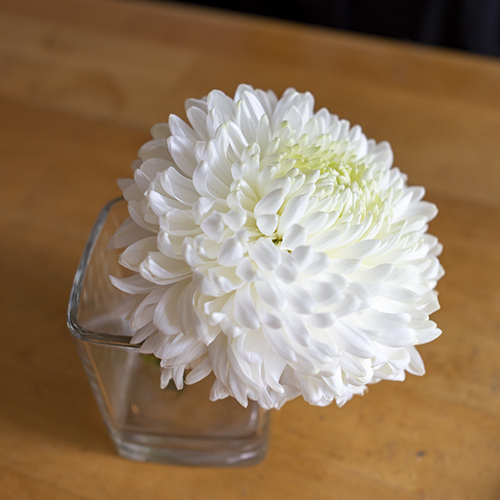
Happy chrysanthemum season! It’s the flower of the month for November. It’s also popular on Mother’s Day in May in Australia (mum’s the word!). It’s a flower of love and friendship, and also of death: in some places (notably New Orleans) it’s the featured flower of remembrance on All Saints’ Day. It’s the imperial flower of Japan – the throne of the emperor is the Chrysanthemum Throne, and the flower is featured on the imperial flag – and it’s also used as slang in Japanese and Chinese for ‘butthole’. In English, it has a long name but is often reduced to a very short one (mum!). It comes in dozens of species and countless cultivars. It is thus, we may say, a flower of considerable variety.

Well, in some ways, at least. Among Western languages, the words for it are just about universally chrysanthemum or something nearly identical (Finnish krysanteemit is about as far as it goes), all tracing back to Greek χρῡσάνθεμον, from khrusós χρυσός ‘gold’ and ánthos ἄνθος ‘flower’ (which not all chrysanthemums are, but the Greek name was first originally for the corn-marigold, Chrysanthemum segetum). The mum to which we commonly shorten it is really just a suffix – a bit of Latinized derivational morphology, nothing to do with the roots.

On the other hand, in China, where the chrysanthemum was first cultivated some 3500 years ago, the name for it is 菊花. That’s also the name for it in Japan, if you’re writing in kanji, and it’s also the name for it in Korea, if you’re writing in hanja. But of course it’s not pronounced the same in all three languages. We’ll get to that; I’ll start by telling you that in Mandarin, it’s júhuā (the j is said about like English “j”; the u is like German “ü”; hua is like “hwa”; and the tones are rising on the first and high level on the second).

菊花 is made of two characters, and the second one means ‘flower’; the first one means ‘chrysanthemum’. Why not just say  (菊)? Because there are assorted other words that are also pronounced , a notable one of which is 局, which means a lot of things, including ‘office’, ‘bureau’, ‘situation’, ‘arrangement’, ‘organization’, and ‘chessboard’. So for clarity the huā (花) is added to make it clear when speaking that this is the  that’s the flower. (By the way, no, ‘flower arrangement’ is not 花局, sorry; it’s 插花, chāhuā, which could be translated as ‘insert flowers’.)

And why the heck would they have words for ‘flower’ and ‘arrangement’ that sound the same? Well, they didn’t always… in Middle Chinese, the chrysanthemum was said /kɨuk̚/ and the arrangement was said /ɡɨok̚/. But – in Mandarin, though not in all kinds of Chinese – the final stop got dropped (as they all did in Mandarin), and the initial stops got palatalized and merged. But Japanese borrowed the words (both of them) along with their characters a long time ago, and in Japanese 菊 is kiku but 局 is kyoku (there are actually other pronunciations of both of them in different contexts; Japanese’s use of Chinese characters – kanji – is ideographic and not strictly phonetic; for example, 花 is most often pronounced hana but 菊花 is kiku ka).

OK, fine, but what about these characters, these little flowers of ink? The first thing to note is that both of them, 菊and 花, have the same top part, which is a piece that by itself signifies ‘grass’ – or, more broadly, any kind of field-growing plant. Beneath that, in 菊 you see something that kind of looks like a chrysanthemum face-on: 匊. When it’s like that without the grass on top, it’s pronounced , and it doesn’t mean ‘chrysanthemum’. Nope, it’s also two parts; the middle bit, 米, by itself is , and it means ‘grain’; it comes from a depiction of the separation of grains by threshing. The outside part, 勹, isn’t used by itself, but in combining it usually refers to wrapping or enclosing. Together those two, 匊, originally meant ‘handful’ (the amount of grain you could hold in your hand) but now translate as ‘receive with both hands’. 

Which is a lovely thing to do with a big bunch of chrysanthemums, but really the 匊 in 菊, however much it might look like a chrysanthemum head-on, is just there because it’s phonetically the same (though the tone has changed now), so the character is put together as ‘field plant that sounds like ju (handful)’. But that chrysanthemum-looking bit is there; they could have used a different character for the sound, after all – there are others…

OK, and 花? Is it put together as ‘field plant that sounds like hua’? Well… yeah. But again, that phonetic part, 化, is recognizable and has meaning too. It’s made of two parts, which – originally – are the same character, 人, one right side up and one upside down, and it just got modified a bit over time. What does that character mean? ‘Human’ or ‘person’ or ‘man’. Meaning that 化 is formed as two humans, one right side up, one upside down. Nice, eh? And what has that to do with flowers, aside from the sound (huà)? Its meaning is ‘change’. The two humans depicted were really one in two states, tumbling head over heels. Not because flowers will make someone fall head over heels for you – they might, but your results may vary – but flowers are a transformation of a plant of the field from mere grass to something lovelier.

So here. Have a handful of transformation. If you look at all the things this plant’s name has been, there’s no shortage of transformation – and if you look at the things it can signify (including love and death), there’s still more. And then there’s the matter of how many different ways chrysanthemums can look…

prig

As I said in my last word tasting, smugness smothers like an overstuffed overpriced cushion, but priggishness pricks like a cactus. A prig is someone who is unassailably conceited on a point of correctness, self-righteous with the primness of certainty of moral as well as factual correctness. And it is not enough for a prig to be right; there must also be someone who is correspondingly wrong. Indeed, I think that prigs choose their opinions precisely on the basis of being able to flatly “correct” others on occasion. As George Eliot put it in Middlemarch, “A prig is a fellow who is always making you a present of his opinions.”

There is, I should say, no sure etymological connection between prig and prick (though a person who is called the former might well also be called the latter). There is also no known connection between prig and any other word such as sprig or brig or rig, because, to be plain, its origin is unknown. Its earlier senses included ‘thief’ and ‘dandy, fop’, and the latter shaded into the present usage, but before about the time of Shakespeare we have been unable to get a grip on prig, source-wise. Sound-wise, it may well gain from the “pr” we hear on prick and prim and proper and a few other words of similar tone, and perhaps from the stiffness or restriction of sprig, brig, and rig. But there’s no way to know that for sure. Not that priggishness requires any support – it is entirely self-assured – but linguistics sure does. Which is one reason linguistics is a natural enemy of priggishness.

I’ve wanted to write on prig for some time, but each time I’ve had the thought to do so, I’ve determined to wait for a bit so that I won’t seem to be focusing on some specific person I’ve had an interaction with online. The problem is just that by the time the smoke from one such interaction has wafted away, either I’ve forgotten about the topic or – at least as likely – another prig has come along. 

You see, when it comes to grammar and usage, well-informed, open-minded views draw prigs like a fruit basket draws flies. As soon as I use linguistic fact and understanding to contradict some reactionary mumpsimus (remember, “unalterable tradition” is what any given change-hater recalls learning in their childhood, even if it was new at the time and even if they have not accurately remembered it), I can count on someone showing up to flatly contradict me. They don’t present any counter-argument; they simply say I’m wrong, and that’s that, as though they had such authority that I ought to accept it and sit down and be quiet.*

I’m not the only language person to encounter this – not by a country mile. Others with higher profiles than I encounter it even more. My fellow editor and friend John McIntyre recently posted a column on letting go of long-held usage rules, and in it he quoted one person on Twitter who took exception to letting go of one particular “rule”: “actually, right is right and wrong is wrong, and as the ink-on-paper world dies it should do so with some fidelity to the language. also, ‘they’ and ‘their’ as references to an individual are always grammatically wrong. precision exists for a reason.” (This statement is wrong in every detail, incidentally, not just analytically in the present but in terms of historical fact too; I’ve written and presented on the topic in detail already.) As John said in a tweet about the column, “Apologies to anyone from whom I may be taking away things that make them a prig.”

But of course one of the things about prigs is that they refuse to have those things taken away. A prig is someone who clings to the last floating matchstick of a sunken ship and declares themself captain of it. Often that sunken ship is some idea of intrinsic superiority that is actually the ghost of class (well, “ghost” in the same was as a person may leave a “ghost” in an elevator after a lunch of beans and cabbage, and the next people into the elevator will not see a spectre of them but will certainly know something ghastly has passed). A most famous prig – indeed, the one person whose name comes up repeatedly if you search “prig” today – is Jacob Rees-Mogg, an English politician who has resolutely determined to mistake class signifiers for infallible marks of intelligence one hundred percent of the time. 

Another political figure I have seen called priggish is John Bolton, erstwhile US “diplomat” (technically yes, but astoundingly undiplomatic) and national security adviser, whose signature move is lecturing other people and being unable to conceive of any occasion in which he could possibly be even slightly in the wrong. Both Rees-Mogg and Bolton are blue-ribbon members of the “geez, you must be fun at parties” set, and this is an essential quality of prigs: above all, they do not, they may not, have fun. Fun is childish, and they are fully invested in being superior, which means absolutely not childish. You may on occasion see the phrase “joyless prig”; in truth, it’s pleonastic, but use it anyway if it pleases you. As one Reverend Alexander Carlyle wrote in his 1860 autobiography, among the clergy, “The prigs are truly not to be endured, for they are but half learned, are ignorant of the world, narrow-minded, pedantic, and overbearing.”

Which says, in its way and with more words, about what George Eliot said. The motion of the prig is upbraiding. Pigs might fly, but prigs will not – but they will sit on their dilapidated rooftops trying to shoot down anyone who does.

*Which, if you know me, is pretty funny. I have many weaknesses and undesirable traits, and I can certainly be provoked, but if you try to bully me on matters of understanding of language or general perspicacity it is not going to go as you appear to have envisioned it. I may have been bullied many ways as a kid, but, if I’m being honest, when it came to matters intellectual, I was the bully, so much so I didn’t even notice or admit it. And was I priggish? Yeah, probably, but mainly when I was wrong. Priggishness is rigid and rigidity is the best way to be wrong.

smug

Today I saw two unrelated but in one way coincidental tweets adjacent in my Twitter. The first, from @PamelaLeibfried, in response to a tweet by @mollypriddy that “we gave morning people way too much power,” read “And they are so damned smug.” The second, from @BCDreyer, said “I know that some people are anti-blocking because blocking allegedly gives the blockee some sense of smug satisfaction, but that’s nothing compared to my smug satisfaction at being rid of the asshole.”

That’s the thing about smugness: it’s insufferable, but we all allow ourselves a little from time to time, as a treat. A person who is smug is a schmuck, but there are some people we will be quietly pleased to imagine thinking of us as schmucks.

The Oxford English Dictionary defines this common sense of smug as “having a self-satisfied, conceited, or consciously respectable air,” and I have to say, as much as I love the OED, that definition doesn’t fully capture the particular kind of irritating smugness can be. It could almost equally define priggish, and while there could seem to be some overlap between smugness and priggishness, in truth it’s a narrow borderland; priggishness pricks like a cactus, while smugness smothers like an overstuffed overpriced cushion. 

So, after gently setting aside the plate I received when I was given the Karen Virag Award by Editors Canada, I reached behind my little Eiffel Tower filled with bottles of champagne and other sparkling wines and hefted up my ponderous copy of Webster’s Third New International Dictionary – which some years ago I portered home from the ACES conference after winning it in a spelling bee – and flipped casually to page 2153, whereat I read what I think is a more satisfying definition: “marked by or suggestive of belief in one’s own superiority, virtue, and respectability usu. accompanied by contented resistance to change, provincial lack of vision, or deprecation of others.”

I may be coming at it just from my own perspective, but I do think the “belief in one’s own superiority” is a particularly signal characteristic of smug as it’s used today, as is “resistance to change” or “lack of vision.” When I think of smug people I have encountered, top of the list is political insiders: that subset of people who have worked in some government office or otherwise had some particular “in” in politics (such as working for a candidate or giving lots of money to a candidate) who are prone to chuckling lightly, rolling their eyes, waving their hands, or whatnot, any time someone in earshot suggests that something better than what we have now might be possible.

Not that they are the only smug people out there, of course. I’m sure we can all think of instances where someone who had a certain seemingly unassailable advantage – money, height, insider status, or some other apparently unalienable boon – treated our concerns or questions as so much lint to be blown off. (The comedy duo Garfunkel and Oates conveyed the sense rather trenchantly a decade ago in their song “Pregnant Women Are Smug.”)

And as repellant as it is on the receiving end, smugness has an undeniable appeal on the giving end. It’s just so… snug. You get to be calm and happy and yet somehow smuggle in just a little bit of emotional murder. 

And so you might think that smug is related to snug, and perhaps to smuggle. Well, yes, I suppose you might think that, since you haven’t been reading up on it. Oh, now, that’s fine, I’ll tell you; you had no reason to know better, really. In truth, snug has an uncertain origin but is likely related to Proto-Germanic words meaning ‘tight’ or ‘handsome’, and has no evidence of relation to smug, and although snuggle is quite obviously derived from snug with the -le suffix we see from time to time, there’s simply no evidence to tie smug to smuggle – in fact, smuggle came into English from a Proto-Germanic root meaning ‘creep’ or ‘sneak’ or ‘slip’.

No, no, smug is a little mysterious – oh, when we’re smug, aren’t we always playing at being mysterious? – but before it had our current sense it started up in English as meaning ‘well-groomed, neat, smart’ and seems to have come from Low German smuk ‘delicate, neat, trim’ – though it’s hard to account for just how that k became a g because, though I wouldn’t expect you to know this, it’s not a usual change in that environment between those two languages. But anyway, that Low German smuk is, yes, related to German schmuck ‘pretty’ and Schmuck ‘jewelry, ornament’.

And does that mean therefore that smug and schmuck (in the English sense of ‘jerk’, taken from Yiddish for ‘penis’ or ‘foreskin’ or ‘fool’) are, back in the mists of time, the same word? Well… we’re not sure. There were, it seems, several kinds of schmuck and related words in the Germanic sphere at the time, and they may or may not all have come from the same source. 

But we know, don’t we.

foliambulation

Would you like to go for some foliambulation? It’s just so pretty among the trees right now.

You know what foliambulation is, right? You’re familiar with perambulation, which is going for a walk, and with ambulant, which means walking. You may also be put in mind of amble, which means ‘stroll’ and also comes from the same Latin root: ambulo, ‘I walk’. And you’re familiar with folio and exfoliate and especially foliage – which, by the way, used to be foilage, as we got it from the French word now written as feuillage, which, however, came from folium, and when there was a rage for showing English’s vaunted Latin roots, foilage was ‘corrected’ to foliage. So you may well have twigged what foliambulation means at first sight.

But we’re not here to leaf through the lexicon. We’re here to lexicalize through the leaves! Specifically, we’re here to go for a walk among the lovely fall leaves. We’re here to foliambulate. And while there’s nothing about foliambulate that requires the patent presence of anthocyanins (i.e., it doesn’t mean the leaves have to have turned yellow, orange, and red), and while I for one adore strolling through lush green forests, there really is a special something in wandering in the blood-coloured leaf-slaughter of autumn.

What, have I taken leave of my senses? No, I’ve taken my senses to leaves. And while we can all say we’d like to “walk in the fall foliage,” isn’t there an exquisite folly in foliambulation

Nothing forces nature to be so colourful, after all. I grew up in Alberta, and while fall there is not unpretty, the fact is that the leaves all turn yellow in one week and blow off the trees in the next. When I was heading into my first fall in New England at Tufts University, my parents (born and raised in western New York State) would ask every week over the phone if the leaves had turned, and every week I would say, no, why do you keep asking? And then the leaves turned.

Look, if you’ve only ever lived where the leaves just go yellow and blow away, moving to Massachusetts is like knowing only the piano version of Pictures at an Exhibition and being taken to a concert of the symphony version. Both are nice, but wow, what a difference.

And likewise, there’s nothing wrong with saying “walking in the fall foliage” or “going for a stroll among the leaves.” But if we can have another, fancier word for occasional use, why not have one? It’s an easy word for figure out and a fun one to say. Yes, this is surely the first place you’ll ever see foliambulation, because it’s a new old word: improbably, no one else seems to have used it; I glued the two bits together myself. But if you don’t want it, well, just walk another way. It’s a big, beautiful world out there.

Pronunciation tip: sbagliato

Recently Emma D’Arcy (of House of the Dragon) made a splash when they mentioned that their favourite drink for unwinding is a negroni sbagliato. I’m not here to tell you how to make cocktails – recipes are amply available online – but people are uncertain about how to say sbagliato, and that’s where I step in. Here’s my latest pronunciation tip.

offing

This word tasting has been in the offing for a while – if by offing I may mean my notepad on my phone. It’s not that it’s been perceptible to anyone else. But, hey, it’s my offing. Lay off. -ing.

Most of us know this word only in the phrase in the offing, and meaning something that’s a-comin’ like a slow train across the prairies. Occasionally you may even see it reconstrued as in the offering, because, really, what the heck is an offing? We know what an inning is, and we know what an outing is (by the caprices of English the two are not antonyms), and we know what a siding is and a topping (probably not a bottoming, though), and we can talk about upping the price and downing a drink, but there’s no such thing as an onning and it’s not clear to most of us why the offing is the offing.

Well, what it is, is if you’re on shore and looking out to sea, out there, off shore, off past all the coastal hazards, off in the stretch of sea before you get to the horizon, if you see a ship there, it’s in the offing. Because the offing is that stretch of the sea that’s far off, but not so far off that you can’t see it. And it’s called the offing because, well, it’s off in the distance. 

Really, that’s it. The word’s been with us at least since Shakespeare was alive and writing (though the Bard himself never used it in his plays), and the figurative use has been around at least since the late 1700s. Now, a ship that is in the offing is not necessarily heading towards you; it could be just crossing from one side to the other, parallel to the shore at a distance, or it could even be going away from you. But when people were keeping watch on the offing, it wasn’t principally to make sure that a ship was good and gone; it was to see if there was one coming, looming in the offing, to use a turn of phrase that Theodore Dreiser and Walter Scott were both comfortable with.

The offing is not a strictly established distance or span of distance. The inshore hazards and anchorages extend a varying and imprecise distance, beyond which the offing starts, and the distance of the horizon – the farther limit of the offing – will depend on your elevation. Just for example, when I stand on the shore of Lake Ontario, on Toronto Island, the far shore is beyond the horizon, but when I look from the south window of my apartment on the 27th floor, I can see the far shore, nearly 50 km away. 

This can certainly inform the metaphor too: not just that if you take a more elevated perspective you will be able to see more in the offing, but also that sometimes the offing ends before the horizon – there is a far shore, and who knows but the ship you see in the offing may be heading for it. And you’re on the far side of the offing for people on the far shore. Perhaps that puts you in the onning.

distraught

On September 23, George Wallace, @MrGeorgeWallace, tweeted “How come you only hear about folks being distraught? No one’s ever like, ‘I’m good, Bro. I’m traught as hell.’”

The answer to this might leave you variously whelmed or gruntled, but I wouldn’t be surprised if you felt a little straught. At the very least, though, you might be distracted.

The thing is, distraught is… a bit of a historical misanalysis. Like parsnip, or belfry, or cockroach, or penthouse, or female. The best you could even say is that it’s a deliberate blend, like chillax.

Oh, are you a bit distracted by that list of examples? Maybe even disgustipated? Are they vomitrocious? Sorry, I’ll give you the quick low-down and then we can move on to the main event. Parsnip looks like a blend of parsley and turnip but it actually came from Old French pasnaie (from Latin pastinum, probably), reanalyzed to pasnepe under the influence of nep (‘turnip’), and then that was reanalyzed to parsnip because parsley somehow (they don’t have a lot in common). Belfry comes from berfrey, related to German Bergfried, referring to a tall defensive tower – but, hey, bells! Cockroach, as you may know, is from Spanish cucaracha, no relation to cocks or roaches (a roach is a kind of fish, and I don’t mean a silverfish), but if you see one crawling from under your pineapple, you’re only reaching for your Merriam-Webster for the sake of violence. Penthouse is from pentice, ultimately from the same Latin root as append. And female is originally from femelle, from Latin femella, diminutive of femina, no relation to male.

OK, but distraught? Well, it started as distract (meaning, as I’m sure you don’t need to be told, distracted), ultimately from Latin distractus, but, in a Reese’s Peanut Butter Cup way, it also started as straught, a strong past-tense form of stretch (in other words, straught is to stretched as taught is to teached, except that the strong form won in the latter but not in the former). We could say that distract was just misanalyzed by analogy, but we could also say that it was at least partly deliberate, a blending like disgustipated or vomitrocious or chillax, because being distraught is not just being distracted (even as in “driven to distraction”) but feeling stretched in various directions (as, for instance, by several divergent horses).

The funny thing about that, mind you, is that that’s what distractus meant too: dis- ‘apart, away’ plus tractus, from trahere ‘pull, drag’ – you might recognize the relation to traction, tractor, and even attraction (something that draws you in). If you’re distracted, your attention is pulled in different directions. 

And if tractus had passed through the same Germanic machinery as Proto-Germanic *strakkaz (which became stretch and, at one time, straught), it could have become George Wallace’s traught. It still would have meant ‘pulled’, but only one way, not several at the same time. Which, I guess, is more attractive.