Author Archives: sesquiotic

cantabank

“Why can’t a bank job be good enough for you?”

“Oh, mother,” Mark said, stepping down to pavement level, “I can’t abide it. I’d rather sing for my supper.”

“Why not go back to Cambridge,” Mark’s father said from the other side, “and become a scholar of note?”

“There shall be no Cantab ankh of immortality for me,” Mark said. “I am a scholar of notes.” He cleared his throat perfunctorily and hummed a couple of foreshortened notes. Then he mounted the bench again and started into a melody: “Like a song I have to sing, I sing it for you…” He paused, smiled down at his parents, and identified the source: “U2.” And at the same time, he said “You two” and “You too.” He straightened up and continued the song: “Like the words I have to bring, I bring it for you.”

His father looked over his shoulder nervously, then tugged on Mark’s coat. “Do stop, there’s no one around.”

“There will be.” Mark smiled.

“It all seems so… shady,” his mother said, looking down as she nervously kneaded the top of her oversize purse.

“Like a mountebank?” Mark said, stepping down again. He sat on the bench and propped his face on his fist as he lifted an eyebrow towards his mother. “Some charlatan hawking nostrums? A veritable saltimbanco? But the quality of what I give is not concealed. It is experienced first, then paid for. If you are not enchanted, you simply decamp.”

His father pursed his lips in a lemony moue and folded his arms. “With such a vocabulary, why don’t you do better than a street singer?”

“But that’s exactly it,” Mark said, looking up and then standing up. “I am a—” he sprung up once again onto the bench “—cantabank! Cantambanco! One who sings on a bench!” And again into song: “Volare! Ohh! Cantare… sul banco!”

“If you’re singing for your supper,” his father said, looking around again, “you can’t have much of a banquet awaiting.”

“Well, if it keeps me lean, then it keeps me leaning, and I so am banking one way or another.”

His mother reached into her purse and somehow presented a melon. “Have this.”

“Cantaloupe! Thank you, mother.” He took it and set it on the bench. “Can I sing for it?”

“No, just take it as a message, mister cantabank. If you can’t bank on a decent income, you also can’t elope with your girlfriend.”

Mark raised his eyebrows, took a breath, exhaled. “She has decamped. Recanted. Abandoned me…” he tilted his head… “for a banker.”

Then he stood at the canting edge of the bench and began, his eyes upwards: “E lucevan le stelle…”

capybara

Toronto is thrilling right now to the news that two huge rodents are on the loose. Huge. The size of dogs.

Well, I suppose that’s better than having two chupacabras on the loose. Much better, in fact. But these creatures at least have a similar name: they’re capybaras.

How is capybara pronounced? /kapɪˈbɑːrə/ – sort of like it should be the coffee bar at the Copacabana. I’m tempted to say that two of them are gone because the first one escapyed and the second one was a capycat, but that’s trite. You can read more of the saga in this Toronto Star article, “Fugitive High Park Zoo capybaras duo elude search party after morning escape.”

The word capybara comes to us probably from Tupi, a language of South America; it appears to mean ‘grass eater’. The Latin name for these beasties is Hydrochoerus hydrochaeris, which is a Latinization of Greek for ‘water pig’ – twice. (They’re not pigs, true, but neither are guinea pigs, which are capybaras’ closest relatives.) One way or another, they’re tailless things that seem generally inoffensive. Here’s a pet capybara repeatedly doing something like what the High Park duo may have done:

Well, if the door is open, they’re capyble of using it…

My first introduction to the capybara came thanks to the cartoon character The Tick, a prodigiously stupid superhero who, in one concussion-induced daze, encounters a capybara and adopts it as a pet:

Good luck for the capybara that The Tick wasn’t looking for a low-carb lunch. Its meat is eaten in some places, and in fact it can even be eaten during Lent by Catholics in some parts of South America. It’s not threatened – there are lots of them (capyous numbers?), so hunting is quite legal.

But where do you look if you want to find a capybara? Start by looking for other capybaras. They’re very gregarious animals. And where do you find the other capybaras? Down by the water, eating grass, of course. You haven’t forgotten the etymologies already, have you?

We can only assume that when the High Park duo are finally found, that is where they will be. The only problem is that there’s a lot of water and grass in High Park, so it may take a while…

scenicest

“It’s not the scenicest day,” I said to Aina, looking out the train window at a cloudy sky as we headed to Niagara for some wine and walking.*

Or perhaps I should spell that scenic-est, so you know I wasn’t saying it like “see nicest,” even though what is scenicest is nicest to see.

“Is that a word?” you may be thinking – or perhaps typing in an email to me. Well, I used it and you understood it, so yes. But is it a well attested word? No. You can find a couple hundred hits for it on Google, but it’s a safe bet most of them are – as I was – self-consciously using it as an awkward construction rather as Lewis Carroll used curiouser.

Why wouldn’t I just say most scenic? Because I like playing with words. Now it’s your turn: Tell me why scenicest shouldn’t be allowed. It’s a two-syllable word, after all, and it’s quite common to append –er and –est to one- and two-syllable words. The selection of those for which more and most are reserved is almost random-seeming. At the very least, the distinction is not black and white. For some words, it is a matter of personal taste which to use: beautifuller and beautifullest were formerly common enough, but now it seems we see the two-word version as the more beautiful.

I do think that what we see is part of the problem here. For assorted historical reasons (mostly to do with palatalization before front vowels in Latin and Romance languages), c “softens” before e and i. But the sound /k/ does not have an actual allophonic alternation with /s/ in modern English. We just retain the rule about c because of our borrowings from French and Latin. This makes a problem when we have something that sounds fine but runs into a spelling issue. Take chic. Lovely word, stylish, smart. Borrowed from French. By borrowed I mean adopted – actually I mean stolen. Anyway, it’s treated like an English word: it’s one syllable, so instead of saying most chic we often just add the –est and make it chicest.

Which looks horrible on the page. And chic-est looks at least as bad. And you can’t add or swap in a k because chikest would look completely wrong and incomprehensible and would conduce to yet another inaccurate pronunciation, and chickest is chick plus est. Somehow the chicest word to say is one of the unchicest (let’s say least chic) words to write.

Well, what do we expect? It should be supercalifragilisticexpialidocious?

Am I the only one who feels certain that supercalifragilisticexpialidocious should be two words? Normally, morphologically, we can add only other suffixes after a suffix, not a whole new root, let alone a prefix plus a root plus a suffix. And yet that’s what appears to come after the the ic in supercalifragilistic. Another bit of evidence to marshal for its being two words is that the spelling would seem to require a pronunciation like “–listi sexpi–,” which is clearly wrong.

Which takes us back to our problem of the orthographic scenery. Now, –ic words often used to be spelled with a k, as in musick and magick. So could we borrow on that and make it scenickest? Hmm. It looks a bit of a snickerfest. It may also tempt a person to shift the accent onto the second syllable because of the “heavy” consonant ck.

Or we could just keep using it and writing it and people will get used to seeing it and saying it. That’s how a lot of things in English have come to be as they are.

We ought not to be distracted by looks, anyway. A cloudy day may be warm and lovely. Indeed, when the sun is out and it looks most scenic, you are at greater risk of getting burned.


*It was not a reference to the fact that we would not be taking in a play at the Shaw Festival, even though scenic referred to the stage a century before it referred to the natural environment – it comes from a Greek word for a stage.

“ಠ ಠ what is that alphabet?” “ ツ easy!”

Another article for The Week! Actually, I wrote this a couple of weeks ago, but it took a while getting posted because they were busy with the thing I wrote my other piece this week about, which shall not be mentioned here.

Anyway, this piece is the necessary sequel to the “How to identify languages” piece. That one focused on the Latin alphabet. This one looks at all the other alphabets. (Well, most of them. The Cree and Cherokee syllabic alphabets were cut to save length. And I skipped a few others that you really are unlikely to bump into.) It even has tips on telling apart languages that use the Cyrillic alphabet – and ones that use Arabic script!

How to identify Asian, African, and Middle Eastern alphabets at a glance

ket, ketty

You may not keep these words in your kit, but they could be a cute addition. Not cute like a kitty, though – these are not words to pet, even if they could be petty words. They are better suited to a kettle of fish, and not a fine one either.

I have an instant association with ket, but it’s not an English one. It’s from a set of lessons in Breton, which is a Celtic language spoken in Brittany, France. (If Breton and Brittany sound like Britain, it’s not a coincidence: the people in question were, a long time ago, Britons, but they were driven across the channel by the Anglo-Saxon invaders.) The dialogue includes this classic line, which you can even hear spoken on the page at Kevarker.org: “Ac’h ! N’eo ket gwin !” Which means “Ecchh! That’s not wine!” The ket is the second half of a two-part negator (French has ne…pas and Breton has ne…ket). So it’s negative. And in the dialogue in question, it’s rather disgusted.

That is not where the English ket comes from. Rather, you should turn to Scandinavian languages: Swedish kött, Icelandic kjöt, Faroese kjøt, Norwegian kjøtt, Danish kjød or kød. They’re all from the same origin as ket. In those languages, it refers to flesh or meat. But in English, it’s gone downhill a bit. It’s raw flesh, thence carrion, and rotten meat, and by extension from that trash or rubbish. And ketty means… let me quote the Oxford English Dictionary for that: “Having bad flesh; carrion-like; rotten, foul, nasty; worthless. Of soil: Soft, peaty.” So… disgusting.

It’s kind of a pity, isn’t it? A cute word like this one, so crisp, even a bit rakish. Its overtones are not nasty: kit, cat, cot, cought, cut, pet, kitty, jetty, cutty, kept, kex… Why would you want to cut this out of your kit? Other than the fact no one will understand it, of course. But if you want to slip in some petty cutting remark, it’s there for recourse. “This is a fine ket of beef you’ve served.” “Oh, there’s your little ketty cat.” And it’s less crude than some other ***t and ***tty words.

A whole nother thing

Originally published on The Editors’ Weekly, the national blog of Editors Canada

As editors, we pay attention to the written form of our language. Its relation to the spoken form is a whole other thing.

The spelling is odd, we know. But even our hyphenation doesn’t really break according to pronunciation. Consider the word breaking. Where do you hyphenate it? Break-ing. But where does the syllable break happen in pronunciation? Before the k. Don’t believe me? Shout it, emphasizing each syllable equally. You’ll shout “Bray! King!” rather than “Break! Ing!” In speech, we automatically shift a consonant at the end of one syllable to the beginning of the next if there isn’t a consonant there already, regardless of how the word is formed. But in writing we reflect the bits the word is made of, because that’s how we think of it.

Except when we don’t. And then it’s a whole nother thing.

Take a word like another. It’s made of two pieces: an and other. Put them together, and the n is automatically said at the beginning of the second syllable, so it sounds like a nother. You’d think we’d still keep it in mind that it’s really an other. You would not inevitably be right.

A whole nother isn’t the only place we’ve done this redivision. Centuries ago, a newt was an ewt and a nickname was an ekename. And speaking of nicknames, Ned and Nan come from mine Edward and mine Ann (we used to alternate my and mine as we still alternate a and an), and in Shakespeare you’ll see nuncle in place of uncle.

It also goes the other way. A poisonous snake, in English, was næddre, which would normally have become nadder, but instead of a nadder we have an adder. Likewise, a naperon gave us an apron. We pronounce them no differently, unless we put another word in between, but we think of them differently. We hear the n said at the start of the next syllable, but since the n in an always does that, we reanalyze it in a way that seems – for one reason or another – more appropriate.

Do you wish you could have someone to make rulings on these kinds of resplittings (also known as rebracketing and false splitting)? Try calling an umpire – as long as you don’t mind that your umpire would once have been a noumpere.

This doesn’t mean that we have to accept a whole nother, of course. A whole other is considered formally correct, although that implies a two-word an other. Since we’ve glued the two parts together, putting whole in the middle is arguably more like what we do in abso-bloody-lutely… except we wouldn’t write a-whole-nother.

Perhaps we should reconsider what we do and don’t think of as inviolable word boundaries. We may dislike alot quite a lot, for instance, but if we can make a word like another, can you think of a truly defensible reason for it not to be another one such? Or is that a… completely different issue?

Trumpery and repetition

Slick Donald is confident. Slick Donald is calm. Slick Donald knows just what he’s doing. My latest article for The Week:

How Donald Trump hypnotized America


ping-pong

我們打乒乓球吧!

That’s Mandarin Chinese for ‘Let’s play ping-pong!’ It’s understandable to imagine that ping-pong was invented in China, since they dominate the game now. Have a look:

And then there’s that name. The actual ‘ping-pong’ part is 乒乓, pronounced just like we say it in English (but with level tones, which we usually don’t use). It looks just perfect, doesn’t it? As though it was invented for it. The characters together look like a ping-pong table with a net. (They also kind of look like squared versions of eyes with lines under, perhaps tired from playing too much ping-pong…)

In truth, the original Chinese character those characters come from is 兵, which is pronounced “bing,” means ‘soldier’, and is derived ultimately from a representation of two hands holding a short weapon. From it came two onomatopoeic words, 乒 and 乓. They didn’t come from it for the game, though. They showed up during the Ming Dynasty to represent the sounds of a fight. In fact, 乒乒乓乓 is idiomatic for consecutive percussions, as in a gunfight, a ruckus, or – these days – a ping-pong match.

Ping-pong, however, was invented in England (or perhaps by British in India) in the later 1800s. It was popular as an after-dinner parlour game among the upper class. The various equipment was still evolving at first, of course, as was the name. Ping-pong was an obvious onomatopoeia, imitating the percussion and using the i/o alternation to indicate back-and-forth, here-and-there. And it was in common use as a name for the game in 1901 when J. Jacques & Son came out with a proper high-quality kit for playing it… and trademarked the name. They sold the US trademark to Parker Brothers. This is why in official tournaments, including the Olympics, it’s called table tennis.

Various improvements to the equipment have been made over the years, but the play itself is pretty simple. Especially if you’re just playing it with friends and none of you are all that good at it. It’s the sort of game you can just kind of play without, you know, keeping score. As I have on various occasions at such places as a friend’s country house.

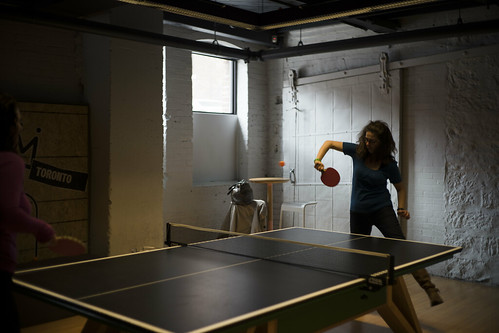
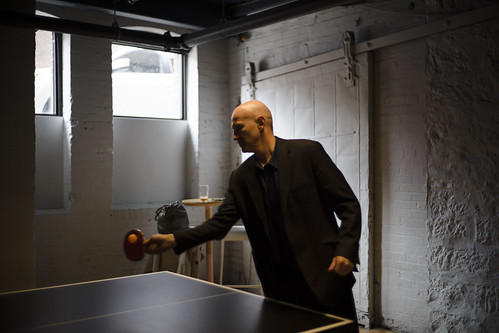
As we did this past Saturday at a friend’s birthday party at a ping-pong club. Yes, that’s right. Ping-pong tables, bar service, platters of meat and cheese and so on, and a guy going around with a nifty device made from a modified tennis racket on a stick with which he picked up balls by the dozen. Once we saw him do that, we stopped bothering to pick them up ourselves.

You can play singles ping-pong.

You can play doubles ping-pong.

You can even play with a beer in your non-racquet hand.

Maybe you won’t always hit the ball with your racquet. But what is this, the Olympics? Name another actual sport you can play in a normal-sized room while holding a beer. And not care about keeping score. And not worry too much about getting injured. Because those balls are pretty light. They weigh about the same as a half teaspoon of beer. Meaning that a big bucket’s worth of 200 will weigh the same as the beer in a pint glass. And, the way I play it, will take about as long to get through.

salix

As I stroll through the neighbourhood where I work, I see mostly apartment blocks and trees. I like the trees; they are calming, anodyne. There is one tree that is especially salient. It rains green on the lawn between a road and a building; none of the others around can match its winsome nobility. It is an elixir for the eyes.

I am told that if I were to lick its bark, I might be absolved of pain temporarily. I think it’s better to leave that extraction to others. But this tree, this regal green-duster, is a salix. It is from its bark that we derive salicylic acid. If that has a familiar sound, it is because its acetate – acetylsalicylic acid, also called ASA – is the active ingredient in Aspirin.

I like this word, salix. It starts with a curve and ends with a cross, and in the middle there is a tree or perhaps two. The word as a whole is slick, even slippery, but crisp.

Perhaps you don’t see the word too much. It names a whole genus, comprising some 400 species. Do they have other names? Some are called osier; some are called sallow (a word that is cognate with salix); but as whole, and for most individual species, they are known as willow.

Yes, willow. That famous tree of love and longing, of wisdom and wind, of weeping and whomping. The usual word is soft as a pillow, liquid and gliding, and in shape so willowy with the w and w fairly dripping with leaves and the ll reaching above. It is a tree of pain and relief, of despair and perseverance: where there is a willow, there is a way. But why not, as the occasion allows, use the Latin word, which has been formally adopted into English as well, though not often used? Why not call it salix? We can call holly ilex if we want, and there are other plants that also carry a Latin name for dropping into conversation. We may, if we will, wallow in willow, but I will on occasion elect to relax in the sunlight under a salix.

tenebrity

Times are dark, thoughts are dim. The current tense celebrity of some shady figures tempts many to ebriety in hopes of managing at least some glow in the turbidity to match the afterglow of retreating brightness. How may we frame the situation? How do we see ourselves in this tenebrity, overshadowed, benighted? Are we left to pray in the dark hours?

That might seem suitable; tenebrae is the name of a Christian service held in the dark hours before the last three days before Easter. It is marked by the extinguishing of candles, leaving the congregation in the gathering gloom. But tenebrity refers not specifically to this but to darkness more generally, not only of the earth and firmament but of the mind and mood and spirit and heart. Its Latin etymon is tenebræ, but in Latin that just means ‘darkness’.

But what is darkness? Are you now, as you read this, in darkness? If not, is there anywhere that is brighter? If you are inside, you are not in the brightest circumstance you could be in; step outside into daylight and you may squint at first. If it is after dusk and before dawn, however bright your surroundings, they are still too dim for high-quality photos from many a camera. If you are in darkness, how do you read this? The glow from your screen is bright, yes? But if it is like my computer or my phone, the screen adjusts its brightness according to context. Sit where there is light on the screen but not on the camera and the screen will seem excessively dim. The truth of tenebrity is that there is almost nowhere that brightness is ten out of ten. We simply adapt our eyes to the dimness. It’s all a matter of how you frame it.

Consider the photo above, taken by the elevators in the building where I live. I am in the dark, little light reflecting off my face, my eyes almost vanishing in the well of shadow. If it were not for the glowing frames of the repeating mirrors, there would be nothing at all. And yet that’s true anyway: without a light source, whatever wherever, we can’t see – our eyes don’t reach out and grab objects to perceive; they await the light, and they adjust to its level.

And sometimes they adjust too well. And sometimes we adjust our view too much to try to bring the truly bright down to an acceptable level so we can see its contours better. When I am standing at those mirrors, I can see the surfaces of the lights and yet I can also see myself well: the hallway is not dim but quite acceptably bright. But when I point my camera at the mirror, it adjusts its narrower dynamic range to the brightness; my face, quite clearly lit to the eye, shows in the image as badly overshadowed.

Tenebrity is relative. What light level is shadow in one place is a bright spot in another. Likewise in our minds and our lives: we know tenebrity by contrast. If we adapt too much to the brightest lights, all else will seem unduly dim. The truly dark will always seem dark, but there is much else that could be bright if we would let it.