My latest article for TheWeek.com is about words that were put together one way and then broken apart another way. They’re words you know, too…
10 words that are badly broken

My latest article for TheWeek.com is about words that were put together one way and then broken apart another way. They’re words you know, too…
Posted in The Week
Tagged English words, etymology, morphemes, morphology, pseudomorphemes, The Week, words
This article was first published on The Editors’ Weekly
You can’t split an infinitive.
I don’t mean I don’t want you to. I don’t mean it’s not proper to. I mean it’s not possible to. This is for the same reason that I haven’t just broken one off three times, at the ends of the three preceding sentences.
The English infinitive is one word. Not two. The to is not part of it. It’s just the infinitive’s trusty butler, and sometimes the infinitive doesn’t need the butler. When it does need the butler, it doesn’t need it right next to it all the time. And sometimes the butler stands in its place.
It seems rather posh, doesn’t it, for an infinitive to even have a butler? It wasn’t always thus. In Old English — that Germanic language that was taking root as of the AD 600s, brought over by the Angles and Saxons — the standard infinitive was one word, for instance etan (eat).
But there were cases where the infinitive functioned more like a noun and would be inflected like a noun in the dative case, and it would have the appropriate preposition before it, to. Here’s a clip from the Bible:
Ða geseah ðæt wif ðæt ðæt treow wæs god to etenne
“Then the woman saw that the tree was good to eat.” That is, good for eating. Generally the inflected infinitive was used in places where a noun (e.g., gerund) construction was equally usable: begin to work could also be begin working; the power to kill could also be the power of killing; to speak is a sin could also be speaking is a sin.
Obviously those instances have persisted, since my examples are in modern English. Something happened in-between the Old English period and now, though: English lost almost all of its inflectional affixes. The spelling and pronunciation changed some, too. So instead of ic ete, þu etst, he eteð, we etað, ge etað, hie etað, infinitive etan, subjunctive ete and eten, imperative ete and inflected infinitive (to) etenne, we now have I eat, (thou eatest), he eats, we eat, you eat, they eat, infinitive eat, subjunctive eat, imperative eat and (no longer inflected) to-infinitive (to) eat. All the affixes got eaten and just a little s is left.
One result is that the to-infinitive is now used a bit more widely than it was in Old English, since there are places where it wouldn’t be clear if it were just plain old eat. But the pattern is largely similar: we use to when the infinitive is the focus of purpose or necessity (want to eat, need to eat), completes the sense of a verb or noun (begin to eat, the power to eat), or is the subject or object of a sentence (to eat would be nice). We use the bare infinitive when it follows certain auxiliaries of mood and tense (you must eat), verbs of causing (I’ll make you eat), verbs of perception (I want to see you eat) and a few others in that general vein.
And we can snap off the infinitive and leave it implied; we don’t have to say it if we don’t want to. (Want to what? Say it, of course.) In fact, the to generally tends to stay more readily with what’s before it than with the infinitive it’s serving.
Well, that is how a butler treats guests. He has to watch them to make sure they don’t get lost or steal the silver.
Posted in editing, language and linguistics
Tagged grammar, infinitives, language, linguistics, split infinitive, usage, word choice, writing
One nice thing about kids: they haven’t been trained out of scratching itches, linguistically.
Take for example my friend Trish’s daughter Nenya, not (quite) yet in grade 1. She asked Trish why some hand weights were on a towel. Trish told her it was to protect the floor. Nenya’s response: “Why? They’re not scratchative.”
You will not find scratchative in the dictionary. The more desiccated among us will therefore insist that it is not a word and must be replaced by something that is. Because, as we all know, every word that is a word was in the dictionary before anyone used it.
As long as by “every” we mean “one” – and that word is flauccinaucinihilipilification, which means ‘the action of estimating something as worthless’… fitting, no? Pretty much every word except that one (and maybe a slight few others) was invented by someone at some time and then, after people used it enough, put in a dictionary.
And how did those invented words catch on? They scratched the right itch. They were appropriately scratchative.
So why shouldn’t Nenya learn to put a different, more established word in place of scratchative? Well, what word? “They’re not scratchy” doesn’t really carry the same sense – scratchy has applications to clothing and sounds, but is ambiguous with something like hand weights. “They’re not scratching” is definitely out; of course they’re not scratching right now, they’re just sitting on a towel. Nor need we form a Latinate neologism such as, say, grattive. I mean, really, that’s just pretentious. If we can say someone who talks a lot is talkative, we can say something that scratches a lot (or perhaps at all) is scratchative.
Anyway, grattive wouldn’t truly trace to Latin. It would trace to the German root that Italian got grattare from. That German root showed up in two English words: cratch and scrat. They both meant about the same and both had rather suitable sounds, and eventually this doublet started to chafe and people simply merged the two into scratch. And Nenya took that new root and the established suffix ative and made a word. A perfectly serviceable word. She didn’t have to start from scratch. Just from scratch.
She’s not the first person to make up the word, either. It gets a couple of Google hits. We find that the word was used in a Missouri newspaper in 1889 (as transcribed in 2011) in reference to getting “a good scratchative cat.” And a 2007 account of using poetry for psychoanalysis reports a 10-year-old referring to her gerbil as “a good scratchative pet.”
So clearly this is a word that has been contained in potential in the available morphemes, just scratching to get out. And every so often it has managed to come free. Rather than scratch it out, why not admit it’s up to scratch?
What colour is livid?
For many of us, that may seem an odd question. “Furious is a colour?” (Linguists know that colorless green ideas sleep furiously, but most others are unaware of this.) We know the word pretty much exclusively as a descriptor of someone who is enraged. It is a lovely, nearly symmetrical, v-necked, candle-lit word, yes, but also one ending in that –id that shows up on stupid and several other not-desirable words, and we can always feel it vibrating with delicious ire. So when we are introduced to the idea that there is a colour called livid, we make the connection that this colour is the colour of fury.
OK, so what colour is fury? What colour is rage?
The answer comes readily enough to many people. Allow me to give two quotes from AA Gill, a travel-and-food writer with a razor-sharp tongue and a very well developed vocabulary:
The jam was thin and formed pools in the butter and tasted intensely of strawberries, not the thick, livid red anonymous fruit of England. (“Why I love Paris”)
Steak houses used to be leathery, clubbable lounges with cartoons of dead customers on the walls and faux Victorian paintings of obese cattle, staffed by ancient, permanently enraged waiters with faces as livid as well-hung sirloin and aprons that went from nipple to ankle. (“Steak Shows Its Muscle”)
There can be no doubt: Gill, like many others, means a red like blood and meat and cooked overripe berries. Vascular, florid. Vivid. Of course livid is vivid: just listen to it! It is vivid like living and loving, as over-rich as a liver; indeed, it is lurid. No?
Say, do you watch crime shows such as CSI? Do you recognize the word lividity? What do they use this word in judging?
The colour of corpses.
And do you know the phrase white with rage?
When people get angry, the blood runs to their faces. When they get very angry, the blood drains from their faces. A person whose face has gone red is mainly disposed to shouting and can be dealt with calmly. But if you should happen to see an angry person turn a whiter shade of pale, clear the vicinity immediately; Tarantino-style violence is very likely to ensue.
But wait, there’s more. Our word livid comes from a Latin word referring to a bluish-grey colour, the colour of a bruise. From the leadenness of that hue it shifted over time to mean pale. If you look up livid on Visual Thesaurus, you will see it has connections in four directions: black-and-blue; blanched, white, bloodless, ashen; light; and angry.
Thanks to that bruising, lividity names a discoloration caused by blood coagulating under the skin. This is one of the things that happen at a predictable time after death: Latin livor mortis. The skin in these areas turns… purplish-red.
Oh, for heaven’s sake! Yes, another colour.
Meanwhile, the association with rage has led to the ‘red’ sense being so common it has even been added to some dictionaries. Might as well – if AA Gill is using it that way, you can be sure many other educated users are too.
So livid is or isn’t lurid. Oh, by the way: lurid has two dictionary definitions. One is ‘glowing red’. The other, older sense (right from the Latin) is ‘wan, ghastly, yellow’. So livid and lurid simultaneously are and aren’t and aren’t and are roughly the same colour. Which is or isn’t vivid.
Divilish, isn’t it?
Neighbourhoods and plan-built towns are often named for what was deleted from the landscape so the ticky-tacky could be tucked and stacked all over it instead. Occasionally they name things that were never really there but that the developer would like people to think of as they ramble through the empty intestinal streets lined with lawns and garages and picture windows and vinyl sidings and garnished with parsley hedges and trees stuck into the green like so many birthday candles. And some of the developers’ favourite morphemes for the morphed geomorphology are bits of words seldom seen elsewhere.
Hurst is one such. Many a neighbourhood that hurts the hillscape has had this overrehearsed syllable thrust upon it. Pinehurst, Hillhurst, Woodhurst, Bensonhurst, Deerhurst, Beechhurst, Lakehurst, Millhurst, Stonehurst, Sandhurst, Oakhurst… Just about anything you can attach vale or dale to in a neighbourhood name can come to have a hurst on it instead.
Which is not to say that a hurst is like a vale or a dale. In fact, it’s the converse. It is not a dip down in the landscape but an upthrust. It’s a hill or knoll, either sandy or covered in trees. A sandhurst is thus a kind of hurst, while a hillhurst is really more of a redundancy. Or, sometimes, a double irony – in Calgary, Hillhurst is a neighbourhood in the valley along the Bow River, one of the lowest-lying parts of a very hilly city. (Well, OK, at its northern end, above Riley Park, it creeps up onto the heights to include the Southern Alberta Institute of Technology; by that technicality it is not as low and flat as its neighbours, Sunnyside to the east and West Hillhurst to the west.)
Hurst comes to us from old Germanic roots and has cognates in other Germanic languages. In English it remains as a nearly forgotten bit of the lexical geography, a word form largely ridden over and unnoticed, like the land beneath the streets that have spread like mold across the tawny foothills of Calgary. But it is not hearsed yet; it remains alive parasitically, a little verbal caboose – or a footnote, ready to be looked up by those who thirst for more.
Originally published in Active Voice, the national magazine of the Editors’ Association of Canada
English has many quaint and curious phrases, clichés, and idioms, and we quite often see them misconstrued. Ours can be a very unforgiving game. You don’t have free reign to pawn off whatever one-of usages will tie you over, or do just any linguistic slight of hand (or vocal chords). No, you have to tow the line and stick to the straight and narrow, or your straight-laced readers will develop a deep-seeded dislike for you and give you short shift – they will wait with baited breath to see you get your just desserts and be hoisted on your own petard without further adieu, and the value of what you have to say will be a mute point.
Heh heh. Let me put that right:
You don’t have free rein to palm off whatever one-off usages will tide you over, or do just any linguistic sleight of hand (or vocal cords). No, you have to toe the line and stick to the strait and narrow, or your strait-laced readers will develop a deep-seated dislike for you and give you short shrift – they will wait with bated breath to see you get your just deserts and be hoist with your own petard without further ado, and the value of what you have to say will be a moot point.
Of course, that’s all well and good as long as we’re all playing the same game. But when we’re dealing with international audiences, the phrasing we use in hopes of striking a home run with our readers (or even just stealing a base) may seem to them to be not just cricket, and you won’t strike out – you will be dismissed.
We Canadian editors may be a bit smug about our position seemingly straddling the British-American fence. After all, we all know about our/or and re/er and ise/ize, and we may feel that, having mastered aluminium with an i and orientate with the ate and perhaps revise for study, estate agent for real estate agent, and some food terms – rocket (arugula), courgette (zucchini), marrow (summer squash), swede (rutabaga) – we can count on our intuitions with British.
But we run the risk of taking something for an error or typo when it’s really the correct British form. A bit over a decade ago, Orrin Hargraves came out with an excellent guide to British-American differences, Mighty Fine Words and Smashing Expressions; let me share with you some of the benefit of that smart volume: If you want to make a home from home in British English, and make a good job of it, don’t take the attitude of the know-all; know when to leave well alone if you want to cater for your readers and get on with them. Knowing your phrasal idioms can make the world of difference and give you a new lease of life – and if you don’t know them, you can rub your readers up the wrong way, and they might have a go at you and want to get shot of you. It will be more than a storm in a teacup; you will end up down at heel.
Which means, first of all, you will not render the above in a Canadian way: do not change it to home away from home, do a good job, know-it-all, leave well enough alone, cater to, get along with, make a world of difference, a new lease on life, rub your readers the wrong way, give you a tongue-lashing, get rid of you, tempest in a teacup, or down at the heels.
The best idea, of course, is to get a native British speaker – or, as occasion demands, an American speaker to add American idioms and weed out Canadianisms: don’t slip up and start talking about writing the odd test in pencil crayon, for instance (“Ohhhh, you mean taking the occasional test using a colored pencil! What was that other weird stuff you said?”). But at the very least, always look twice before crossing the idiom.
Posted in editing, language and linguistics
Tagged American English, British English, Canadian English, idioms, phrasal verbs
This word makes me think of music. And the music it makes me think of brings to mind two specific places and times: two similar yet different places and two paradoxical juxtapositions.
The music it makes me think of is not Wagner. Das Rheingold does not play into it at all, even though it involves the Rhine and some stones. That opera is about actual gold, not fake diamonds. True, the gold in Das Rheingold is found in the Rhine, just as the original rhinestone crystals were (they’re manufactured now). But the gold was forged into a golden ring of power and trouble, while rhinestones are really for people grasping at the brass ring on the carousel of life and fame. Their meretricious coruscation is perfectly emblematic of the big music business.
But rhinestone does not make me think of Liberace or Elvis Presley, either, although both of them wore plenty of rhinestones. Nor does it make me think of the Rolling Stones, whether or not crossed with a rhinoceros.
Picture Water Street, the main drag of the Gastown historical district in Vancouver, in the late 1970s. A tourist mecca – or tourist trap. A family from Alberta is visiting: mom, dad, two boys. The boys are loading up on seashells and similar souveniry dreck with which they will fill shoe boxes to occupy the back corners in their closets and under their beds. Mom and Dad are looking at more adult things, jewelry and clothes, probably. Everything is novel and everything is so Vancouver and so not Alberta, so sea and shells and fish and so not dust and horses and cows. The boys are having friction with this bizarre thing called sales tax, whereby the price on the sticker is not the price you pay, but even that mainly serves to underline that they are somewhere else. And down this street, this historical seaside city street full of not-back-home-in-cow-country, walks…
Not a cowboy, no. A guy in jeans and whatever, carrying a portable radio that’s blasting Glen Campbell’s song “Rhinestone Cowboy.” (I will not swear he was walking; it was a long time ago, and the radio may have been plugged in.) I found this hilariously incongruous. You may think I even turned to my parents and said, “Mater, pater, that is hilariously incongruous.” But actually I just laughed. Cowboy? In Gastown? And then I turned back to my abalone shells.
Fast forward about three and a half decades, to another shopping street full of tourists and historical buildings. But this street is in Copenhagen, one of the half dozen streets that concatenate to make what’s called Strøget, the longest pedestrian shopping area in Europe. That’s fitting – Copenhagen comes from words meaning ‘merchant’s port’. We are right by the sea, in a city famous for a statue of a mermaid. Denmark has fields and farms and so on, but the only thing that is cattle-like is the herds of people plodding along the cobblestones to the slaughter of their wallets. It would be incongruous to hear something about cowboys there.
So, yes, there was a street performer, playing on his guitar and singing: “Like a rhinestone cowboy, Riding out on a horse in a star-spangled rodeo… Like a rhinestone cowboy, Getting cards and letters from people I don’t even know…” Of course. Meanwhile not too many steps away people were having the dead skin on their feet debrided by small fish in tanks, and hundreds of dollars were being spent on postcards and silly porcelain Vikings that would adhere magnetically to a refrigerator.
But rhinestones don’t fool anyone, and aren’t intended to. Everyone sees that a rhinestone is a rhinestone and not a diamond. It is a glitter for those who want fame, who want to make it, who want to believe they have made it. For those who know that they’re a bit out of place. The singer of “Rhinestone Cowboy” is a hustler walking the dirty sidewalks of Broadway,
With a subway token and a dollar tucked inside my shoe
There’ll be a load of compromisin’
On the road to my horizon
But I’m gonna be where the lights are shinin’ on me
A street full of tourists wanting to see something different from where they’re from. People paying good money for cheap trite tchotchkes, compromises with reality, simulacra of simulacra. Stores filled with expensive clothes that you can only look at and aspire to. But in the end you’re aspiring to not another reality but a higher-status fantasy. Real cowboys don’t wear rhinestones, just like real longshoremen don’t. Skip the docks and go to the statue of the fictional being who wanted to become a real human but traded her voice to do so and in the end was discarded like any beautiful dream awoken from.
We went back from the charming escape of Vancouver to our Alberta of real cowboys, who are nothing special when you’re around them a lot. The image of them most people have comes from movies, which are meretricious coruscations. And we went back from Copenhagen to our Toronto of… no cowboys, no rhinestones. Never mind. The shining of the lights never lasts, and the dreams are always awoken from. Back in Copenhagen, the mermaid still sits on her rock, looking to the west. But we’re not there.
I bet that guy with the guitar is, though.
Posted in word tasting notes
Tagged Copenhagen, Gastown, Glen Campbell, rhinestone, Rhinestone Cowboy, Strøget, Vancouver, word tasting notes
Champagne for my real friends, real pain for my sham friends.
When is the best time to drink champagne? Before, during, and after.
Champagne occupies a spot similar to that of the martini: a drink of class, sophistication, legend, debauchery. But champagne is more expensive and less efficient.
Champagne is the only wine that you can safely match with any food at all – or none at all. It goes well with everything you can eat, as well as with battleships and race cars.
Champers, as some call it, is the drink of champs. It is also a good thing to drink if you want to feel like a champ. Or if you just don’t want to feel like a loser. Have it at the start of a campaign and at the end of a campaign. Fill your flute with it. If you must, use it as champu. I mean shampoo. Bit of a waste, that, though, really.
Champagne the beverage takes its name from Champagne the place, which comes ultimately from Latin campus, ‘field’. Which is fine with me. I’d like to be in a field where there’s champagne to be drunk. And a campus – as of a university – is a fountain of knowledge where students gather to drink. The region of Champagne is now called Champagne-Ardenne because it includes the Ardenne forest. I find this ironic, because champagne generally doesn’t make people ’arden. It more likely makes them soften.
Champagne is often seen with caviar: two expensive luxury foods, both rather heavily marked up. But caviar is, for many people, an acquired taste. The taste for champagne is largely self-acquiring.
Champagne is like diamonds: a triumph of marketing. Both are overpriced and trade on image. But whereas a diamond just sits on your finger and glints a little, champagne really is genuinely enjoyable. It may not be forty dollars better than a sparkling wine that costs forty dollars less, but it usually is better, in its subtle, quietly joyful way. Mind you, there are a great many sparkling wines I would never say no to.
The word champagne starts with an effervescent “sh” that purses the lips; they then come together and release with a little pop, followed by a nasalized vowel and a nasal to fade away on. It has two elements of the opening of a champagne bottle – the “sh” and the pop – but they’re out of order and mixed in with that other stuff. Oh well.
Obviously champagne is a great way to celebrate a birthday. Champagne is how my wife and I celebrated her most recent birthday. Here, from www.tonyaspler.com/pub/articleview.asp?id=3287&s=5, is the benefit of our experience.
Lesson 1. If you want to give your wife a great birthday, and you’ll happen to be somewhere south of the English Channel at the time, schedule a side trip to Champagne. Reims is 45 minutes from Paris by high-speed train, and Épernay is a half hour from Reims by slow local train. Do some champagne tasting. Get yourself a private VIP tour at, say, Moët & Chandon. Look, this is your wife we’re talking about here. Make it happen.

This is what your wife should look like on her birthday.
Lesson 2. You can eat decently in France without spending stupid amounts of money. For example, delicious (and jaw-exercising) baguette sandwiches are available at the ubiquitous boulangeries, and crepes to go are a bit of thing too. Yes, of course French cuisine is famous. So is French wine. If I don’t have unlimited amounts of time and money, the wine gets higher priority.

A French lunch.
Lesson 3. You cannot drink coffee in France without spending a lot of money. But it’s good coffee, served with a view of the passers-by. Start your day with a grand crème and save the rest of your money for wine.

A French breakfast (I skipped the cigarette).
Lesson 4. Leisure time is important in France. Most of France is closed on Sunday, and the stores that are open are generally open from, say, 10 to 2, except for the tourist trap luxury chain stores on the Champs-Élysées. On weekdays, if you’re in a town like Reims or Épernay, many places are closed from noon to 2 – so they can go have lunch, naturally. In France, land of liberty, equality, and fraternity, the equality means that customers are not more important than storekeepers or, you know, lunch. And they close the stores by 7 or 7:30 in the evening, after which they of course go eat dinner. You can really appreciate and respect the French attitude towards taking some time to relax and eat. Until it gets in the way of what you do for relaxation, e.g., shopping.
Lesson 5. Almost everything in France is striking. The scenery is striking. The food is striking. The wines are striking. Unfortunately, at any given time, quite a few of the workers are striking too.

A village in Champagne. I can’t remember which one. Rilly-la-Montagne, perhaps.
Lesson 6. If you’re taking pictures, you’ll be sure to have one shot you missed because you weren’t ready and you’ll wish forever after you’d gotten it. In Reims, they have a really big really old striking and exalting Gothic cathedral with lovely stained glass windows, including some recent ones by Marc Chagall. But the picture from the cathedral I will always wish I had gotten was of a guy walking around in there wearing a Dead Kennedys T-shirt.

Note the absence of the Dead Kennedys T-shirt.
Lesson 7. Forget about finding public washrooms in France. They mostly don’t exist. Where you can find them, they’re unpleasant and costly (for urine in Europe, if you’re down you’re out: 50 cents to spend a penny). Assume you will need to make increasingly urgent trips back to your hotel room every so often. Book your hotel in a central location.
Lesson 8. Two-star hotels are fine. Fine. Save your money for wine. The hotel owner will probably be nice, the beds will be sufficiently comfy and clean, there will be an actual bathroom with an actual shower, there will probably even be free wi-fi (extremely sketchy free wi-fi, mind you), the owner may even come back from his lunch break five minutes early so you can get your bags and make your train, and anyway, think where you are. Why spend much time in your room? Except to drink the wine you’ve bought.
Lesson 9. In spite of the generally laid-back air of France, remember that this was the home of the Concorde and is the home of the TGV (Train à Grande Vitesse = High Speed Train), a train that goes over 300 km/h. I think the French made these so they could get home to the washroom sooner. Or, of course, to wine country: Reims is only 45 minutes from Paris; Beaune is 2 hours 13 minutes away, Bordeaux 3 hours 14 minutes.

The French countryside pours past at 314 km/h.
Lesson 10. Take first class on the train. It’s not as posh as flying first class; don’t count on all-you-can-drink wine and hot flight attendants. But it also doesn’t cost all that much more than second class, especially if you book in advance, which you should do via the SNCF site if you can; huge savings are available. For the extra few euros, you get a comfier seat and a quieter, less crowded place. No loud conversations about sports, no protracted torture of infants, no tour groups of extraverted seniors discussing in repetitive detail what they had for breakfast.
Lesson 11. The background music does not always go with the beverage. Of the two little tasting bars we visited in Épernay, one had the soundtrack from Grease playing, while the other one was playing some anonymous loud music for disemboweling neighbourhood stray cats. Later on our trip, in Belgium, we drank strong beer while classical music played. But if what you’re drinking is good enough, you can survive the music. If.
Lesson 12. If you want to go taste champagne in Champagne, don’t miss Épernay. We stayed in a hotel in Reims, but we did a day trip to Épernay, a half hour each way by train. In Reims you can walk up and taste champagne in approximately one producer’s place (Charles de Cazenove, near the train station); all the others require you to pay for their cellar tour, and there are only so many of those you can do (but see below). Also, most of them are a bit far from the centre to walk to. There are no tasting bars in Reims, just quite a few shops that may or (probably) may not have something open to taste and lots of cafés that will sell you a small glass of low-dose fizzy-o-therapy costing half what you would pay for a whole bottle in a shop. In Épernay, on the other hand, we tasted from a small producer (Janisson-Baradon; the proprietor is a really friendly guy with some interesting stuff) and in two champagne tasting bars. There are several major labels in easy walking distance of the train station. Oh, and there was that VIP tour of Moët & Chandon’s cellars…

Aina samples the goods at Janisson-Baradon.
Lesson 13. If you can arrange for a VIP champagne cellar tour, do. The big champagne labels all have cellar tours with tastings. It’s educational and diverting and historical and ends with champagne, so do it at least once. You can join a group tour or you can try to arrange something more special. Here is how a VIP tour of Moët & Chandon goes: We were met, just the two of us, by this super cute young French woman, who gave us pretty much the same cellar tour as the people in the group tours, but with individual attention and not shuffling around with a herd of people including the sort who write their initials with their fingers in the dust on wine bottles on racks as they stand around pretending to listen. And at the end we went not to a stand-up bar with a dozen of our closest strangers but to a table on the back lawn with just our charming guide and the sommelier, a presentable young fellow, and had two glasses of champagne each (real glasses, not stem thimbles) under the shade of the Three Emperors’ Tree, so named because three different emperors got smashed on champagne in its shade.

These bottles will in the fullness of time be sold for 34 euros each.
Lesson 14. Champagne cellars are cool. Literally, I mean. The sun was slapping down sweatily outside, so it was nice to be down there, but I was glad I had a jacket on. Our fetching hostess put on a black wrap that made her even more fetching. My wife, of course, dresses to kill everywhere and all the time, and is a former professional figure skater, so she’s used to cool places.

The vaunted vaults, or vaulted vaunts, or whatever, at Moët & Chandon.
Lesson 15. Champagne is typically blended. A lot. Moët & Chandon use well over 100 different wines in their Impérial, three-quarters of which are from the most recent harvest (like most champagne, it’s non-vintage). They use grapes from all 17 of the grands crus plus 30 of the premiers. (Champagne growers are classified by cru, which is really just the village they’re nearest to.) Rosé champagne is normally made by blending red with white; less commonly, they do it by macerating red on the skins for just a little while, like you’re supposed to when making still rosé. (Two out of the three grapes used in champagne are actually red wine grapes: Pinot Noir and Pinot Meunier. They press them gently and remove the skins immediately so no colour is added. Unless they want to make rosé.)
Lesson 16. The secret ingredients in champagne are added yeast, added sugar, and more added sugar. The rest is process. Does that seem like a bit of a riddle? Well, riddling comes in too. I’ve written an article about the champagne process and its vocabulary if you want to know more.
Lesson 17. Some champagnes have surprising flavours. Although champagne generally has a light and dry flavour, with a few main notes (such as bread, citrus, caramel, or fungus) and subtle variations that can require close attention, there are some that diverge strikingly. In my tastings, Janisson-Baradon’s Conges 2006, a vintage champagne made entirely with Pinot Meunier, came forth with burnt brown sugar, lavender, and gooseberry. Charles Heston’s rosé delivered a definite message of tequila. A champagne I will refrain from naming (not one you’re likely ever to have anyway) had a dominant flavour of wax lips and beauty soap.

One of these has notes of berry-flavoured hard candy. The other one has notes of a 12-year-old girl’s toiletry kit.
Lesson 18. There are many, many champagne makers you will never hear of or get to buy in Canada. Some of them are very good. Some of them are not. Taste as much as you can get away with, identify a few of the first kind that are well priced and buy bottles to consume in your further travels.

A grocery store in Reims. As you can see from the sign, this is the “Home” section.
Lesson 19. Make sure to leave room in your luggage for the bottles you are going to buy. Also, bring a pressure-tight stopper, just in case you open a bottle but don’t want to finish it within the hour.
Lesson 20. The likelihood of having to lift your luggage over your head increases with its weight. Its weight increases with the number of bottles of wine (e.g., champagne) you have in it. Remember that all trains have overhead racks and not all of them have other places for bags.
Lesson 21. Decent means of keeping champagne chilled are not universally available in European hotels. You may have to wait a few days to drink your purchases. Do not assume they have heard of ice machines.

Come join me for a glass. In Reims.
Buffy Sainte-Marie got me thinking about pow-wows tonight.
Listen to this:
This is Buffy singing her great song “Starwalker.” I heard her and her band do it in a live outdoor concert this evening.
Now listen to this:
This is a Nakoda (Stoney) drum group singing at a pow-wow. Notice the resemblance?
That’s a sound from my childhood.
I don’t mean because of Buffy Sainte-Marie. Oh, my parents had one of her records, sure. But a recurring soundtrack of my youngest years was Stoney drum groups at pow-wows. I grew up on the Morley reserve, after all. As an outsider, an inside-outsider, a child of outside-insiders. But it was what was all around me.
I don’t know just how the word pow-wow tastes for you; probably it has some kind of Hollywood Indian kind of reference and may even seem vaguely racist, calling forth cartoon images of American Indians in feathered headdresses dancing in circles. It’s such a simple-sounding word, the first part sounding like the drum going “pow pow pow” and the second like the singers singing “wow wow wow.”
Here’s how it tastes for me, the real-life thing that the cartoons simplify. Pow-wows are a big thing on the Stoney reserve, as big as rodeos and often held in the same place. They’re special occasions and they take a lot of planning. When I was a small child in the 1970s, they were held in a large Quonset-hut-type building in the town of Morley, the same place the Thanksgiving and Christmas and Easter community feasts would be held with their bannock and tea and canned cranberry sauce.
We drove up, gravel crunching and popping under our tires. Some local kids might be hanging around and playing outside, but most of them would be inside. You could hear it all well before you got to the doors. Drumming and singing and drumming and singing and drumming and singing. In between dances, the MC talking, making jokes and introductions, all electrically amplified, all in Stoney, so all incomprehensible to me.
You come in the door and here is how it is: the drum group in the centre, singing and drumming. It is a lot of sound. A lot. Nearly nightclub levels. The dancers going in a counterclockwise circle around them, taking up most of the floor space. Along the walls, people sitting, watching, talking. We make our way around. Every interaction with everyone begins with handshakes and “Âba wathtech!” (to my young Anglophone ears, “Umba wastitch!”). This gradual meet-and-greet with every next person takes the same time as elapsed between the fall of Adam and Eve and the flood of Noah, which is to say somewhat longer than a car trip to Calgary. All conversations are in Stoney. I understand nothing but my Stoney name (which to my young ears sounds like “Pobby dowscun”) and my brother’s (Thija), always said in the same friendly high-pitched drawn-out tone, the kind that communicates that they think we’re just the most adorable young things.
A few times, I have my pow-wow outfit, mine, my own, with feathers and beads and all of that. I can hardly wait to join the Chicken Dance, the one dance that all the little kids can join in. We dance like little kids: that is to say, we bounce around like little kids, in a circle. The rest of the time we watch the older dancers, the old kids and the adults, the best of them with serious regalia with lots of beads and feathers and dancing in truly impressive whirls, dips, dives, and leaps. Some dances are plenary and most people join in, not too vigorously. Others are competitive.
Once I have outgrown my outfit I do not dance, but I am always impressed – even if I don’t say so – by the best dancers. And then eventually as I get older still I do not join my parents when they say “We’re going to the pow-wow.” I watch my own cultural heritage: crappy TV. And I look things up in the encyclopedia for fun.
Pow-wow is not a Nakoda word. Actually, it comes from a Narragansett word for a priest or healer. I don’t know what the Nakoda word is, but I’m pretty sure they didn’t get their drumming and dancing from an east-coast tribe. But, then, all those feathers and beads are something of a modern invention; the materials available were different, less colourful, in earlier times. The beads and bright feathers became available and were latched onto as an obvious improvement, just as Italians latched onto the tomato, Irish onto the potato, Indians (from India) onto red peppers, all imports from across oceans within the past few centuries. The Stoneys always had tipis and dancing and drumming and community gatherings, of course, just as they always had smoked dried meat; when they had the chance to improve the celebrations with bright beads and feathers and electric amplification, of course they did, just as they added tea and bannock and canned cranberry sauce. Those are now important parts of their culture.
And why not? Nobody who speaks the English language can get too uptight about purity and originality. We got nearly all our best words from other places.
And anyway, everything means for you what it does because of what you have experienced in connection with it and heard about it. And what it makes you think of. That’s what culture is about.
Arrive in Copenhagen, in the hovedbanegården – the central train station. Come up from the tracks, walk through the vaulted hall, step out the main door. Cross the street. And enter – upon payment of 99 kroner – the Tivoli Gardens.
Tivoli! Does not the name suggest something twilit, volatile yet inviolate? A taste of a classic movie theatre, of frivolity and violets, of desire – ti voglio is Italian for ‘I want you’. Is it not a dark garden where dreams happen as in movies?
There are various parks and theatres called Tivoli, but there is only one Tivoli Gardens, a walled-in square block in the heart of Copenhagen, right between the train station and the city hall. You can circumambulate it in ten minutes. The view from street side is a high wall with occasional eating establishments set into it. But when you enter its gates, you enter somewhere much larger, larger because fuller.
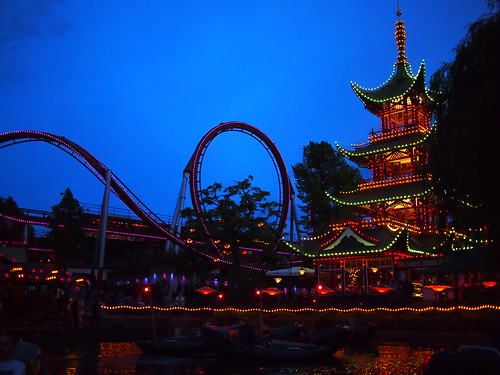
There are no wasted swathes of space in Tivoli. Roller coasters swoop over roofs of restaurants; a Ferris wheel and a faux mountain perch above a lane of shops and beer gardens on one side and a concert lawn on the other. From the carousel you may walk briefly past a brace of emesis-inducing rides to a placid lake overlooked by a pagoda, with a restaurant by it, quiet little bumper boats on it to ride for ten minutes and, farther down, a pirate frigate. Everything is twenty seconds from another thing; it all lies together with the density of dreams and of dense dreamers, limbs tangled languidly over the lush property. Take the high swings and see – with blurry eyes, as you have surrendered your spectacles for the duration of the ride – the entirety of central Copenhagen, all right around the gardens, buildings and stores and station and squares. The urban is rudely there; you soar in sight of quotidian space. But when the swings lower you are back again in Tivoli, like returning to slumber after a mid-night awakening.
Tivoli is the Xanadu of Denmark, and the Kublai Khan of this pleasure dome was one Georg Carstensen, who opened it in 1843, the year he turned 31, and who died in 1857 when he was younger than I am now. He got royal permission to develop it there – at the time just outside the city gates; the city has since grown to surround it – by telling the king, “when the people are amusing themselves, they do not think about politics.”
This quadrangle of magic is a third incarnation of Tivoli. The original is a town near Rome; in Roman times, when it was known as Tibur, it was a resort. It is still the site of the vaunted Villa d’Este. In Paris a pleasure garden was named in its honour in the 1700s; the Jardin de Tivoli, now the site of the Gare de St.-Lazare, was done in and brought back to life twice (once more than St. Lazarus) before its final demise in 1842. After metempsychosis and gestation, it was reborn the following year as Carstensen’s brainchild, a great progenitor of modern amusement parks and an inspiration for Disneyland. But the Tivoli Gardens do not have the celluloid mythos of Disneyland; they simply have more than a sesquicentenary of accumulated joy and dreams and play and living vividly, frivolously, in the limen. This is no oblivious TV. It glitters like Tiffany’s and relaxes like the Riviera, lively and lovely.
We bought all-ride passes. We spent four hours there and rode eight or nine rides – high swings, three roller coasters, a death drop, the Ferris wheel, and something called Monsoon that nearly forced the recall of the Swedish family smörgåsbord we had had that afternoon across the Øresund in Trelleborg. In Tivoli we consumed not much more than two outsized beers and a packet of popcorn, although there were many food options. We whiled and whirled the time away as the northern daylight slid slowly into darkness.
At last the clock on the Rådhus (City Hall) began its idiosyncratic tune, and as the bells tolled midnight we walked, chime, along, chime, the fence, chime, through, chime, the gardens, chime, to a corner, chime, and passed, chime, through, chime, the gate, chime, and out, chime, onto, chime, the street, chime. And through the lively dark of a Copenhagen Friday night, a place still tipsy-bibulous and delirious and cool-warm and vivid, but our Eden was behind us, our dream awakened from.





Buy my books on Lulu.com:
You can also get them on Amazon.com. Please note that I make less than half as much per book if you buy them there, however.
 Sesquiotica