Author Archives: sesquiotic

A more delectable dictionary

Imagine a cookbook that only gave the ingredients for each recipe, with no instructions on how to put them together. Many dictionaries are like that: nothing but bare-bones denotative definitions for the words.

Now imagine a cookbook that included not just the instructions, not just different variants on how you can make the recipe, not even just menu suggestions and beverage matching suggestions, but also other recipes it would go with or remind you of or definitely not go with, and even things the food could or would make you think of – other dishes it would remind you of, other times and places and people.

I would like to have a dictionary that does all that for words.

Of course much of that is individual. Every word is one of Proust’s Madeleines, a key to places you have heard it and seen it and used it before. The way it sounds and how you feel about those sounds will provoke you differently from how it provokes others. But there are several aspects of a word’s extended meaning that users will have in common. Most of them show up in one kind of dictionary or another, but not all, and not all in the same place. Let’s look at how a dictionary that covers a fuller ambit of meaning and effect would handle… let’s say the words dude and fellow.

Connotation

An important dimension of words is what they say about the speaker, the hearer, the subject, and the relation between them – what effect the speaker is trying to have on the hearer and what he or she is saying about what’s going on between them and any third party spoken of.

dude: Casual, informal. Friendly or mildly contemptuous, depending on overall relationship constructed. As an emphatic vocative, expressing some kind of amazement within a pointedly informal frame. (Read this good article by J.J. Gould for more.)

fellow: Intended to be neutral, but can be more formal, often with a taste of condescension.

Register

Register is a key concept in sociolinguistics: your choice of vocabulary and syntax bespeaks a specific situation – it’s like putting on different clothes for different places and activities: clubbing, visiting family, working at the office, working in a hospital, etc. Words are known by the company they keep. Most dictionaries won’t go beyond saying something is formal, or colloquial, or medical jargon, if they go that far. But there is always more that can be said.

dude: Tends to be laddish, often with a sense of drug, surfer, or frat-boy culture; cowboy speech is also possible. Cannot be used for formal registers, except in archaic senses (meaning dandy or greenhorn).

fellow: Broadly usable, but in youthful and casual contexts may sound old-fashioned or formal. Suitable for friendly or pseudo-friendly versions of more formal speech. As a title (e.g., Fellow of the Royal Society), suitable for the most formal speech.

Collocations

Many words have well-known travelling companions – common collocations, as linguists say. These are a word’s circle of close friends. There are dictionaries of collocations, often meant for students of English to help them know how to match their ties and socks, so to speak; there are also corpus databases that list words that tend to show up more often with them. Here are some results (mutatis mutandis) taken from www.wordandphrase.info:

dude: cool, fucking, sorry, funny, awesome, skinny, tall, like, weird, straight, ranch, dude, surfer, shit, fuck, chick, Chicano

fellow: senior, young, old, little, poor, visiting, postdoctoral, fine, nice, honorary, research, craft

Cultural references (including quotations)

Some words have the ability to call forth films or books or historical moments. Berliner can make a person think of Kennedy; cheeseburger can make many people think of endearing kittens with captions; frankly can call up Gone with the Wind. Traditional sources such as Bartlett’s should be complemented with current culture resources such as knowyourmeme.com and the auto-complete in Google searches (which can also be good for collocations). Note that fellow (noun) may arguably call forth references to fellow (adjective).

dude: Jeff Bridges as “the Dude” in The Big Lebowski (quote: “The Dude abides”); Dude, Where’s My Car? (movie); “Dude Looks Like a Lady” (song)

fellow: “Hail fellow, well met” (Jonathan Swift); “Alas, poor Yorick! I knew him, Horatio: a fellow of infinite jest, of most excellent fancy” (Shakespeare); “fellow traveller” (mid-20th-century euphemism for Communist sympathizer); “Write me as one who loves his fellow-men” (Leigh Hunt, “Abou Ben Adhem”); “my fellow Americans” (standard in US political speeches)

Etymology

Etymology is not inherent in our experience of a word; many people are quite oblivious to where their words come from, even as many – often some of the same – have the mistaken idea that a word’s “true” meaning is determined by its “original” meaning. But if you have an idea of a word’s origins, it will influence how you think of the word. This is true whether your idea is accurate or inaccurate. The words picnic and nitty-gritty are poisoned for many people who have false beliefs about their origins; the same people would never use bulldoze again if they knew where it came from – but most of them don’t. Many dictionaries supply etymological information, so I invite you to look it up on your own! And you will find that sometimes not all that much is known.

Rhymes and other echoes

Words will make us think of other words. Not just synonyms, which thesauruses and some dictionaries handily provide. And not just rhymes, which have their own dictionaries. There are other echoes that may contribute in some measure to the effect of a word – words that the word has some resemblance to in sound or appearance. Some non-rhyme examples:

dude: dud, dead, dad, deed, pube, dada, dildo, doobie, redo, stupid

fellow: fallow, follow, fuller, filler, fell, fail, allow, hello, willow, well, low, flow, cellophane

Phonaesthetics

And then there’s the issue of the aesthetic effects of sound qualities, still a bit controversial, but some effects are well known, such as the association of high front vowels with smaller things.

dude: The main vowel sound is a low, hollow sound (it has the lowest resonances of all the vowel sounds), often associated with dullness and stupidity; the d sounds are not as crisp as t sounds but are on the tip of the tongue, which makes them comparatively light.

fellow: The e is fairly open and bright, while the l is soft and liquid, and the f is the quietest of the fricatives; the final ow is darker and more withdrawn but allows sustain.

Obviously a dictionary that included all of this would be rather thick, and would take a long time to put together. Some of it might benefit to some extent from a wiki-style approach, though one does have to be careful. But any added attention to these aspects of how a word communicated would help us all be more fully conscious and engaged users of the language – and would surely make our words more delectable.

Our changing language: When does wrong become right?

Iva Cheung has done up a nice, cogent, accurate summary of my presentation at the 2014 Editors’ Association of Canada conference. You can read it at www.ivacheung.com/2014/06/our-changing-language-when-does-wrong-become-right-james-harbeck-eac-conference-2014/.

The PowerPoint I used for the presentation can be downloaded from www.harbeck.ca/James/harbeck_wrong_right.pptx.

Badly broken words: the podcast

My article on words that are badly broken has been converted (in shortened form) to a podcast. Give it a listen if you want – it’s at theweek.com/article/index/264020/5-words-that-are-badly-broken.

Brugge

Where Brugge is:

  1. Belgium.
  2. Get a map.

How to get into and out of and around Belgium:

  1. Thalys. The Belgian high-speed train. Belgium is too small to need high-speed to get around it. The trains exist to get you in and out. Book first class in advance and save money. First class comes with food and beverage that, outside the train, would cost up to half your ticket price.

    Lunch with Thalys

    Lunch with Thalys

  2. Any other train, if you like moving slowly and don’t feel like eating or drinking for some reason. Or the Thalys doesn’t go there when you want to go there.
  3. Well, it’s not that big a country anyway.
  4. I really don’t see why you’d want to drive. What’s relaxing about that? Also, beer. This is Belgium.

Things to do in Brugge:

  1. Beer. Germans made beer pure; Belgians made beer interesting.
  2. Chocolate.
  3. Beer.
  4. Look around.
  5. Beer.
  6. Take photos.
  7. Beer.

    Beer

    Beer

  8. Chocolate.
  9. Some other food who cares French fries or something with one of the eighty-three sauces you can put on it maybe a sausage too if you must.
  10. Beer.

How to get around in Brugge:

  1. Walk. The old cute part is not very large. The streets are medieval-style: stone, not all that wide, pedestrians and vehicles often mixed together watch where you’re walking and what’s coming at you there are cars and they go fast
  2. Local bus. Good to get to and from the train station. Goes on the same streets as you walk on. Somehow manages to go in both directions on a street not quite wide enough for one.
  3. Bike. Stay at a hotel that has bikes. Bike in the park along the canal that rings the oval heart of town. Bike up and down the streets. Pro tip: when a sign says Uitgezonderd it means “excepted” – so if the sign is a No Entry or One Way sign and it has a picture of a bike and it says Uitgezonderd, that means you can go that way even though the cars can’t. Oh, by the way, watch out for the cars holy cow.

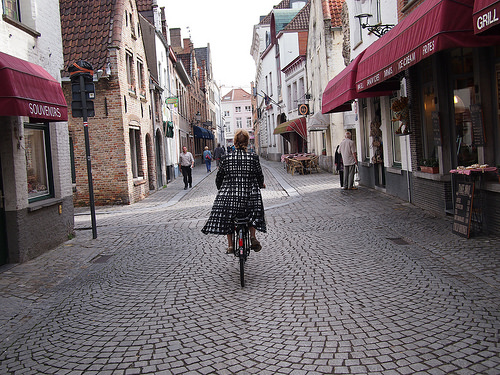
    Follow that woman. She will lead you to beer

    Follow that woman. She will lead you to beer

  4. Take a horse carriage if that sort of thing turns you on and you have the money flopping around and you forgot you were going to buy beer and chocolate with it.
  5. Drive? Not. Don’t do it. Locals blast through in their cars. You are not local. There are canals and stone walls and people. And you will be drinking a lot of beer.

What to see in Brugge:

  1. Brugge.
  2. Look, dude, it’s an outrageously cute medieval town. Bring a camera. You’ll only be taking the same pictures as one hundred sixty-five other people today, but you’ll want pictures to remember it by, especially if you drink all that beer, and to prove to other people that it exists.

    Congratulations! You are the 5,783,624th person to take this picture. The slight tilt gives an authentic impression of squiffiness

    Congratulations! You are the 5,783,624th person to take this picture. The slight tilt gives an authentic impression of squiffiness

  3. Bruges.
  4. Yes, Brugge and Bruges are the same place. We call it Bruges but that’s the French name and they all speak Flemish (Dutch) there so I prefer to call it Brugge, which also allows me to surreptitiously clear my throat on the gg, because that’s how you say the gg. But if you say Bruges people think of that movie.

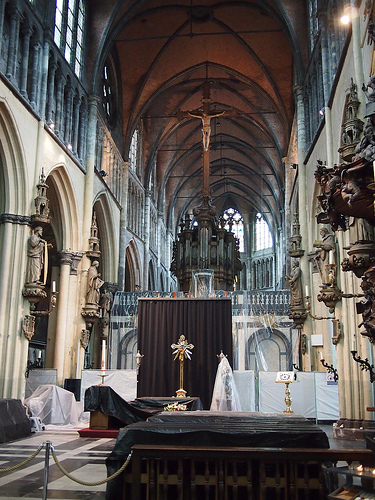
    They only take the plastic off when company is coming over

    They only take the plastic off when company is coming over

  5. OK, you want specifics? See the churches. See the streets. See the canals. See the bridges over the canals. That’s what the name of the place comes from, the Flemish word for “bridges.” Walk walk walk walk. Bring a map or you are doomed, even though you can see the Belfort tower on the market square from many places in town. Seeing it and getting to it are different things.

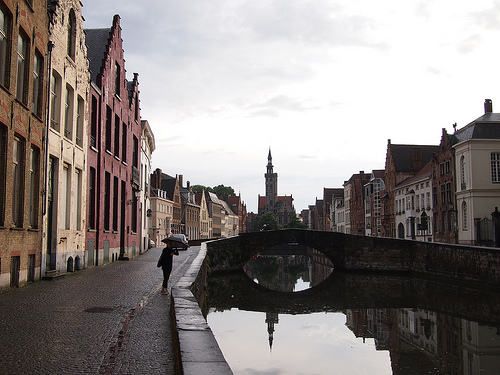
    Brugge is canal retentive

    Brugge is canal retentive

  6. The inside of a brasserie.
  7. Chocolate shops. These are easy to find. Simply start walking. You will see several soon enough. If you don’t succeed, go to the market square and follow a horse-drawn carriage. You will pass some. Watch where you step, these are real horses, with asses behind them… sitting on the carriage, driving.
  8. The inside of another brasserie.

What to eat in Brugge:

  1. Beer.
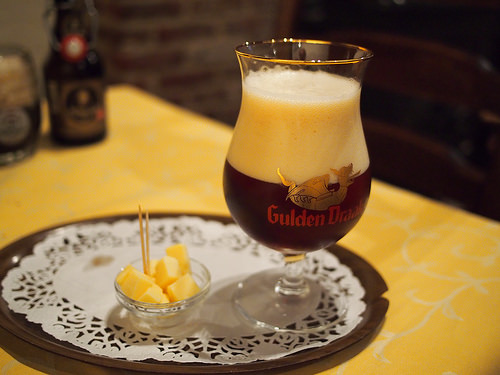
  2. The little dish of cheese they bring with the beer.

    Food

    Food

  3. Chocolate.
  4. Frites, maybe from a truck in the market square, doused with a sauce you would never have thought of putting on French fries but is good. Curryketchup? Samurai? Andalouse? All of the above? 50 cents each.
  5. Seriously, did you skip the part about beer? Have a sausage. Whatever.
  6. Yes, of course they have restaurants. Are you there to eat or are you there to drink beer?
  7. Beer.

What beer to drink in Brugge:

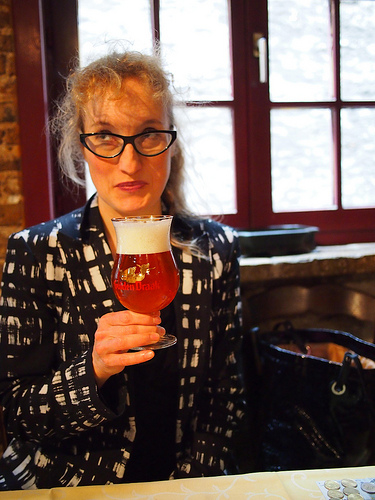
  1. Tripel Van de Garre. This is the house beer of Brasserie van de Garre. It is sweet with lemon notes and a lasting ring of bitterness around the back of the tongue. It comes with a big head. It is 11% alcohol. They limit customers to three each. You get to Brasserie van de Garre by going along Breidelstraat just off the market square, through a little doorway off the south side, and down a rough cobbled alley. This alley is a sobriety test. If you can’t make it to the brasserie, you’re done for the evening. If you’re in the brasserie and can’t make it out, well, shucks.

    Abandon all sobriety, ye who enter here

    Abandon all sobriety, ye who enter here

  2. Anything by Gulden Draak. Nice, caramelly, and strong.
  3. Anything by Boon if you like sweet fruity beers. Kriek means “cherry,” by the way. Do not expect the fruity beers to be strong.
  4. Definitely have a lambic. Anyone’s lambic. Lambic is made by sticking the wort (liquid) up in the attic and throwing open the window and letting the local airborne yeast get it going. Look, you’re not in Germany. Belgian beer is Saturnalia for your mouth.
  5. Gueuze. Heh heh.
  6. Oh, did I mention that gueuze is really sour? I gueuze I forgot. Well, it is. And super interesting. You just ordered one and you can’t finish it? Fine, give it to me, I’ll finish it for you.
  7. Literally anything else that looks interesting. Especially if it’s on tap. Unless the bartender makes a little face when you ask about it.

    Tripel van de garrulous.

    Tripel van de garrulous.

What to buy in Brugge:

  1. Seriously?
  2. Don’t bother with clothing unless you have a pressing need. It’s the same as everywhere else and no cheaper.
  3. Don’t bother with trite souvenirs unless you have friends who really like them, in which case go ahead, there’s plenty to be found.
  4. …um…
  5. Chocolate, obviously! Some for you, some for your friends, and some for you.
  6. Yes, beer. Buy some bottles in a store too, for when you get back to your hotel.

    Our hotel room

    Our hotel room

Where to stay in Brugge:

  1. Well, we stayed at the Adornes Hotel, and it was nice, we would go back. Good breakfast too. Yes, yes, OK, we had real food at breakfast, cold cuts and fruit and cheese and pastries and muesli and tea and juice. Then we went cycling on free hotel bikes and then we went beering.

    Before beer and bike, breakfast

    Before beer and bike, breakfast

  2. If you want to look at other options, go on TripAdvisor. Look at the reviews. Make sure to look at the pictures. If many of the guest pictures of a hotel feature a steep, narrow, long staircase, that means you will have to drag your bags up and down it. Our hotel had an elevator, although you had to cower at the back as though hiding from a hitman or you would interrupt an electric eye by the door and it would stop.

Whether Brugge (Bruges) is like that movie:

  1. Yes.
  2. Minus the hitmen. I think.
  3. And the dwarf.
  4. Have another beer, you might see them anyway.

otter

“We are game-playing, fun-having creatures, we are the otters of the universe. We cannot die, we cannot hurt ourselves any more than illusions on the screen can be hurt. But we can believe we’re hurt, in whatever agonizing detail we want. We can believe we’re victims, killed and killing, shuddered around by good luck and bad luck.” —Richard Bach, Illusions

I think Richard Bach is the person who came up with the phrase otter of the universe. It has gotten around some since.

When I first saw it, used by someone else, it struck me as a useful play on author of the universe. Many people want to know who the author of the universe is. They want to find out how everything got here. They want to understand the author’s intentions.

When children approach a playground, how many of them ask themselves what things the designer had in mind, and try to do only those things? The ones who do (there may be some) are the annoying ones who suck the fun out of it. They probably grow up to be grammatical prescriptivists or similar dogmatists. Or I should say fail to grow up, because while play is childlike, dogmatism is just plain callow.

Otters don’t show up and try to establish first causes. They just look at what can actually be done. And one thing that can be done is play. Otters reallyliketo play. They make good use of what’s around them. And by good I mean fun.

The first time I saw otter of the universe was actually about the first time I became aware of otters as playful animals. I had always thought of otters as just sleek aquatic animals with a name that sounded like a ruler when you hold one end of it against a desk near the edge, bend and release the free end, and pull the ruler back towards the desk: “ott-tot-tot-tt-tt-ttttrrrrrrrrr.” Wooden, rigid as a rudder, a hard sound at odds with the water in which the animals moved. I oughta have known better.

The word otter is easily played with, after all. It’s practically made for a Dr. Seuss treatment: If an otter bites the butter that a potter put on platter for his daughter, will the potter hit the otter with a putter or a rudder? Will the potter’s daughter titter at the otter’s pitter-patter? Will the bettered, battered otter battle bitterly for butter? Or do otters bite on potters’ pretty daughters’ butter patties just to put on pity parties when they’re battered by the potter with a butter-splattered putter as they skitter to the water?

There’s more than that, though. The word otter comes ultimately from the Proto-Indo-European root *udr-, ‘water’. This water has followed many courses: the hydro- root we get from Greek (and that multi-headed water serpent, the hydra); some of the words for ‘otter’ in some other languages (Slavic languages in general have something in the line of vidra; Latin had lutra, which has shown up variously changed in Romance languages); and of course various words for ‘water’, including water.

So this word has flowed around and frothed and leapt like water – and like otters in the water. Do the various flows and changes of words over time seem like utter madness? I’d say they’re more like otter happiness.

Language is my favourite sport. A word isn’t worth much in my world if it can only mean one thing at a time. Rules are made to serve communication, not the other way around, and sometimes what’s being communicated is first of all “Have some fun with this.” And sometimes that’s the best thing to do – whether or not the utterer thought of it, go with what the otterer will do with it. I want to frolic in the stream of consciousness. I want to push language play to the otter limits. And beyond!

And then, at the end of the day, we can rest like otters in the water, floating, holding hands, allowing ourselves even in sleep some play in the stream.

Pineapples, butterflies, and etymology

The words for ‘pineapple’ and ‘butterfly’ have a little thing in common in English – and a striking difference in other languages. Read about it in my latest article for TheWeek.com:

The curious linguistic history of pineapples and butterflies


limpid

Eyes. Blue eyes. Eyes like pools. Eyes like pools you can dive into. No. Eyes like pools that dive into you. Eyes, blue eyes, deep, hypnotic. You can see to the bottom. No. You can see that there is no bottom. Look in these eyes and you are seven leagues deep and in the gathering darkness as the surface slips behind. So much. To see. You are impelled.

Is it clear? We know what things are limpid. Pools are limpid. And eyes are like limpid pools. Wide eyes are like limpid Olympic pools. But what does that mean?

Do they limp? Are they limp? Are they lambent? Impish? Implied? Dimpled? Simply liquid? A Spanish speaker will know that limpiar means to clean. But limpido means limpid. Or, as in Italian, clear. Right from Latin limpidus. Pellucid, free from turbidity.

But limpid is a word of turbulence: the emotions of poetry. It is a word that says “I want to look into your eyes, I want you to feel that I want to look into your eyes, and I am a poet.” It says this even when it is being used to describe something other than eyes.

Limpid is the feel of a blink held just a moment longer, springing then back open to reveal orbs with a hint of outward ripples as of a pool with a simple drop in the middle. It is a word that makes you the more turbid within as you use it and read it. Here, here are quotations from poems; see if after them you can even come to the surface.

He has no need to steal a sip
From Hafiz’ bowl, or bathe his lip
In honey pressed from Pindar’s comb,
Or taste of Bacchus’ philtered foam,
Or filch from Chaucer’s bounteous grace
Some liquid, limpid, purling phrase.
—“The Brook,” William Bull Wright

Ray’d in the limpid yellow slanting sundown,
Music, Italian music in Dakota.
Leaves of Grass, Walt Whitman

He tore out a reed, the great god Pan,
From the deep cool bed of the river;
The limpid water turbidly ran,
And the broken lilies a-dying lay,
And the dragon-fly had fled away,
Ere he brought it out of the river.
—“A Musical Instrument,” Elizabeth Barrett Browning

O little shells, so curious-convolute! so limpid-cold and voiceless!
Leaves of Grass, Walt Whitman

Give me thy hand, and hush awhile,
And turn those limpid eyes on mine,
And let me read there, love! thy inmost soul.
—“The Buried Life,” Matthew Arnold

Ebb stung by the flow, and flow stung by the ebb—love-flesh swelling and deliciously aching;
Limitless limpid jets of love hot and enormous, quivering jelly of love, white-blow and delirious juice;
Bridegroom night of love, working surely and softly into the prostrate dawn;
Undulating into the willing and yielding day,
Lost in the cleave of the clasping and sweet-flesh’d day.
Leaves of Grass, Walt Whitman

and each, as soon as it felt the antennæ, immediately lifted up its abdomen and excreted a limpid drop of sweet juice, which was eagerly devoured by the ant.
The Origin of Species, Charles Darwin

Limpid. All that is limpid is pure poetry and ecstasy and clarity. It is a lamp, but a lamp filled with the late-night oil of the quill-pen wielder. It infects. It sweetens.

All who say limpid thirst for clarity, the clarity that says nothing is clear. The word is shaped like a dream bed by a stream, l and d the posts, and i and i candles or heads; the m is a pillow or a pair of legs, and the p is an arm dipping into the stream. Dipping into the dream. Not dreamy eyes: eyes that you dream about. Not eyes that you see through: eyes that see through you. Limpid like the night sky when you see stars, millions of miles away and thousands of years ago: you see clearly that all is dark and unreachable, and all that you see is past. And you thirst for it and it enters you and breaks you. You limp into limpid eternity. And the eyes never stop looking, so cool and blue.

pillock

If you’re not from Britain, this term may not be all that familiar to you. Allow me to quote the synonyms given in Visual Thesaurus: dolt, stupid person, stupid, stupe, pudding head, pudden-head, poor fish, dullard. To these I think I could reasonably add a common term from Canada: dickhead.

I think that’s a viable synonym not just because of the resentfully abusive way in which the word pillock tends to be used – it carries implications of not just dullness but obnoxiousness too – but also because of its literal reference.

Oh, you don’t know what part of the body the pillock is? Would you care to make a guess? The Oxford English Dictionary reckons that it’s probably shortened from pillicock. The pill is Scots and northern English dialect, probably taken from Scandinavian influences (the Danes used to run that part of the country); it refers not to, say, a little blue pill such as Viagra but rather to that part of the body that the little blue pill is meant to affect. The rest of the word pillicock should be sufficiently obvious. As to the aphetic form pillock, I have to wonder whether it may not have been affected by bollock, a word usually seen in the plural (like its referent).

The word seems like what you get when you expect a pillow and get a rock. It has a taste of someone who gets in a mixed-up pickle, someone who brings ill luck. And at the same time the /p/ and /k/ with a liquid and /ɪ/ between have a bit of a taste of prick as well as bilk and a bit of an echo of kill.

Although the word has been in at least some versions of English since the 1500s, it hasn’t been very evident in print until the last third of the 20th century, when it started being used as a term of abuse. I can’t say whether there was one particular work that served as a primary vector for this, but the word evidently caught on like wildfire.

I like this definition of pillock from 1978 in Approach: The naval aviation safety review: “An idiot who, having gotten himself into the wrong lane, then expects everyone else to give way so that he can get to where only he knows he wants to go, with or without use of flashing indicators or consideration for traffic flow.” You can see where, with such images in mind, the word might have proven quite appealing for general use. And might seem a nearly exact synonym for dickhead.

meatball

My friend Michelle wondered aloud to me, “Why is the word meatball so funny?”

I’m inclined to think the answer lies in large part in its combination of two words often used in humour, especially rather impolite humour, and sometimes in terms of abuse – meathead is a well-known example of the latter. As well, meat and ball are both basic things, learned early in life, free of any veneer of politeness (except in alternative usages, e.g., society balls, ballrooms, etc., which are etymologically unrelated – but even there the simple basic image and sense lurk in the background, as we see in the comedy shows done to benefit Amnesty International, The Secret Policeman’s Ball and The Secret Policeman’s Other Ball).

Meat gives an image of a dense, red lump of muscle, or perhaps of an equally dense brown bit of cooked food, not brain food but brawn food. Actually, the word meat originally referred to pretty much any food, and its sense narrowed over the centuries to the main attraction of the meal, that bit of insensate but strangely desirable dead animal that all the other bits attend on (does this sound like your workplace?). It also shows up places such as meathook (slang for hand), meat market (slang for that bar across the street from us, you know who you are), meathead, meat-eater, one man’s meat is another man’s poison, bush meat, red meat

Ball can be a simple sphere, used for playing games, or it can be a conglomerate of items packed densely and probably messily together, or some formerly flat thing rolled or crumpled in a not-necessarily-tidy approximation of a sphere, or any of a number of things that happen to resemble spheres in some way, I’m sure a few come to mind. Balls are blunt things, projectiles, insensate objects. You’ll see ball in such combos as ball boy, ball handler, ball of wax, ball peen, be on the ball, play ball, keep your eye on the ball, blackball, butterball, cannonball, disco ball, eyeball, highball, pinball, snowball, spitball, the names of several sports, and various expressions referring figuratively to the testes.

So all of that is balled up, complete with seasoning and filler, into meatball. The seasoning includes a few popular culture references, chief among which the 1979 summer camp movie Meatballs, which was the first movie starring Bill Murray, and the popular children’s book Cloudy with a Chance of Meatballs. The flavour also includes the sound: coming in on /m/ with the lips together like a pitcher reader to throw, adding the quick /i/ like a windup, cocking at /t/ and percussively releasing with /b/, and flying through the air and trailing off with /ɑl/. It’s a word just made to be shouted by a sports announcer through a PA – or by a boy on a playground.

Meatballs, the real things, are not (especially not under that name) thought of as highbrow cuisine. Take a bunch of thoroughly ravaged ex-animal and wad it up as you would something undesirable? No, this isn’t fancy cuisine, it’s just cuisine that people practically everywhere love to eat. In world cuisine, there are many kinds of meatballs, with many flavours and sizes, and having many different names in the various languages.

In the US, the dominant image is of the meatballs that one gets with spaghetti: large-ish ones with Italian herbs and spices – probably a jar mix – floating in tomato sauce – probably from a jar or can – and sometimes shoved into long bread in possibly the single most awkward sub sandwich idea ever.

Anyone who lives near an IKEA (including, of course, the entire population of Sweden, along with all the other places that look like Sweden, notably Canada) may be more likely to think of the smaller, differently spiced Swedish variety, often served with a cream sauce and/or lingonberry sauce, and potatoes rather than pasta. (See www.flickr.com/photos/sesquiotic/14340519212/ for a genuine southern Swedish smörgåsbord, already more than half eaten. You will notice that the meatballs were made in greater quantity than anything else.)

Still other people may think first of one of the many variations of kofta/kofteh/etc. eaten in the periphery of the Mediterranean and parts eastward. But it might seem vulgar to call those meatballs. It’s too familiar a word and suggests that this exotic discovery you are eating at the charming restaurant in that strip mall you usually don’t venture near is really something quite homey. Which, of course, for the people for whom it is not exotic, it is.

What meatballs are best? What are the most authentic? What kind should you eat? Is it OK to find meatball funny? An answer to these questions and more is provided by the film Meatballs:


sequoia

Name a tree that has all five vowels in it.

Well, I kind of gave that one away, didn’t I? It’s the title of this word tasting note – today’s word to taste. It’s a seven-letter word, and the only two letters in it that aren’t vowel letters are s and q. Seven letters makes it a possible bonus word in Scrabble – but it’s not really all that long a word given that it names a very, very tall tree. (A longer word for a larger tree, also having all five vowel letters, is Indo-European… but of course that’s a language tree, i.e., a family, not an actual physical tree.)

Still, it’s fairly comprehensive: its consonant sounds involve the tip of the tongue [s], back of the tongue [k], blade of the tongue [j] (that’s a “y” sound; I’m using the International Phonetic Alphabet), and lips [w]. And the vowel sounds are one in the front, one in the back, one in the middle.

So did you notice how I just listed four consonant sounds and three vowel sounds? And yet this word has five vowels and two consonants.

No it doesn’t. It has five vowel letters and two consonant letters. The u and i are standing for glide consonants, which are pretty much vowels acting like consonants or consonants that sound like vowels…

But that doesn’t mean it doesn’t have all five English vowels. Actually, it can’t have all five English vowels, because English has more than five vowels. The six letters that can stand for vowels – don’t forget y – stand for, depending on your dialect, ten to twelve different individual vowel phonemes (monophthongs), plus several two-vowel combos (diphthongs) (some of the monophthongs tend to be said with some movement, making them really diphthongs, but I won’t go into that now). So my opening sentence was not accurate. Always remember: vowels and consonants are sounds, not letters. The letters just represent the sounds. The language exists without its written representation; the written form can have a feedback effect on the spoken language, but it is not primary.

And, in the case of English, it’s rather difficult and not all that transparent. It has some relation to sound, but it’s inconsistent and capricious. If you want to know how it got that way, read “What’s up with English spelling?” The point, anyway, is that while it’s a fun game for those who are good at it, it really fights the learner.

Consider the case of the Cherokee nation in the southern US in the early 1800s. They did not have a written form for their language. But one of the Cherokee, a clever and somewhat driven fellow, decided that it would be very helpful to them to have one. They were trading with white English speakers, so there was an example of a written language – albeit one that the particular Cherokee in question did not speak or read. He tried at first to come up with a written form that would have a different symbol for every word, but this took too long and would require too much memorization, and anyway his wife burned his efforts because they were keeping him from working. So he tried again, this time creating a syllabary, borrowing some forms he had seen in use in English (but with no relation between their English use and the Cherokee use) and inventing a number of others, for a total of 86.

Cherokee syllabics were not systematic like the Korean or Amharic syllabic forms; they were an arbitrary-looking set. But they represented the language quite tidily, and once a Cherokee learned them, he or she was fully literate: there were no booby-traps in the spelling, and they all knew how to speak the language (and no fools had taken it upon themselves to publish works declaring that they were all speaking it incorrectly). So once the Cherokees adopted this syllabary officially – because they could see how useful it was – they had higher literacy rates than the whites in neighbouring communities, who were afflicted with the perverse English orthography.

The Cherokee who invented this syllabary – which you can see at Wikipedia and various other places – was named Sequoyah.

Coincidence? Or is the tree sequoia named after the man Sequoyah? It’s debated. In fact, the Wikipedia article on the tree declares it very likely that Stephan Endlicher, the botanist – and linguist – who named the tree in 1847, did it in honour of Sequoyah, using a Latinized version of the name, and considers alternatives with some thought and detail, while the Wikipedia article on the man Sequoyah declares flatly that “this hypothesis has long been questioned and has now been rejected” – yet another illustration of why you should not take a Wikipedia article as final authority on anything, useful though it may be.

Whatever the case, I think this word sequoia is a good word for talking about language and spelling, and the vagaries and variations available therein. But since I like finding extra layers of meaning and levels of communication in language, I have an inclination to lengthen this word by half, to make it a bit more sesquipedialian – literally ‘foot-and-a-half long’. It has seven letters, so we’ll round up and add four more. Which four? I’ll say s, i, t, and c, and I’ll interleave them in the word, one after se, one after qu, one on either side of i. And what do I get?

Sesquiotica, of course.


Thanks to my brother, Reg, who brought up the link between sequoia and Sesquiotica. In case you’re wondering, sesquiotics is actually a pun on semiotics, and Sesquiotica a pun on the international journal of semiotics, Semiotica. In which, incidentally, I once published an article.