Category Archives: editing

Does verbing impact the language?

Originally published on The Editors’ Weekly.

A favourite crank for language cranks to crank is the demon of verbing. It wrecks our language, they protest! They target such usages as impacted and referenced in business-speak and medalled in broadcasting. While liberal-minded linguists may see these words as just more of the odd flowers that bloom in the spring (and spring up throughout the year, for that matter), the grumblers want to weed them out.

Just recently, for instance, the Guardian gave column space to one Jonathan Bouquet, who fumes at such conversions and would like to bin them all. He welcomes loanwords, he protests, but “there are some constructions that still grate”: impacted and reference, for two, and “Only yesterday, I heard a business reporter on TV use ‘headquarter’ as a verb.” He especially dreads “the fullest flowering of such manglings” during the Olympics, with medal and podium used as verbs.

I honestly can’t tell whether Mr. Bouquet sincerely believes what he writes, or whether he’s taking the, uh, mickey. Although his position is extreme, there are many who hold the same views. But it’s not really the movement of words from one class to another that nettles them – it is the movement of people from one class into another. They dislike the words because they dislike the self-important upstarts who use them: barbarous posers putting on airs and commandeering the language.

I state this with confidence because when they air their grievances they nearly always characterize the sources of these usages peevishly, and because they inevitably use – without comment, without even noticing – words that are the product of exactly the same process: verbs that were nouns first, nouns that were verbs first, adjectives that were nouns first, and so on. They accept and use the fruits of conversion, except when someone they don’t fancy uses a word that looks new to them.

Do I overstate my case? Consider verbs Mr. Bouquet used gladly: grate, flower, mangle. If I look at the rest of his brief rant, I see also – used ingenuously – the verb monitor and the noun import. But take a look at the rest of what I’ve written here. How many words can you count that are regularly used as multiple classes of word? Let’s see: crank, wreck, protest, target, broadcast, mind, flower, mangle, bloom, weed, matter, fume, bin, welcome, protest, dread, hold, class, nettle, like, start, air, pose, state, peeve, comment, process, fancy, rant, look… Look, whenever you scan a book (or book a scan), you’re sure to spy some verbing. English would not be English without it.

And if you’re fine with all those but not with impact, reference, medal, or podium as verbs, why is that? Is it because those latter four could be rephrased using existing words? Consider how many of the words you’re fine with could be paraphrased reasonably well. This is English. We are the ancient spice shop of languages. We have far more words than we need – but we can use them all to good effect. When we take dislikes to words, it’s almost always related to our ideas of the people who use them.

This doesn’t mean you have to use a word you don’t like. But it’s best to be clear on why you don’t like it.
Our strange language, or: How I learned to stop worrying and love language change

Let’s start with four hard truths:

  1. Language changes.
    Language is used by living, changeable people who are constantly being gradually replaced by new people who learn it in different circumstances and get different ideas about it. It’s a part of a society that is in constant flux. Nothing else stays the same; why would language?
  2. We take part in that change.
    You and I are among language’s users – and editors have extra influence in what makes it into print.
  3. We can’t always predict or control how it will change.
    We’re still only individual players in a very large game.
  4. We are usually unaware of how it has changed in the past.
    We have less of an idea of how our language has changed than we have of how our clothing and décor have changed. Most of us don’t know that a sentence such as The suspect planned to use a car to raid the warehouse would have been “bad English” in 1900 for its use of suspect as a noun, plan and raid as verbs, and car to mean automobile, while every “awful new error” in Hopefully, gifting generously will impact our decimated morale has been established usage for much longer.

Change always happens, but it happens at different speeds in different ways in different places. Teenagers embrace and create change; certain areas of publishing resist it obdurately. Some new words catch on slowly, others quickly, and some don’t last (zowie!). We change language for four basic reasons:

  1. To make life easier.
    We reduce the effort in saying a word or we reduce the number of words in a sentence: give incentive to becomes incent. We cut down the complexity of a language system: more than a dozen different forms of the definite article have been merged into the. We avoid social awkwardness: we now always use you so we never have to decide if someone is a thou. We add clarity and reduce ambiguity: some dialects now have a you all. Sometimes making life easier means increasing effort in order to avoid confusion.
  2. To feel better.
    We do it for fun: wordplay, clever slang, cute turns of phrase. We do it for art, for example metaphor. We do it for culture, using new words for food, artifacts, and so on. And we do it for in-group identity: teen slang, technical jargon, the pervasive in-house acronyms of the business world.
  3. To control.
    Some change happens because some people want to exert power over others. And some change happens because some people want their world to be tidy. These two impulses often work in concert, as when we impose a standard version of the language with specific rules and exceptions and make it a badge of membership in a certain social set. Words, phrasings, or pronunciations are deprecated because they’re associated with lower-status groups, even if they’re the product of the same kinds of processes used in the standard dialect.
  4. Things slip.
    We actively change language for the three preceding reasons. But sometimes we also change it through accident and the gradual slippage inevitable in centuries of use and transmission. The word ask started out as acs and now some dialects are taking it back to that; throw used to mean “twist” and warp used to mean “throw”; an adder eating an orange and some peas used to be a nadder eating a norange and some pease.

 The most insidious kind of change is imposition of rules that claim to be guarding against change. All of the big “rules” that some people get so exercised about were introduced in the last two or three centuries: don’t split infinitives, don’t end a sentence with a preposition or start one with a conjunction, don’t use double negatives or double superlatives… If you ignore these “rules” there will always be people who claim you are changing the language (and making an illiterate mess of it – see reason 3, above), but you will in truth have more historical basis.

So what do we do about all this? Since we’re all active participants in language change, and since we editors have some influence and have to make conscious decisions about what change to accept and what to resist, we need some criteria on which to base our decisions. I recommend asking the following five questions:

  1. What is the change? Really?
    Make sure you know what’s newer: the “new” thing or the “rule” against it. Hopefully, you can look it up.
  2. Where did it come from? When?
    Dictionary sites such as Merriam-Webster and Dictionary.com and language-focused sites such as World Wide Words, Language Log, and several others (including my own) can give useful details.
  3. Where is it used? By whom?
    Corpora such as the Corpus of Contemporary American English and other tools such as Google ngrams can be very useful to find out when, where, and by whom a word has been used.
  4. Who is your text for?
    It’s up to you to know as much as possible about the demographics of your readership and the general expectations for the kind of writing you’re editing – some genres and audiences are more conservative (or stuck on schoolhouse “rules”) than others.
  5. What are the gains and losses?
    This is the real point of decision on any usage or rule. If it adds expressive power, it’s worth keeping: subtle differences of tone, emphasis, and signification. (That doesn’t mean use slang freely in formal documents – it might make the slang lose its casual tone!) But anything that mainly serves to limit what you can do with the language – whether it be a blurring of a semantic distinction or a rigid rule against a certain construction – will do more harm than good and is best put aside… if it can be.

A macaronic feather in our cap

Originally published in The Editors’ Weekly, the official blog of Canada’s national editorial association

English is gloriously macaronic.

I don’t mean that it’s like a big bowl of elbow noodles, not exactly. But I also don’t mean that it’s like a macaron – well, maybe I do, but that’s not the word means. Macaronic, linguistically, refers to something that’s a mixture of languages. Macaronic poetry, for instance, may switch from English to Latin – some well-known Christmas carols do this (anything containing the words in excelsis, for starts). More broadly, macaronic refers to something that’s a jumble of things. Macaronic architecture, for instance, is exemplified by the heedless stylistic promiscuity of the McMansion style. English is macaronic: it’s made up of an almost hyperreal mixture of words from different languages. And it’s full of macaronic words, too.

A macaronic word is one that combines parts from multiple languages. The word hyperreal, for instance, uses hyper, which we took from Greek, and real, which comes from Latin (via French). And, fittingly, McMansion mixes Gaelic and Latin sources. This may seem like mixing Lego and Meccano – inadvisable or at least somehow improper. But we do it all the time, and not just with the usual classical parts. In fact, any new term that enters common usage has a pretty good chance of being an assemblage of pieces every bit as cosmopolitan as a modern city. To illustrate, let’s look at a few entries added in 2017 to Merriam-Webster dictionaries:

  • froyo: from frozen, an old Germanic word, and yogurt, taken from Turkish
  • Internet of Things: Internet is Latin inter plus Germanic net, and of and Things are also Germanic
  • ransomware: ransom, by way of French from Latin redemptio, plus ware, an old Germanic word
  • pregame: Latin pre plus Germanic game
  • photobomb: Greek photo ‘light’ plus bomb, which comes from French bombe, which comes from Spanish bomba, which comes from Latin bombus, which refers to a buzzing or booming noise and is also the source of boom
  • airball: air, ultimately from Latin by way of French, plus ball, Germanic
  • EpiPen: the Epi is in this instance short for epinephrine but, either way, is a prefix taken from Greek; Pen traces back to Latin penna, ‘feather’
  • weak sauce: From weak, which is Old Norse in origin, and sauce, which comes from French, tracing ultimately to Latin salsus ‘salted’ (which is also the source of salad)
  • alt-right: from alternate, which comes from Latin, and right, which is Germanic (so much for their “purity”)

Macaroni? The effects are more like the sandwiching of cream between meringues in a macaron. And as with our words, so with our sentences. Nearly every sentence in this article liberally mixes Germanic and Romance (Latin/French) words, plus some Greek (sometimes by way of Latin) and occasionally something else too. I think it’s delicious.

The linguistic bodhisattva

In Buddhism, a bodhisattva is someone who could attain pure enlightenment and transcend to Nirvana, but chooses instead to remain on earth to help other beings come closer to enlightenment. The idea of the bodhisattva is popular in most sects of Buddhism, and though I’m not a Buddhist, I’ve always liked it.

I make no claim to being anywhere near the kind of enlightenment that leads to Nirvana (it seems a fraught route, though I’ve heard with the lights out it’s less dangerous). But I do have a sort of parallel in my own life. Continue reading

Writing “smart” versus smart writing

An impression of intelligence is readily achievable, even in the absence of significant information value, through the expedient of adhering to the expected usages of a genre associated with intellectual output.

Let me put that another way: You can sound smart without saying much by just following the rules of the “intelligent writing” game.

We all know this, of course. You can use ten-dollar words instead of two-bit ones, and the mental effort associated with their retrieval and decoding will stand in for the mental effort associated with working out information-rich content. More than that, though, words are known by the company they keep; words seen in “smart” content will cue your mind that what you’re reading is smart. It’s just like going to a restaurant with expensive décor and smartly dressed waiters: they could serve you frozen dinners and cheap wine and you’d still assume, at least at first, that the food and bev were of high quality.

But wait. There’s more. Continue reading

Currying favour with your readers

Originally published on The Editors’ Weekly

Editing and writing have a lot in common with cooking. For one thing, people come to a text, as to a restaurant, with certain expectations and ideals, and you should satisfy them. You don’t have to give them something completely predictable – especially if you’re in a line more artistic than industrial – but you do want to curry their favour.

That puts me in mind of a recipe in the Larousse Gastronomique, 1977 English edition: “Chicken curry (Plumerey’s recipe).” The listed ingredients are two chickens (cut up), butter, 500 grams of diced uncooked ham, a tablespoon of flour, light veal stock to moisten, a bouquet garni (a standard French seasoning made of a bundle of herbs), and two teaspoons of curry powder.

I don’t think you’ll be served that recipe at any restaurant today. It would seem weirdly out of place (and just weird) in a French restaurant, and it would get the chef in an Indian restaurant fired. But there was a time when French cuisine was considered by many to be the apex of the culinary world, and anything you might eat could be “improved” by a French touch. Even curry.

Likewise, there was a time when a single standard prevailed throughout most of literature. Even if a given work didn’t meet that standard, it was understood that that was what it was aiming for. Certain things were simply infra dig, my dears. Other standards were sub-standard. It was important to show you had the right sort of education.

That time is past. Just as we no longer consider French ingredients and techniques the basis of all the best food, we – or many of us, anyway – are now wise enough not to think that starchy formal English is necessary or even appropriate everywhere. There are, alas, still some people who believe that an overarching consistent adherence to a single standard is the goal of writing and editing. If a writer aiming a rambunctious piece at an informal audience puts “There’s a couple things you should know,” such an editor will tut-tut and change it to “There are a couple of things you ought to know” – or “a few things” if there are more than two. Never mind that that changes the flavour completely; somehow, a palate that can’t taste the difference is supposed to be better.

And perhaps such an editor would be pleased to be served a curry cooked to the standards of Carême. For everyone else, let’s use appropriate ingredients and techniques. English – like any living language – has a multitude of styles suited for different contexts and people. When we recognize that and work with it, we aren’t letting go of rules, we’re choosing which rules to use to suit the occasion. When people come to a French restaurant, give them the best French cuisine, sure. When they come to a chain restaurant, give them a consistent demotic product. And if they’re after good barbecue, or tortellini, or nuer pad prik, or vindaloo, leave Larousse on the shelf.

frontline

Who is at the frontline of language change?

Sorry, should that be front line? I think it should. If you are at the foremost front, you are at the forefront, not the fore front, but the line that forms the front of a battle – or, more figuratively, any other advance (especially in conflict situations) – is the front line, according to, well, every dictionary you look in.

But a lot of those dictionaries have frontline too. Not as a noun, though: as an adjective. Staff who are dealing directly with customers are front-line staff or frontline staff. If they were written as front line staff, there could be confusion over whether they were line staff at the front rather than staff at the front line. So we hyphenate. And, over time, as with this adjective, we may merge.

Or we may not. Mergers happen sometimes and not other times. You can be a healthcare professional working in health care – or working in healthcare, because that noun has a closed-up version now too. And you’re reading this on a website – or, to be old-fashioned, a web site. But you can have an ice cream float or an ice-cream float, but if you had an icecream float you risk having some pedant with a marker draw a couple of lines to indicate that there should be a space there, implying that you need grammatical trainingwheels.

The front lines, in language change as in war, are very uneven, meandering up and down and in and out, and the main thing that keeps them from moving is just if they get really entrenched (yes, when you think about it, front line and entrenched both call to mind the ghastly battles of World War I – both predate it by centuries, but both have military origins).

So… could frontline become the noun form too? Some people want it to be – a colleague mentioned to me that one of the people he works with is pushing for that change in their published text. Mind you, his coworker isn’t saying “I know that front line is standard, but I think we are making a good move forward to close up this compound. We may be in the, erm, vanguard, but we can take the fire.” No, his coworker is saying “I looked in the dictionary and it has frontline as a form so I’m going to use it everywhere.” His coworker is heedless of the noun-adjective distinction.

Which is how language change so often happens: reanalysis, or what members of preceding generations tend to call mistake. The English language isn’t really an ongoing battle – if there is an enemy, they are us. It’s more like a complex game that gets passed on from one family to another, and it doesn’t have a rulebook, and each new group of players pick up a few things from the previous players but mostly figure things out for themselves, resulting in some shift of the rules over time. We hear our parents talk, and we work things out for ourselves, and they don’t correct all of our reconstruals.

So, yeah, you could say that the front line in language change is the battle between the older generation, wanting to preserve what it knows, and the younger generation, wanting to do what suits them best. But from another perspective, the battle is as much like explorers having to put up with previous people – who didn’t get as far – shouting at them “No, you fools! You’ll fall off the edge of the planet!”

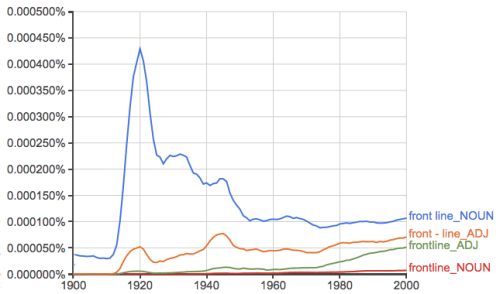
Fine, fine. The question remains: is frontline taking over from front line as a noun? Is it heading the way of healthcare and forefront? Will we soon see not only the frontline but the frontlines just as we see the headlines? Or is it like icecream and trainingwheels? Let’s have a look at a Google Ngram:

frontline_NOUN is way below front line_NOUN and both adjective forms, and not gaining very much

Hmm. Nope. Anyone who uses frontline as a noun is going to be awfully far in front of everyone else, exposed and prone to being shot at… from behind. And the general usage may not ever come close to catching up. It looks pretty well entrenched.

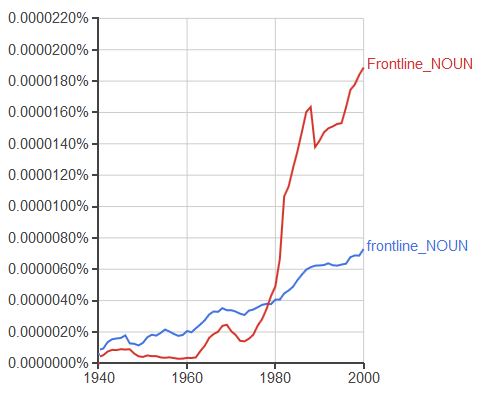
Addendum: I neglected to consider one important vector for change in this. Google ngrams are case-sensitive, and I only surveyed lower-case. But take a look at this:

Frontline-1

So Frontline is increasing in usage much more than frontline. Why is that? I’ll tell you one reason. Since 1983, PBS has had a documentary series called Frontline. TV shows are important vectors for language change.

But that doesn’t mean the branding of the show is spreading the one-word noun throughout the language rapidly. A brand is a brand and may stay as such. Let’s put this in perspective:

Frontline-2

After all, it’s on PBS, not NBC, ABC, or CBS. Public broadcasting is at the front line of knowledge, but most people don’t actually like to get too close to the front line. At least not intentionally.

Whoever is the subject?

Who will inherit the investigation?

Oh, whoever will inherit the investigation?

Whoever will inherit the investigation, he will be someone Mr. Trump nominates.

Whoever will inherit the investigation, Mr. Trump nominates him.

Whoever Mr. Trump nominates will inherit the investigation.

Wait, says the writer. Mr. Trump nominates him. So it must be whom. Whomever. And so, in The New York Times, appears this:

Whomever Mr. Trump nominates will inherit the investigation.

Because formally correct. So whom. Yeah?

Nah. Hyperformalism.

Of course cases like this bedevil writers. The construction is complex and whom is not part of standard daily English; in effect, it is a foreign word for most of us. Wherever we think it might be appropriate for formally correct speech, we are tempted to slip it in, sort of like how some people stick –eth on every conjugation when they want to sound old-fashioned. But sometimes we go overboard and use it where it doesn’t belong.

When people write sentences like the one in question, the rule they’re turning to is that the object must be whom, not who.

The rule that they’re forgetting is that every verb must have a subject.

What’s the subject of will inherit?

It has to be whoever, because whoever else would it be?

One loophole that writers miss that would resolve some grammatical dilemmas is that a whole clause can be an object, as in “Mr. Trump will nominate {whoever gives him the most money}.” Another loophole they miss is that the subject or object of an embedded clause can be made to disappear by what linguists call moving and merging, leaving just an embedded trace (that we know exists thanks to psycholinguistic experiments). That’s what goes on here. The him in Mr. Trump nominates him gets tossed like a baseball in a double play back to the Who, and the catcher’s mitt on the Who is ever. (It can also be an emphatic as in “Oh, whoever will help us?” but it’s not one here.)

Look at “Who(m)ever Mr. Trump nominates, he will inherit the investigation.” (I put the m in parentheses because if you use whom as the object you would use whomever here, but in normal non-prickly English we use whoever as the object too.) Notice that you (almost certainly) wouldn’t write “Who(m) Mr. Trump nominates, he will inherit the investigation.” The ever sets up a second reference, the he. It can also set up an object (him): “Whoever gives the most money, Mr. Trump will nominate him.” (All of this works with she and her too, but we can see that Mr. Trump does not work with very many shes and hers.) So the ever can refer to an object while attached to a who that’s a subject, or the converse.

Our sentence du jour, however, is not derived from “Who(m)ever Mr. Trump nominates, he will inherit the investigation.” Not quite. In “Whoever Mr. Trump nominates will inherit the investigation,” the main verb of the sentence is clearly will inherit (will is the auxiliary that takes the actual inflection, and inherit is the infinitive that conveys the sense); the subject of will inherit is Whoever, as already pointed out. Mr. Trump nominates is an insertion – a subordinate clause modifying Whoever. By itself it would be Mr. Trump nominates him, but, as I said, the him is tossed back and caught by the ever.

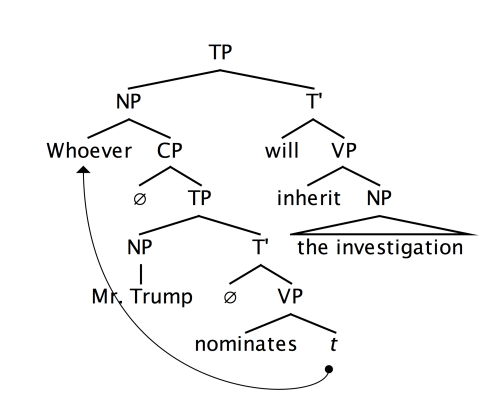
Let’s diagram that like a good linguist, shall we? This is the fun part! Syntax trees have details that non-linguists will be unfamiliar with, so let me set down a couple of basic facts:

  1. A sentence is a TP, which means tense phrase – because it conveys tense (when the thing happens), not because it’s too wound up. The heart of it is thus the part that conveys when it happens: the conjugation on the verb. The verb phrase (VP) is subordinate to that, but it merges with it unless there’s an auxiliary verb taking the tense.
  1. A subordinate clause is also a TP, because it has a conjugated verb, but it’s inside a CP, which means complement phrase, because it’s a complement to something else in the sentence. Often there’s a complementizer, such as that or which, but not always.

So.

The subject is Whoever. Because in English conjugated verbs (except for imperatives) have to have explicit subjects and they have to be in the subject (nominative) case, this can’t be Whom or Whomever. The tense goes on will. The verb is inherit. The object of that (its complement) is the noun phrase (NP) the freakin’ mess – sorry, the investigation. (I haven’t broken that down further, but actually it’s a determiner – the – and a noun.) The complement of Whoever, by which I mean the subordinate clause that describes who the Whoever is, is Mr. Trump nominates [him]. The him is tossed back to the ever.

Whoever Mr. Trump nominates will inherit the investigation.

Whoever will inherit the investigation?

Who will inherit the investigation?

He will inherit the investigation.

(Mr. Trump nominates him.)

So why doesn’t the NYT version instantly sound bad, as “Whom will inherit it?” would? It’s a more complex and unfamiliar construction, and what we tend to do in such cases is go with the salient rules we can remember and basically make up rules to make the rest work. For people who don’t balk at the “Whomever Mr. Trump nominates will inherit the investigation,” I believe what’s probably going on is that it’s an underlying “Whomever Mr. Trump nominates, he will inherit the investigation,” and the he is getting tossed back to the ever. So you have a trace of the subject rather than the object. Now, you can have a trace of a subject when you have more than one verb conjugated to the same subject – “Whoever gets the nomination inherits the investigation” – but it’s not normal formal standard English for a subject to be deleted and merge with an object that is not deleted. We need the subject!

But then, really, whoever speaks formal standard English all the time? Well, not whoever wrote that sentence, anyway, or it wouldn’t have been written, because it would have sounded wrong.

What’s logical about English?

A common complaint about English – by those who are inclined to complain about English – is that it’s not logical enough. Whatever that means. Words aren’t premises and sentences aren’t syllogisms, after all.

If you inspect the targets of their opprobrium, you find soon enough that what they mean is that English isn’t tidy enough for them. It’s inconsistent. Lacking in symmetry. Their experience has led them to believe that for every up there should be a down, for every in an out; when they see an over, they think “therefore under,” and if there is no under, they are… underwhelmed.

They’ve condemned themselves to a lifetime of disappointment. English does not satisfy their need for an overarching tidiness. It is not a Zen garden; it is a forested mountain, every tree grown unplanned in its place and conditions, every rock where the ineluctable complexities of physics left it. It is not an edifice of modernist design with proportions based on the golden mean; it is a Winchester House of a language, a veritable Heathrow Airport of accretions (for those who have not been to Heathrow, let me just say I suspect that J.K. Rowling based Hogwarts on it). Like any natural language, English has been built up by habit, need, association, and analogy. It does have structure – in fact, it has some inflexible syntactic requirements. We have slots to fill, and fill them we do. We just sometimes grab whatever’s ready to hand to fill them.

Let’s consider a few examples. One case where a desire for logic has actually prevailed is “double negatives.” Anyone who has studied logic will tell you that in “not not” the second not undoes the first one. “There will not be cake” is disappointing; “There will not not be cake” is affirming. Thus, the reasoning goes, “I do have nothing” and “I don’t have nothing” are opposite. But anyone who has learned a Romance language ought to know ça ne vaut rien, no vale nada – that ain’t worth nothing.

Nothing, you see, is not not. It’s a noun, not an operator. And one thing languages like is agreement. Concord. Adjectives tend to take the same gender as the nouns they modify, for instance. In English, we use concord with tenses in some contexts: “Should we expect them tomorrow?” “They said they weren’t coming.” Notice how we use weren’t even though we’re talking about the future? We even let negative concord pass unremarked in some contexts: “They won’t be coming, I don’t think.” This doesn’t mean I don’t think they won’t be coming; it just retains the negative aspect.

But since it’s possible, with shifting emphasis, to make “There ain’t no one here” and “There ain’t no one here” mean opposite things, an argument can be made for disallowing negative concord for the sake of unambiguity. So the proscription stuck, defended by pleas for logic – although “if negative noun, then negative verb” is perfectly reasonable if that’s the rule in the language.

Syntax has its requirements – as linguists would say, there are principles and parameters that specify how it functions in a given language. Negative concord is one parameter we have managed to turn off. Others are not so easily disabled. It’s necessary to have an explicit subject (except in imperatives), for instance; I can’t write “Is necessary to have an explicit subject,” so I stuff in an it that has no meaning. It may not seem logical to have a pronoun with no referent, but consider that, from the view of our syntax, “if it has a sentence then it has a subject” is solid. Sometimes we grab and stuff on the fly – we may jam a word in the place where a word like it normally goes, even if in this case it’s a whole nother thing and what even were we thinking? This, too, comes from a simple if-then – just a little simpler than it might have been.

Another plea for logic comes when a word is pressed into service in a way that seems untidy. One I saw recently was an objection to using disconnect as a noun, as in “There is a real disconnect between the labourers and the management.” We don’t say “There is a connect between them,” we say connection, so it’s illogical not to say disconnection. Indeed, this is untidy, in the same way as it’s untidy that when my wife is at home I heat two servings of food and pour two glasses of wine, but when she’s not at home I heat one serving and open a beer (or go out for sushi). But our little untidinesses have reasons: my wife doesn’t drink much beer and doesn’t like sushi. And disconnect is an allusive use borrowed from electronics and telephony.

A line of communication is expected to remain connected, so there is no instance where we would say that it has experienced a connect. We grabbed a bit and stuck it where it fit, and in so doing made a metaphorical connection. There’s no need to construct a symmetrical positive use any more than there is a need for a 33-storey building to have 33 levels of basement. And there’s no need to disallow allusions just for the sake of tidiness – we don’t forbid lights on Christmas trees just because there are none on the house plants. If you want to make a connection, you make it; if you don’t, you don’t. That’s logical, no?

Some people also like to laugh at how “illogical” English words are. “Why do our noses run and our feet smell? Why do we park in a driveway and drive in a parkway? Why do we say a bandage was wound around a wound? How come you can object to an object?” OK, now tell me why these are illogical.

Every one of them comes from a well-motivated historical development founded on consistent principles: metaphor, ergativity, historical sense developments and standard compounding rules, phonological shifts, stress-based differentiation of nouns from verbs. In every case there was an if-then judgement based on analogy. It just happened not to be exactly analogous to some other if-then judgements, and it produced results that seem inconsistent when juxtaposed. I think that’s fine – why not have funny things? But more than that, it’s not even illogical. In every case, we got to it from “if A → A´, then B → B´.” They just happened to be local judgements made in the context of a big, multifarious, inconsistent world.

But it would be illogical to treat a multifarious, inconsistent world as though it were elegant and pervasively consistent, wouldn’t it? It certainly wouldn’t be well adapted. It would be like laying down a strict grid street plan for a very hilly city (and San Francisco knows how well that worked out). It wouldn’t be as much fun, either. And it might do real harm.

croon

The lexis of our language is like a coral reef, full of wonders rich and strange. And, as with coral reefs, one of the threats to its diversity is bleaching.

Coral bleaching is a result of coral shedding algae due to rising sea temperatures. Semantic bleaching is a result of words shedding distinctions of meaning due to overuse, over-broad use, what one might call thesaurusitis: treating all words in a section of Roget’s as fungible. The words are still in use, but they lose much of their distinction of sense, thereby reducing the expressive power of the language. And modern electronic media can amplify this effect.

Expressive power and electronic amplification have much to do with the word of which I sing today, croon. It’s not a new word; it dates back half a millennium in Scotland and northern England, where it has for that long had the sense of a low sound, either (particularly in Scotland) a low, deep, loud, steady sound, or (more broadly) a low murmuring sound or soft quiet singing. It sounds like it should mean what it means. In singing, it’s the opposite of belting. Belting is the kind of singing you do when you have a noisy room and poor (or no) amplification. Once you have a good microphone and good speakers, you can draw the audience in with quiet, smooth singing. You can croon.

Which is what happened in jazz in the late 1920s onward. The first truly famous crooner was Rudy Vallée. His soft voice crept like a lover into millions of living rooms through the radio. Many others followed; the one probably most often thought of as a crooner was Bing Crosby. They all had a gentle, quiet singing style that worked closely with the microphone.

But as one technology giveth, another helpeth take away. Newspapers are written by people who are trained to be allergic to repetition. They seek different words for the same thing to make their prose seem more varied and expressive. We can never forget that a pumpkin is a gourd thanks to them; we are given the idea that every promise, however solemn and formal or not, is a vow; food writers talk of people munching even the softest, smoothest, quietest foods (ice cream? oatmeal?). And every act of singing may be called crooning.

It’s not that the word is always used over-broadly; it has not been utterly bleached. But a quick look through recent New York Times articles finds gospel choirs “crooning” more than once and a jazz singer who “crooned over the trio, belting the 1941 Duke Ellington classic” – yes, crooning and belting as the same act. Even non-singers, we are told, have sometimes “crooned”: soccer fans, en masse in a stadium, “crooned” “We’re not going home”; Donald Trump, at a rally, “crooned” “I love you! I love you!” to his supporters. Every one of these uses is amplified to an unlimited number of eyeballs through the wonder of the world wide web.

As a linguist, I can look at this and just write it down as instances of semantic broadening due to an evident desire for more expressive-sounding vocabulary (with the likely long-term effect of reducing the expressive value it draws on). As an editor and user of the language, however, I would rather resist it, because it ultimately reduces the expressive power. And there can be quite a lot of expressive power in the soft, quiet, focused, and amplified sound of crooning.