
Category Archives: fun

Harris, possessive, declined

So which is it: Harris’ or Harris’s? Neither: it’s τῆς Χάρεως. Or maybe Harro. Or, hmm…

There has been some confusion and consternation lately about the possessive form of the surname of the vice president of the USA, who is also the Democratic candidate for the presidency. Many people, remembering what they were taught in school,* insist it must be Harris’. For the record, if you are adhering to the Associated Press style, that is correct in the singular; if you are adhering to any other major guide (as most people do), the singular possessive is Harris’s. The plural possessive, according to every authority, is Harrises’. But I want to talk about what this paradigm manifests in particular about modern English. And I want to have some fun.

The thing about modern English is that we view proper nouns (names that get capital letters) as internally unassailable. The only alterations they can have are additions of apostrophes and s or es for possessives and plurals and plural possessives. We make jokes, sure, for instance calling the Winklevoss twins “the Winklevii,” but that just manifests the other thing we do: treat plurals as the one signifier for non-English-origin common nouns. We know that the “proper” plural of radius, for instance, is radii. If a word has been borrowed into English, a certain kind of person will make a point of using a plural from the original language: “Oh, no, you don’t mean inukshuks. You mean inukshuit.” (This also leads to silly mistakes like octopi.) And that’s it. We have no concept of any other possible alteration to a noun.

But speakers of many other languages do. It’s common enough among languages to have changes to nouns, not just common nouns but proper nouns, to indicate not just plural and possessive (called “genitive” by linguists and philologists) but also nominative versus accusative (we do this with pronouns: he versus him, for instance) and even dative (indirect object) and ablative (the reverse of dative: taking away rather than giving) – and, in some languages, a lot more. Linguists generally call these various noun forms “inflections” (the noun equivalent of conjugations, which are what verbs do).

For fun, I worked out what the full inflectional paradigm would be for Harris if it were a Latin noun. When speaking of Latin, one typically calls this “declension”; you say this is how Harris is declined, because of the image of going down a list of forms on paper (not because of students saying “I prefer not to,” though that surely has happened). And as it happens, Harris in form looks like a noun of the third declension in Latin. So here’s how that goes (note that I’m listing the cases in the order linguists list them in, which is different from the order students of Latin learned to recite them in school):

nominative singular Harris
accusative singular Harrem
genitive singular Harris
dative singular Harrī
ablative singular Harre

nominative plural Harrēs
accusative plural Harrēs
genitive plural Harrium
dative plural Harribus
ablative plural Harribus

Meaning that instead of Harris’s you would write Harris; instead of Harrises’ you would write Harrium; and, for that matter, instead of to the Harrises you would write Harribus (Latin doesn’t use definite articles as English does). And if Harris is not the subject but the direct object, it’s Harrem. (The vocative form, which you use when addressing the person, is in this case the same as the nominative. Note also that the macrons on ī and ē indicating long vowels are a modern scholarly device; they wrote long and short identically in ancient Rome.)

I posted this on Bluesky (which is a site you can go to now instead of Twitter) and it got some responses, including how it would be in Finnish – due to length limitations on posts, @uimonen.bsky.social provided just most of the singulars:

nominative Harris
genitive Harriksen
accusative (i.e., partitive) Harrista
inessive Harriksessa
illative Harrikseen
elative Harriksesta
adessive Harriksella
allative Harrikselle
ablative Harrikselta
essive Harriksena
translative Harrikseksi
abessive Harriksetta
comitative Harriksineni

A thing to think about here is that whereas the Latin declension is really for humour, the Finnish inflectional paradigm could actually be used by actual speakers today in Finland (though when I look at the Finnish Wikipedia article on her, for instance, the paradigm is different: the genitive is Harrisista, for instance. Why? Well, it’s not a Finnish name, for one thing, and, as we will see, that tends to matter). There are no modern daily speakers of Latin, and most descendants of Latin – French, Italian, Spanish, Portuguese – have declined to keep the declensions. 

But another classical language is spoken today: Greek. Here’s the Classical Greek inflectional paradigm for Χάρις, which is how Harris is rendered in modern Greek and might as well be in the ancient kind as well – I’ve assumed the same third declension as for πόλῐς (polis, ‘city’), and feminine gender (the inflection would be different for a man named Χάρις); note also that it’s normal with Greek to include the definite article, which is used far more even than in English:

nominative singular ἡ Χάρῐς (hē Haris)
accusative singular τὴν Χάρῐν (tḕn Harin)
genitive singular τῆς Χάρεως (tês Hareōs)
dative singular τῇ Χάρει (têi Harei)
vocative singular Χάρῐ (Hari)

nominative dual τὼ Χάρει (tṑ Harei)
accusative dual τὼ Χάρει (tṑ Harei)
genitive dual τοῖν Χάρέοιν (toîn Hareoin)
dative dual τοῖν Χάρέοιν (toîn Hareoin)
vocative dual Χάρει (Harei)

nominative plural αἱ Χάρεις (hai Hareis)
accusative plural τᾱ̀ς Χάρεις (tā̀s Hareis)
genitive plural τῶν Χάρεων (tôn Hareōn)
dative plural ταῖς Χάρεσῐ/ταῖς Χάρεσῐν (taîs Haresi/taîs Haresin)
vocative plural Χάρεις (Hareis)

Yes, that’s right: there’s also the dual – which is nice if you’re referring to the Harrises as a couple (except, of course, Kamala Harris’s husband is Doug Emhoff, so never mind). So the family of Harrises, set in English, would, going by this, be not Harrii or Harroi or whatever but Hareis. And so on.

So does this work in modern Greek? Ah, well, I’m sorry to tell you that, while Modern Greek has declensions (just a little simpler than the classical ones), names from other languages are treated as indeclinable. So when you look at articles about Kamala Harris, it’s always Χάρις. Sorry.

But there are other languages that also decline names. Most, however, decline to do so for foreign names – after all, even if the name looks like a word from their language, they know it’s not. Lithuanian names, for instance, tend to end in -is in the nominative masculine, and replace that for different noun cases; Vytautas Landsbergis, for instance, when he is the indirect object (dative case) rather than the subject of a verb, is Vytautui Landsbergiui. And for “Landsbergis’s” it’s Landsbergo. But Harris isn’t a Lithuanian name, and what’s more, Kamala Harris is not a man and so wouldn’t be inflected according to the masculine paradigm.

On the other hand, Lithuania’s neighbours in Latvia have an answer to that. Latvian makes the nominative of her name Harisa, because Latvian feminine names and in -a as a rule, and because rr isn’t a thing in Latvian (you will also see Herisa, but there’s a stronger case for Harisa). And so if she’s the direct object, she’s Harisu; the indirect object, Harisai; and the possessive for her name is Harisas.

This is all lots of fun, of course, but Harris is, in truth, an English name. But we don’t have to leave England to find a full inflecting paradigm for it. We can just go back in time – Old English had a full system of inflections. The Old English inflections for her name would be:

nom sg Harris
acc sg Harris
gen sg Harrises
dat sg Harrise

nom pl Harrisas
acc pl Harrisas
gen pl Harrisa
dat pl Harrisum

So if you give a book to the Harrises, “þu giefst þa boc þam Harrisum” (for those who don’t know, þ is how we used to write the sound we now write as th). 

That’s not nearly as entertaining as treating the -is as a suffix, alas. But it also has two problems: first, the name Harris only appeared in Middle English, so inflecting it Old English style is as contrived as declining it Latin style; second, in Middle English, the name actually does contain a suffix: Harris is the genitive form of Harry. Names formed from genitives are quite common in English, since the genitive used to be used more broadly: if you lived near the field, you were called Fields; by the brook, Brooks; if you were of the family of Stephen, you were Stephens; and if of the family of Harry, you were Harris. And yes, Harry is a nickname for Henry, but so it goes. Toms and Jacks are also family names.

But you can see the problem here: How can you have the genitive of a name that is already in the genitive? Along with which is the fact that it’s Middle English, not Old English. In Middle English, the inflections of Harry would be (with spelling variations):

nom sg Harry
acc sg Harry
gen sg Harris
dat sg Harre

nom pl Harres
acc pl Harres
gen pl Harre/Harrene
dat pl Harre/Harres

But that just means that if there’s a Harry and another Harry and they jointly have something, then it’s Harre thing or Harrene thing. If it’s the thing of the family of Harry, you can’t really do a double genitive unless you treat the first one as just part of the name: Harrisis in the singular and Harrise or Harrisene in the plural. 

It does remind us of one key fact, though: the genitive (possessive) in English didn’t have an apostrophe until just a few centuries ago, when the apostrophe was added on the basis of the mistaken supposition that the possessive was a contraction (imagining “Harry’s book” as short for “Harry his book”). That’s right: this detail that confuses so many people, and that provokes the ire of a certain set, is founded on nothing other than a historically baseless reinterpretation.

Mind you, a Latin inflectional paradigm that gives us Harrium librī for “the Harrises’ books” is also a historically baseless reinterpretation. But at least we know that. And it’s fun, and no one is getting upset.

* First: High-school teachers are not subject matter experts. Not even high-school English teachers. Not even the ones who “beat it into you.” Second, many people do not accurately remember what their teachers tried to teach them.

 Which is truly over the top, because even if it were Winklevus it would just be Winklevi – the -ii ending is only for plurals of -ius nouns – and it’s not, it’s not even Winklevos, which would pluralize to Winklevoi. But, yes, the point is it’s a joke, so it goes to the lengths of caricature.
I can crack my tangle

Twenty years ago – almost to the day, in October 2002 – I wrote a silly piece of short fiction purporting to be an investigation by an unnamed scholar of an idiomatic phrase. I never did anything with it. It came back to mind recently and I looked again at it. I still think it’s funny, as a look at the vagaries of phrasal etymology but also at a certain kind of literary scholar. So here it is, unrevised. I hope it amuses.

I Can Crack My Tangle

by James Harbeck

Considerable controversy surrounds the origins and meaning of the phrase “I can crack my tangle.” As everyone knows, this phrase – one of the most commonly used in North America today – means, depending on the person using it, “I am very happy,” “I am quite unhappy,” or “I have no idea whether I’m happy or unhappy, but it must be something.” This triple meaning has caused numerous arguments; the use of the phrase has in fact come to be something of a mischief in certain circles, and yet it persists in being used more than only a few phrases in the English language. Further, there is a significant contingent maintaining that the phrase is incorrectly rendered and should be given as “I can’t crack my tangle,” or “I correct my dangle,” or “Eyes can crack might’s angle,” or “I can croak ‘my angel,’” or any of several other possibilities. Unfortunately, even those advocating a specific usage often differ on which meaning it should have and what its origins are. Given these difficulties, I have taken it as incumbent upon myself, as a scholar of note, to clarify once and for all the sources and suitable usage of this phrase. 

Allow me first to dispose of a few purported origins bruited about by the ignorant and irresponsible. The most common one – and one which I have personally received in forwarded “did you know” emails at least eight times as of this writing – is that in medieval England there was a competition every year, either at Mayday or at Michaelmas, in which young men either were presented with a knot or had to tie one, and the one who untied the knot first or made a knot that couldn’t be untied would win the favours or the hand in marriage of the May queen or the prettiest eligible girl in the village or the town weaver’s daughter. “Crack,” by this account, could mean either the figurative sense of “solve” or a more literal meaning whereby a hardy young man, perhaps inspired by the sword-wielding example of Hercules, used his fist or hammer to crack the knot in two rather than untying it. By way of explanation it is proposed that the knot was shellacked or – and this is an especially amusingly stupid story – drenched in eggs to symbolize fertility, and the unwise ones would try to untie it while wet but the wise one would let it dry and become brittle and thereupon crack it like an egg, within which perhaps was his beauteous reward. 

The principal problem with this story is that weavers’ daughters are anything but great prizes, whatever they may seem when twenty-one years of age. Beyond that is the contradictory nature of the story and the fact that there is no evidence anywhere of any such competition occurring – in fact, the earliest version of this story seems to be in an email sent from a Hotmail account in 1997. As well, it is more than a little unlikely that anyone would wish to view with approbation such an obvious metaphor for the decline of youthful fecundity and an apparent recommendation of waiting until one’s partner is old and hardened before cracking the egg, i.e., having children.

It is also not the case that the phrase comes from the Irish phrase gan craic i mo cheangal, which means “without fun in my ties/connections/weaving.” Aside from the fact that this is an oddly unidiomatic phrase, and an incomplete sentence at that, and aside from the fact that the Irish pronunciation sounds rather more like “gone cracky moe cangle,” which at most might have converted to “gone cracky, my candle,” and even though this origin would explain the dual nature of the expression (since “ceangal” might also suggest marriage or relations, and a person divorced might appreciate the dissolution of the “ceangal” or even experience considerable happiness at the failure of the ex-spouse to have any fun after unjustly and summarily leaving her hard-working husband because he was “too boring”), there is simply no evidence to support this as an origin, amusing as the picture of a lamenting Irish weaver might be.

Other purported derivations of this phrase are, if anything, more risible than the above, and they hardly need addressing at all, except to say that the printed record gives no support whatever to them. Any person with good breeding and an intellect worthy of consideration would never say “I correct my dangle,” let alone imagine that such a mundane problem might be cause for joy or distress; “I can croak, ‘my angel’” is senselessly saccharine, reeking of the inane romanticism that leads naïve young men to marry inappropriate women and, later, to long senselessly for their return when they have wantonly strayed; and “eyes can crack might’s angle” simply sounds like a bad lyric from an unjustifiably popular rock-n-roll group. No, we must turn to the historical record to untangle this knot and crack this problem.

The earliest printed record of this phrase is in fact an instance from 1842, in Aubrey Whitsun-Ellis’s great novel Joan, or the Last Opportunity. In this novel, an essential part of any truly well-read gentleman’s library and much to be recommended for its tale of the fruitlessness of expecting too much from a woman gone to seed (or, perhaps, gone away from it), the hero, Endel Hughes, exclaims to his friends upon reading the letter from his wife, who had run away either in shame or in wantonness, “Well! —I can crack my tangle! —I do say, but there’s a sort— Hah! What say you fellows to this?” Whereupon the famous gust of wind blows the letter into the fire, and his friends can say nothing, not having had the opportunity to read it. Hughes, for his part, then lapses into a silence that lasts the remaining three pages of the book and, presumably, for some time after, although one would hope that he comes out of it as a disappointed man should, relying on the strength of his character. 

This instance, which is the likely source of the phrase’s popularity, has been much debated by English scholars, who, as usual, are entirely out to lunch on the matter, being ignorant of both linguistics and humanity. Did his wife have the child she was ashamed of never having borne him? And if so, was it by him? It is clear enough that she would not have written to him if she were simply going to stay away; a woman who contacts her abandoned husband obviously has some desire for reuniting, even if he no longer wishes to have her. A person who denies this has had no experience of real life. But in the context of the book, the only reason for her writing him would be to bring news of a child either born or miscarried, since she could not possibly go back to him without some resolution of this central issue. 

Thus he is receiving news of a birth of a child, which could be his or someone else’s, and he could never know which (and perhaps she is only contacting him to tell him she desires financial support for this questionable offspring and to claim that she still doesn’t want him in her life, even though he has been the sole stable influence she has ever had), or else the miscarriage of the same, which would be either a loss of his last chance to have a child or revenge on his wife and her unnamed lover. In either case, Hughes clearly cannot know whether he is happy or unhappy, although he knows it must be one or the other. (In the end, if his wife stays away from him, he will know which it must be or may as well be treated as being, as he is depredated of his income and self-respect by this withered crone, once a pretty girl but now, though the book does not say as much, clearly past her prime in every way and thus much at fault in the whole matter, irresponsible woman that she is, claiming boredom with the only man who could raise her from her unspecified humble origins – likely the ill-sown seed of a weaver or some other ignoble tradesman.) Thus the phrase clearly takes on the ambivalent meaning, with a leaning towards unhappiness in the long term, and those who use it to mean they are quite happy are engaging in an entirely unwarranted act of interpretation of a book they are clearly not qualified to comment on.

But whence did Whitsun-Ellis get the phrase? He uses it as though it were already common currency at the time. And indeed it appears commonly enough in the years after the publication of Joan, principally among those literate enough to have read and appreciated the book. The supposition among linguistic scholars has been that it was a local phrase, perhaps from Yorkshire (although its subsequent use appears almost entirely among educated gentlemen of southern England), taken up and first cast in print by the redoubtable, resourceful and erudite Whitsun-Ellis. I have, however, at great expense and personal effort, finally found the original holograph of Joan, from which the typesetters set the book. 

It will be remembered that the book was published posthumously – Whitsun-Ellis died immediately after its completion, perhaps fully happy at having written such a masterpiece, perhaps completely unhappy with the world he portrayed so accurately. The typesetters would thus not have had recourse to Whitsun-Ellis to revise misreadings of his often harried and cryptic handwriting. And on the select page, we find a very interesting scrawl. It could be read as “I can crack my tangle” by an unintelligent typesetter working in a late-night rush. But other more semantically coherent readings are also easily found. A closer look might suggest “Joan carried my child,” as indeed I read it at first glance. But this is too plain and does not challenge the intellect of the reader as Whitsun-Ellis was wont to do. Upon analysis of the letter forms, which are shaky and suggest writing on an unsteady surface, perhaps in a moving coach, I have concluded that it must be “Joan does not trifle.” The following sentence may also be revised: for the incomplete ejaculation “there’s a sort,” read “there’s a tart,” which is a natural first reaction to the news that a man’s wife has born a child after having left him some eight or so months previously.

Naturally, in keeping with the greatness of the author, these readings do not change the moving uncertainty of the work. We are still left hanging: is it that she will return to him, and so is not trifling with his affections, or that she is making unreasonable demands on him, and so not trifling in her brazenness? He seems to be leaning towards the second option by calling her a tart in the next breath. And, of course, human experience shows that he is right, and that as the child grows it will become apparent that it bears no resemblance to him and probably looks suspiciously like her second cousin. But it is the nature of the great to rise above such circumstances.

We thus see a notable etymological tangle decisively cracked, and we learn that the great Whitsun-Ellis does not trifle with us. And although I do not expect that the ordinary man in the street will forever eschew inane linguistic fantasies, I feel confident that the acute, mature and well-bred intellect will feel at last satisfied and amply corrected and will know “Joan does not trifle.”

Editors’ anthems

A few days ago, Mark Allen of That Word Chat tweeted a request for an international editors’ anthem. So of course I made one.

No I didn’t. I made two. Because why not.

I decided that it should use a well-known existing tune, because otherwise it wouldn’t catch on. It’s not as though I can legislate it. And I decided that Beethoven’s “Ode to Joy,” from the last movement of his ninth symphony, would work well. 

But I happen also to be fond of Parry’s “Jerusalem,” a setting of a poem by William Blake, and I couldn’t resist doing something on that too. Just as a back-up, you know. The words are a bit unusual, but it’s not exactly the only anthem to phrase itself as a series of questions (looking at you, “Star-Spangled Banner”). I originally wrote the second verse in “we” and “us” terms, but really, editing is a one-person-at-a-time job, so I switched it to “I” and “me” – which matches the original more closely anyway.

I would have posted them sooner, but of course I had to record them so you could sing along, and it was a few days before I had the chance. If you don’t like the sound of my voice (with tons of studio effects), just sing louder to drown me out.

Apologies for the key of the Beethoven one – it’s a bit high, I think. But that’s Beethoven’s fault.

Ode to Editing

(to the tune of “Ode to Joy” by Beethoven)

Joyful, joyful, we will edit,
Making language clear and clean,
Seeking virtue more than credit,
Helping you say what you mean.
We work magic with words and grammar,
Polishing sense and adding style,
Weaving gravitas and glamour,
Giving wisdom with a smile.

If you write it, we will read it,
Watching closely what you say,
Making fixes where you need it,
Working hard to earn our pay:
Paraphrasing, trimming and moving,
By paragraph and line by line,
Sense and sentences improving
So your words will truly shine!

The Manuscript

(to the tune of “Jerusalem” by Parry)

And did these hands, in limited time,
Trim twenty thousand words to five,
And did they fix a dodgy rhyme,
And did they keep weak prose alive,
And did the grammar and the words
Show marks of art and learnèd crafts,
And was a manuscript turned to gold
From all those dark and leaden drafts?

Bring me my pen, my laptop too,
Send me an email with the file,
Bring me a mug – no, bring me two –
Bring me my manual of style!
I will not cease from mental work,
My wit and wisdom still unbowed,
Till I have fully edited
Your manuscript to make you proud!

Backing track of “And Did Those Feet” is used under the Creative Commons Attribution-Share Alike 4.0 International, 3.0 Unported, 2.5 Generic, 2.0 Generic and 1.0 Generic license. Creator: Richard MS Irwin, www.hymnswithoutwords.com.

Crossword solution

OK, for those of you who have done the crossword or just want to see what the answers are, the solution is on my Patreon site at https://www.patreon.com/posts/55659653. I’m not putting it up here so there’s no risk of an inadvertent spoiler.

If you would like an explanation of any of the clues, just ask! And let me know if you’d like to see more cryptic crosswords or other word puzzles along with my word tastings.

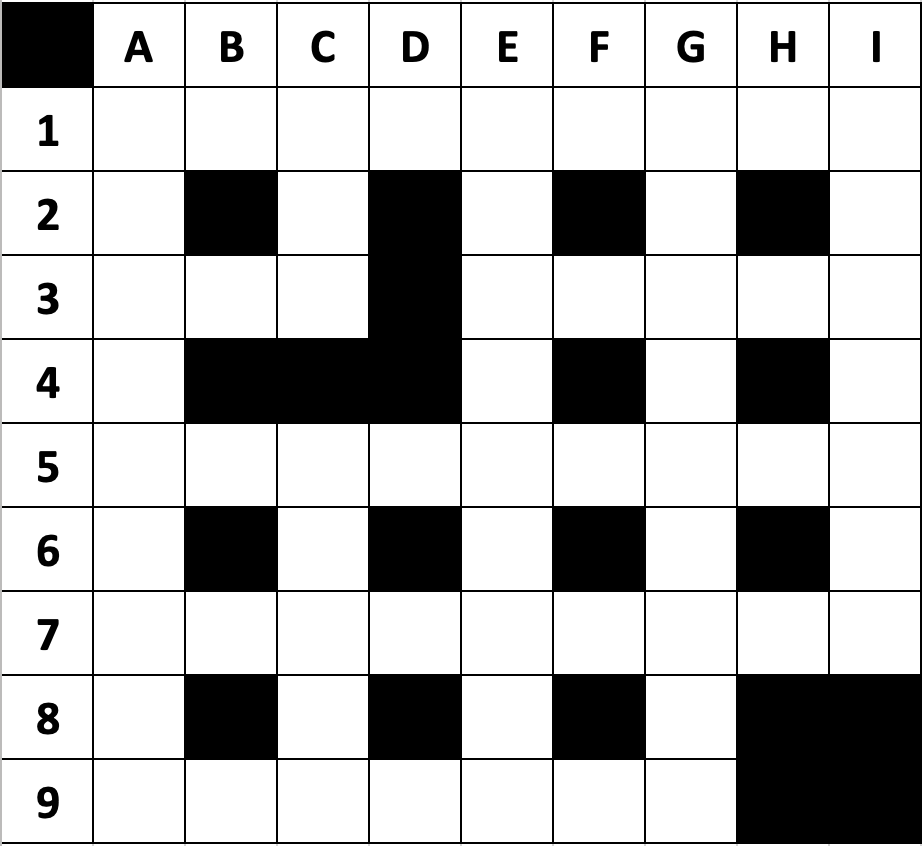
A cryptic crossword

I think cryptic crosswords are fun. If you’re not familiar with them, the way it goes is that each word is described two ways – once by meaning and once by some aspect of its form (usually spelling or sound) – but it’s done in a clever and coy way. An example would be “Booze works heartlessly in writer’s oeuvre (5)” as a clue for BOOKS: if you take BOOZE WORKS and remove the middle of it (ZE WOR) – in other words, if you have it heartlessly – you get BOOKS, and that’s also described as a writer’s oeuvre.

Anyway, here’s a small one. I made it available for my Patreon patrons early yesterday as a bonus for their paying something ($1, $2, or $5 a month) for all my articles that the rest of you get for free. I’ll make the solution available tomorrow on Patreon… but it won’t be visible to non-patrons until a bit later.

ACROSS

A1 Eclipses? Take them to the beach! (9)

A3 Wise raptor or incomplete fowl? (3)

E3 Strum weirdly… and “drang!” (5)

A5 Steals eel unexpectedly, dies (9)

A7 Alive, busy, jumping—a nasty way to do things (9)

A9 Allows to buy preparation for physical with Olivia (4,3)

DOWN

A1 Winter comes too soon, brings deficit (9)

C1 Nothing, just French flax the back way (3)

C5 Almost erupts badly in gush (5)

E1 Draining last of fuels, engines out of order (9)

G1 Eliot’s April in a wild Celt’s rule (9)

I1 Sounds all at once torpid (7)

Want to get things like this crossword and its solutions sooner, or just feel good about paying a bit for what you get on Sesquiotica? Go to https://www.patreon.com/sesquiotic. That’s also where you’ll get the answers to this crossword… in a couple of days.

And let me know if you’d like to see more of these!

al dente: the metal version

You may remember my quick pronunciation tip video for al dente, wherein I make it clear that it’s not said like “Al Dante”:

Well, last week a guy named Robert emailed me about that video. “I am creating a joke metal project that is themed around Pasta,” he wrote. “Very silly, very fun. I was wondering if I could use audio from that video (basically voice clips) within a song of mine?”

Of course he could. I could not possibly say no. That sort of thing is very much to my taste.

So he did. He made it the middle of three pieces in a YouTube EP. You don’t have to listen to it – not everyone likes metal music – but I think it’s fun, and it’s less than three minutes, anyway. Here:

Life lessons I learned from Scrabble

In my leisure time, I play Scrabble online against friends. Over the years I’ve gotten reasonably good at it; I’m happy to say that I know several people who are also good at it and give me interesting games. And as I’ve learned to be better at it (some of it from playing, some of it from reading Stefan Fatsis’s book Word Freak), I’ve learned bits of perspective that are very useful for doing well at the game but also often useful in other parts of life. These may or may not be useful to you in your life – but at the very least, they will help you at Scrabble.

1. There’s no such thing as winning a turn.
The play that’s worth the most points this turn isn’t always the play that’s worth the most points in the long run. The aim of Scrabble is to finish with more points than your opponent. If you get more points this turn but it leads to you doing worse (or your opponent doing better) subsequently, it’s not the best play. I remember playing one friend who, after one game, confessed that he had been using an online anagram finder (which, by the way, I do not – I’m far too vain to seek that kind of help). “And yet you still lost,” I said. Likewise, in other parts of life, you may feel like you have come out on top in an interaction – especially if you’re the sort of person who treats every conversation as a contest, or looks for ways of sucking the last nickel out of a customer – but you may very well lose out in the long run, because the people you “won” against won’t be inclined to let you “win” again in future.

2. It’s not how fancy your words are, it’s how you use them.
Many people think doing well at Scrabble is all about knowing and playing really nice words. It’s true that knowing a lot of words is very helpful, but often you get the most points (and improve your position the most) with plain, ordinary words. This is also true elsewhere in life: fancy words in the wrong place can fall flat, and the right ordinary words may score a lot of points.

3. Most of the time, the little words make the difference.
This is a thing most people learn before too long at Scrabble: big words may make big impacts, but little words – two-letter words that you make while playing alongside another word, and sometimes two-letter words played two ways on a triple – are crucial. Likewise in the rest of life, small words – though slightly longer than two letters, such as “Thanks!” – can really help make connections.

4. But sometimes the right big word can have quite an effect.
This should be obvious: the two previous points notwithstanding, impressive words are impressive, and used in the right place, they can score a lot of points.

5. Some things that appear to be worth the least can be worth the most.
Two of my fundamental rules in Scrabble are “Don’t waste an S” (meaning that if you use an S, the play should be worth at least 40 points, since you are very likely to be able to play a good word and also pluralize or conjugate a word already on the board orthogonally) and “A blank is a bingo” (meaning that a blank tile gives you the flexibility to make a play that uses all seven tiles, which will give you a 50-point bonus, and you do well to hold onto it until you can put it to that use). And yet an S says it’s worth one point and a blank is worth zero points on its own. Likewise in the rest of life, there are things that by themselves don’t seem worth a whole lot but make quite a lot of things possible. But what those things are will vary quite a bit, unlike in Scrabble.

6. Start by looking for where you’ll accomplish the most.
In Scrabble, if I can play a bingo, I will; if not, I look at any high-value tiles I have and see if I can use them on a double or a triple or even a double-double or double-triple. Then I work out the rest of the play on that basis. In the rest of life, similarly, if you come into a situation where there are different things you can do, see where you can put your best assets (skills, for instance) to best use.

7. Manage the board.
Many players play words without looking to see what they’re opening up or closing off on the board. They may make a great opportunity for their opponent (remember that this is a game that you are, in fact, playing to win). Or they may play a word that makes it very difficult to play any further in that area of the board. The play that’s worth the most points this turn isn’t always the play that’s worth the most points in the long run. Pay attention to what opportunities you create. And so, too, elsewhere in life.

8. Manage your rack.
It’s common to have times when you look at the tiles on your rack and see a motley and basically unplayable assortment of tiles. Some of the time this is just bad luck, but some of the time it’s because you played the easy-to-play tiles – or the biggest-point word – and left yourself with a mess, and the new tiles you drew didn’t rescue you. Do what you can to make sure you have a reasonable balance of vowels and consonants. Don’t have too many high-point letters (they seldom go together productively). In short, pay attention to what you’re leaving for yourself. And so, too, elsewhere in life.

9. It’s not a referendum on your intelligence.
Scrabble is just a game. And some people I know who are very smart aren’t all that good at it, because it requires a particular set of abilities and learned tactical skills. If someone beats you at Scrabble, oh well. You are not humiliated (though if you’ve made a lot of noise about how good you are at it, you sow what you reap). Most of the rest of life is not a game, but it, too, is almost never a referendum on your intelligence. Even really smart people aren’t good at everything – and can make mistakes at things they are good at. It’s OK. Own up, suck it up, move on. It’s just a thing you’re doing; it’s not the sum total of you.

10. There are always great plays you just can’t make.
“Aw, man! I had a great bingo on my rack and I had nowhere to play it!” This is a common complaint. There are two truisms, though. First, it’s not a great play if you can’t make it. Plays are made by what’s on your rack and what’s on the board. You don’t have a great play on your rack, only on the board, and only if the board allows. The rest is just “If I had a million dollars” stuff. Second, however often you notice a “great play you can’t make,” I guarantee you there are many more “great plays you can’t make” that you don’t notice – as well as great plays you could have made but didn’t notice. It’s just the way it is. You don’t always get the opportunity, and you don’t always notice when you do. But you notice more if you look more.

11. Always leave room for the other person to do something that helps you.
I generally prefer to play Scrabble in a way that creates openings. Partly it’s so if my opponent takes one opening, there will still be another opening for me to take. Partly it’s because if I’ve set it up right, my opponent’s gain will likely create an opening for me to gain even more. If I play in a way that closes off opportunities, yes, my opponent won’t be able to score big, but neither will I – and my opponent also won’t be able to make a play that will be useful to me. Most of the rest of life is not so competitive (or at least doesn’t have to be, and if you think it does, see number 1 above), but it holds true that you should leave room for others to do things that help you. And one really good way to do that is to help them. When you’re not playing a game like Scrabble where only one person can win, you might be able to help set it up so everyone wins.

12. If you count on getting lucky, you won’t; if you count on not getting unlucky, you will.
And if you count on the other person not getting lucky, they will. I don’t think I need to explain this too much. A short form of this might be “Hedge your bets.” If you make a play that’s worth decent points but creates an opportunity for the other person to score, say, 52 points if they just happen to have the X and an I, you will surprisingly often find forthwith that they do have the X and an I. This is in part because people often hold onto those high-value letters for several turns, so the chance of their having one is higher than a simplistic calculation of the odds would say. The short of it is that if you make plans that rely on things beyond your control going just so, they often will not come out as you wanted.

13. There’s no point in complaining about your tiles.
Everyone gets bad tiles from time to time; Scrabble is a game of chance as well as of skill. It’s not all that different from card games in many ways. If you’re not playing well because you keep drawing crap tiles no matter how much you try to manage your rack, so it goes. It happens to everyone. The game is not a referendum on your intelligence. Similarly, elsewhere in life, if things beyond your control aren’t lining up to let you display the true genius you want the world to recognize you as, consider (a) whether you are that true genius, (b) whether the person you’re complaining to is someone you had been hoping to show yourself as superior to, and (c) whether the person you’re complaining to might have experienced the same from time to time and not made a stink about it.

14. You can’t win all the time, and there’s nothing wrong with the other person winning some of the time.
Scrabble is a game you play to win, yes. But you get to play more than one game in life. Take the insight from point 1 and apply it here in the broader scope. People who win against you at least some of the time are more likely to want to keep playing against you. That’s not to say you should obviously throw games. But you could play a bit more loosely from time to time. And at least not get upset if you lose. Likewise in life, tomorrow is another day – usually.

15. Finish en beauté.
I took a course in syntax taught in French once, and we didn’t quite make it all the way through the text before the last class; the professor told us that we should read the remaining chapter if we wanted to finish “en beauté.” That literally means “in beauty” but idiomatically can mean “with a flourish” or “with panache.” I apply that when I play Scrabble: even if the game is nearly over and there is no doubt who will win (sometimes me, sometimes my opponent), I like to look for the best moves I can play. Because although the point of the game is to win, there’s still nothing wrong with enjoying the other aspects of it. And I can still do the best I can even if it’s just a flourish.

I can’t say that I apply all these lessons equally well to my life, but I can say that I have definitely gained useful perspective from them all. And, as I said, at the very least, they all help when playing Scrabble.

Watch the ACES Celebrity Spelling Bee

ACES, the Society for Editing, has an annual spelling bee as part of its conference, with proceeds going to its education fund, and this year it’s something extra special. Like the rest of the conference, it’s online – and this time it’s all editing celebrities! OK, it’s five celebrities and me. I will be competing against Benjamin Dreyer (of Penguin Random House, and author of Dreyer’s English), Mary Norris (of The New Yorker, and author of Between You & Me), Ellen Jovin (of the Grammar Table, and author of quite a few editing guides), Henry Fuhrmann (of the Los Angeles Times), and Steve Bien-Aimé (professor of journalism at Northern Kentucky University). 

Only one will prevail! But the big winner (aside from you lucky audience members) will be the ACES Education Fund: your fee for getting to watch is a donation of at least $15. It’s on April 21, 4–5 pm Eastern time. Get your ticket at the ACES website.

They asked if I would make a promo video. Of course I would. Here it is.

jactiate

Some days, you know, you have plans, you have designs, you have desires, but at the end of the day, you’ve done jactiate. And other days, you have duties, you have instructions, you have obligations, but at the end of the day, you haven’t done jactiate. And either way, it’s the same.

It’s the same because jactiate is the kind of thing where the result is identical whether you do it or not. Literally – that’s the definition: ‘stuff that can be done or not done with no difference in ultimate effect’. And I say “stuff” and not “things” or “a thing” because it’s a mass noun, like water, air, rice, and business: it doesn’t get an article and it doesn’t get a plural. Mostly, in fact, it just shows up in two collocations: do [or did] jactiate and don’t [or didn’t] do jactiate. And those two phrases mean exactly the same thing, in spite of the opposite polarity.

Where does this word jactiate come from? You might recognize the jact root, as in Julius Caesar’s famous Alea jacta est! That means “The die is cast!” More often, though, jacta (or jactus or jactum) would be translated as thrown or tossed – and you can see the root (mutatis mutandis) in other English words, such as eject and reject, both of which can be paraphrased as toss out.

You recognize the -ate ending, of course; more often it’s on verbs, but it can show up on adjectives describing things that have had the verb done to them, and nouns naming those things. A noun you might recognize in this form is ejaculate, which refers to stuff that has been ejaculated. And an adjective you might recognize is cruciate, as in anterior cruciate ligament, so named not because it’s excruciating when you tear it but just because there are two of them and they cross over (= they are cruciate). In the same pattern, jactiate is stuff that’s tossed out (or will be tossed out, or has been tossed out), and so doing it or not doing it makes no difference; you might as well have done nothing.

You can take the cue for pronunciation of jactiate from the analogous words, too. Although verbs ending in -ate say it like the word ate, adjectives and nouns reduce and destress it. Just as cruciate sounds like “crewshit,” jactiate sounds like “jackshit.” So when you say “You’ve done jactiate” and “We haven’t done jactiate,” it sounds like…

…well, ha ha, yes, it is “You’ve done jack shit” and “We haven’t done jack shit.” I just made this word up because I didn’t have anything better to do at the moment. It’s a Latin joke for word geeks. (It’s not even perfectly formed from the Latin, but whatevs, did you even notice?) You probably know the term jack shit, which first appeared in colloquial English usage by the 1970s (Oxford’s first citation is 1968). Well, now you can spell it jactiate instead of jack shit (or jackshit) and say “So there!” to the tut-tutters. Just tossing that out there…

Sure-fire opening lines

This was originally published on The Editors’ Weekly, the blog of Editors Canada

It is a truth universally acknowledged that a novel in want of readers must be possessed of a good opening line. A book is a relationship – many of us spend more intimate time with books than with people – and it is important to start the relationship off on a good foot.

So, naturally, I wondered whether good opening lines for books were like good opening lines on Tinder.

A book, of course, is not addressing you personally. Still, like your first message to someone on Tinder (I’m told), a book’s opening line should include a couple of attention-grabbing details, be about something the reader is interested in, refer to things they know about, present honesty and vulnerability, and leave the reader wanting to know more. It’s even better if it’s witty.

On the other hand, books are supposed to bring adventure, with danger and disturbance. It’s safe, since you can close the cover and return to normalcy, but it can’t be like a nice date. Death makes for bad dates but good reading.

So, as a study in pragmatics and discourse, let’s try some opening lines of books lightly adapted to be Tinder opening lines and see how they do.

  • “Hey. I am somewhere around Barstow on the edge of the desert and the drugs are beginning to take hold.” (Hunter S. Thompson, Fear and Loathing in Las Vegas)
  • “Good evening. It is a pleasure to burn.” (Ray Bradbury, Fahrenheit 451)
  • “JSYK, everything in my profile happened, more or less.” (Kurt Vonnegut, Slaughterhouse-Five)
  • “Greetings. It is a truth universally acknowledged, that a single man in possession of a good fortune, must be in want of a wife.” (Jane Austen, Pride and Prejudice)
  • “How’s it going? If you really want to hear about it, the first thing you’ll probably want to know is where I was born, and what my lousy childhood was like, and how my parents were occupied and all before they had me, and all that David Copperfield kind of crap, but I don’t feel like going into it, if you want to know the truth.” (J.D. Salinger, The Catcher in the Rye)
  • “Greetings. I am a woman who has discovered she has turned into the wrong person.” (Anne Tyler, Back When We Were Grownups)
  • “Nice day, eh? The sun is shining, having no alternative, on the nothing new.” (Samuel Beckett, Murphy)
  • “A bit about myself: All children, except one, grow up.” (J.M. Barrie, Peter Pan)
  • “Yo. I awoke this morning from uneasy dreams and found myself transformed in my bed into a monstrous vermin.” (Franz Kafka, Metamorphosis)
  • “Hi there. I was born with a gift of laughter and a sense that the world is mad.” (Rafael Sabatini, Scaramouche)
  • “Good day. I am a sick man… I am a spiteful man. I am an unattractive man. I believe my liver is diseased.” (Fyodor Dostoevsky, Notes from the Underground)
  • “My name is Eustace Clarence Scrubb, and I almost deserve it.” (C.S. Lewis, The Voyage of the Dawn Treader)
  • “I write this sitting in the kitchen sink.” (Dodie Smith, I Capture the Castle)

From these we observe two further truisms:

  1. The genre expectations of narrative fiction are sharply different from those of dating.
  2. Most protagonists of novels may be very interesting to read about but are not the kind of people you would want to go on a date with.

