Category Archives: language and linguistics

Pope Francis and the construction site of Babel

I normally stay away from politics and religion on this blog, since responses on such topics can sometimes go off the rails. However, my attention was drawn yesterday to something that, while touching on both, highlights how a translation can say the same thing as the original and yet say more and other – or less.

On April 18, 2025, Good Friday, the Vatican published “Meditations and Prayers for the Via Crucis 2025, Written by the Holy Father Francis.” Francis didn’t speak the words himself (the papal vicar did), but he is the author of record: the words, in each language, can be taken as though they had been spoken by him. It was published in Spanish (Francis’s primary language, which I would assume it was written in), Italian (which I believe it was spoken in by the papal vicar), English, German, French, Portuguese, Polish, and – unusually, I’m told – Arabic. But not Latin, which may seem unusual, but we need to remember that this is not an official missive or declaration. It is devotional text for the Way of the Cross. 

The Way of the Cross is a 14-part devotion following 14 stages of the progression of Jesus, starting with his condemnation to death, going along the carrying of the cross (several scenes along the way), through the crucifixion, ending with his being laid in the tomb. (The resurrection is not part of this sorrowful and contemplative devotion, though of course it’s understood that it will follow.) So this “Meditations and Prayers” is sort of a chocolate box of occasions for spiritual reflection, and in it you can see reflected many different perspectives and priorities from its author – with the intelligence of the translators in play as well. 

I’m going to look at bits from just three of the stations, in their different translations. (Caveat: I have no competency in Arabic, so I will not be addressing that translation. Anyone who does know Arabic is invited to comment!)

First: Station I, “Jesus is condemned to death.” Francis focuses on the merciless choices that Pilate and others made. “We can learn marvellous lessons from this: how to free those unjustly accused, how to acknowledge the complexity of situations, how to protest lethal judgements.” He addresses Jesus: “Yet you are always there, silently standing before us, in every one of our sisters and brothers exposed to judgement and bigotry.” He speaks against “Religious disputes, legal quibbles, the so-called common sense that keeps us from getting involved in the fate of others.”

I’ll focus on two turns of phrase here: “judgement and bigotry” and “so-called common sense.” The first one could have been “judgement and prejudice”; if it had been, it would have been in line with the other language versions: Spanish “juicios y prejuicios,” Italian “giudizi e pregiudizi,” and the rest (including German “Urteilen und Vorurteilen” and Polish “osąd i uprzedzenia”). Why use “bigotry” rather than “prejudice”? It’s more pointed – a specific kind of prejudgement.

“So-called” is the interesting bit in the second phrase. To be more in line with the other translations, it would have been “seeming common sense” or “apparent common sense” (“aparente sentido común”; “apparente buon senso”; “aparente bom senso”; “bon sens apparent”; “scheinbar gesunden Menschenverstand”) or (particularly with the Polish “pozorny zdrowy rozsądek”) “superficial common sense.” You can see right away that the focus is different: in English, it’s not what “seems” to be common sense, it’s what some people call “common sense.” We may recall that “common sense” has been used in many political platforms and slogans.

I’ll skip ahead now to Station VIII, “Jesus meets the women of Jerusalem.” They’re weeping for him; he tells them to weep for their children. Francis writes, “Lord, our broken world, and the hurts and offences that tear our human family apart, call for tears that are heartfelt and not merely perfunctory. Otherwise, the apocalyptic visions will all come true: we will no longer generate life, and everything around us will collapse.” It doesn’t quite mention “thoughts and prayers,” but you can see where it’s looking.

This is less interesting from a comparative translation perspective; there are differences, but they are largely down to available options: for example, English has “heartfelt” rather than “sincere,” which would more directly translate most of the other versions. But there is one turn of phrase that, though also mainly due to available words, can’t not catch my eye: “we will no longer generate life.” 

No other language explicitly says “life.” The Spanish is “ya no generaremos nada” (“we will no longer generate anything”); the Italian, “non generiamo più nulla”; the Portuguese, “não geramos mais nada”; the French, “nous n’engendrerons plus rien.” The catch is that the word in each that can be translated “generate” can also be translated as “beget” or “engender” – it has a clear sense of procreation that’s not so present in “generate.” So, in order to capture this implication, the English version has to make something explicit (using “life,” which has quite a lot of resonance in the Catholic context) but consequently also to reduce the semantic ambit. The German, by the way, is “Wir bringen nichts mehr hervor” (“we bring forth nothing more,” with “bring forth” implying either “create” or “beget”) and the Polish is “niczego nie tworzymy” (“we don’t create anything” – not explicitly to do with birth).

Now for the one that has been remarked on in particular and that first caught my attention: Station III, “Jesus falls for the first time.” Jesus is carrying the cross and stumbles. I’ll quote a longer stretch: 

Even the way of the cross is traced close to the earth. The mighty withdraw from it; they desire to grasp at heaven. Yet heaven is here below; it hangs low, and we can encounter it even when we fall flat on the ground. Today’s builders of Babel tell us that there is no room for losers, and that those who fall along the way are losers. Theirs is the construction site of Hell. God’s economy, on the other hand, does not kill, discard or crush. It is lowly, faithful to the earth.

The reference to Babel is coincidentally apposite for us, since that tower, built to reach into heaven, is (per the Bible) the reason we have all of these languages – to quote the New American Standard Version of the Bible, “the Lord said, ‘Behold, they are one people, and they all have the same language. And this is what they have started to do, and now nothing which they plan to do will be impossible for them. Come, let Us go down and there confuse their language, so that they will not understand one another’s speech.’” But while the story presents the different languages as the downfall of the builders of Babel, we can see that different languages, with their different vocabularies and grammars and idioms, can also bring new insights and particular local implications.

I want to look at the two most striking sentences: “Today’s builders of Babel tell us that there is no room for losers, and that those who fall along the way are losers. Theirs is the construction site of Hell.” Remember, this is the English translator’s choice of phrasing; it’s approved and official, as good as spoken by the pope himself, but so are all the other language versions. I’ll give you the full version of the passage for each language.

Spanish: “Los constructores de Babel nos dicen que no es posible equivocarse y que el que cae está perdido; es la obra del infierno.”

Italian: “Ci raccontano, i costruttori di Babele, che non si può sbagliare e chi cade è perduto. È il cantiere dell’inferno.”

Portuguese: “Os construtores de Babel dizem-nos que não se pode errar e que quem cai está perdido. É o canteiro de obras do inferno.”

French: “Les bâtisseurs de Babel nous disent qu’il ne faut pas se tromper et que celui qui tombe est perdu. C’est le chantier de l’enfer.”

German: “Die Erbauer von Babel sagen uns, dass man nichts falsch machen darf und dass diejenigen, die fallen, verloren sind. Das ist die Baustelle der Hölle.”

Polish: “Mówią nam, budowniczowie wieży Babel, że nie można się mylić, a kto upadnie, ten jest zgubiony. Jest to plac budowy piekła.”

Let’s look first at “Theirs is the construction site of Hell.” How metal! “The construction site of Hell” is more particular (and oriented to tower building) than some of the other ones, which could translate to “the worksite of Hell.” The Spanish is especially lean: “la obra del infierno” could as well mean “the work of Hell.” But, hey, did you notice what else? They all say “It is” or “That is”; only English says “Theirs is,” as a sort of dark echo of the Beatitudes (contra “Blessed are the poor in spirit, for theirs is the Kingdom of Heaven”).

Now to “there is no room for losers, and that those who fall along the way are losers.” Every language but English has something translatable as “one must not be wrong, and whoever falls is lost.” There is no equivalent to “losers” in any of the others. 

That’s striking. In the context of the meditation, the English could have been “there is no room for error, and whoever falls is lost.” There’s clearly a point in using “losers” and in tying it together that way. We know who talks like that. And the reference wouldn’t carry in another language. You see what I mean?

I should say also that I’ve been assuming that the text was drafted in Spanish or perhaps Italian and then translated to the other languages. It’s not impossible that it was drafted first in English – Francis might have had a writer who wrote in English draft it first, with translations to the other languages following; I don’t know who was involved. In that case, it would be a question of nuances intended in a particular language just not being retained – although, as I’m not steeped in the cultural milieux of any of the other languages, I can’t say what particular extra nuances might be present in them. But that’s how language and culture work, after all: built on a foundation of references that are understood by one group of people – and not others. Some things are lost in translation… and some things are gained.


Whither English?

Once again this week I guested into the editing class my friend teaches online at a local university. And this time, along with the usual questions about specific points of usage, one student asked what I think will change in English usage, and what changes editors should resist.

Which is a really interesting question! Predicting language change is fun and occasionally one gets it right, but there are always innovations that you just can’t predict – and social and technological changes, too. When you look at how things have changed in the past, it gives some sense of the usual forces of change. As I said in one presentation on the topic (more than a decade ago now), we tend to change language for four general reasons:

  • to make life easier
  • to feel better
  • to control
  • things slip

Fads that become accepted are common. The shifts in the pronunciation of the letter r – and their shifts in social status (for example, the advent of r-dropping in England, its adoption in America as a sign of higher status, its shift over time towards more of a working-class signifier in America but not in England) – are emblematic of this, as I wrote about in an article for the BBC. A lot of it has to do with signifying various kinds of social group belonging.

On the other hand, sometimes changes are invented and propagated – such as the ideas that you can’t split an infinitive (I’ve written about this more than once) and can’t end a sentence with a preposition, and the prescribed distinction between less and fewer. A few of these “rules” have become undisputed standard English now (such as the proscriptions of double negatives and double superlatives); others (such as the ones I just mentioned) are often waved around as rules but aren’t universally accepted, and serve mainly to license social aggression (as I wrote about in another BBC article). I did a whole presentation on when “errors” aren’t some years ago, and a bit more recently on when to use “bad” English.

None of which yet answers the question. Let’s see… 

  • I think that social media will continue to be a good vector for the rapid spread of new usages and references (everything is citational, after all), but of course I can’t predict which ones. 
  • I think that punctuation will get to be used more and more variably for subtle significations (after all, the presence or absence of a period at the end of a message can convey tone, sometimes importantly). 
  • I think emoji will keep getting used, including as nouns, verbs, and adjectives, not just interjections, but how far into formal writing they will spread I don’t know. 
  • I think capitalization will continue to be basically haywire, because it’s weird and complicated in English anyway (here’s something I ghostwrote for PerfectIt’s blog about it).
  • I’ve noticed what seems to be a shift (yet another!) in the pronunciation of r among younger people, at least partly under the influence of pop singers who are avoiding the retroflex sound in favour of something closer to a mid-high mid-front vowel. I’m not sure where that’s going, but keep an eye on it.
  • I suspect we will, at length, start using they-all or something similar to convey that we’re speaking of a group of people, rather than a single person of unspecified or neutral gender. I am very much on board with singular they – if you have an hour, watch this presentation I gave on gender in language, including the vaunted history of singular they and the deliberate reactionary imposition of the idea that he is the natural generic default. But singular they can bring the complication that we aren’t always sure of the number of people signified. When we started using you for all second persons rather than distinguishing between singular thou and plural you, various people in various places innovated y’all, youse, yiz, yinz, and so on. So why not the same with they?
  • And, because identity is important to people, especially when threatened, and because language is a key means of conveying that identity, I think Canadian usages and in particular Canadian spellings (centre, colour, you know), which have been slipping a bit in general Canadian usage, will come to be increasingly emphasized in response to threats to Canadian sovereignty. That’s not a change so much as a revitalization. But keep an eye out for innovation of Canadian signifiers too!

And as to the question of what changes to accept and what to resist, as I said in my “when does wrong become right” presentation, there are five questions we should ask when evaluating a change:

  1. What is the change? Really? (Sometimes the “change” is the original form and the “traditional” usage was invented and propagated more recently.)
  2. Where did it come from? When?
  3. Where is it used? By whom?
  4. Who is your text for? (Usages that annoy one audience may charm another.)
  5. What are the gains and losses – what does the change add in expressive value and clarity, and what does it take away?

Oh, and I am definitely in favour of being pragmatic to the point of deviousness in our choices. As Machiavelli said, “consider the results.”

If you were to use the subjunctive…

It’s March fourth. Happy Grammar Day! Today is a day when certain people who like to loudly declare their love for grammar put extra energy and volume into promulgating their favourite rules. Which is kind of a giveaway about their motivations: It’s not grammar itself that they love (since “bad grammar” is also grammar, adhering to a coherent underlying set of rules, just not the rules that they prefer), it’s security in an imposed order. It’s authority, as long as they get to be the authority. It’s like if someone were to say “I love flowers!” but simply could not stand the disorder of a meadow of wild flowers and had to have the tidy order of a strictly planted garden, with no flower out of place.

But there is an important difference here: Many neat grammar rules do have an organic basis in the language, and the imposed rule is intended to keep usage from drifting away from that. (This is not true of all grammar rules, mind you; for example, we know exactly when the strict distinction between less and fewer was invented, and we do not in fact owe allegiance to its inventor.)

But usage does drift. For most English speakers, for example, whom is effectively a foreign word; they have no natural feel for its usage, and so they use it in places where it’s inappropriate according to the rules they’re attempting to preserve. So a bit of freshening up on the established rules, for those who want to follow them, is not unreasonable. And – to get to my subject for this Grammar Day – for many English speakers, the subjunctive is also a strange thing that, even if they use it sometimes, they don’t altogether “get.”

Which isn’t that big a problem in most contexts. But if you were to use the subjunctive, you would need to know not just how to use it but when to use it. And the available guidelines for it are sometimes so detailed as to be confusing. Wikipedia, for example, says, “Subjunctive forms of verbs are typically used to express various states of unreality, such as wish, emotion, possibility, judgment, opinion, obligation, or action, that has not yet occurred.”

Part of the problem is that these do not all require the subjunctive, but they are things it can be used for. Another part is that people get confused about what’s real versus unreal and what you can and can’t use the subjunctive for. So – as it is Grammar Day (or, if you are reading this on another day, imagine it were Grammar Day) – let me give you the quick and easy way of thinking about the subjunctive mood: It can be thought of simply as a hypothetical mood. Note that I say “mood” – it’s not a tense; it’s a perspective that can be applied to any tense, just like the indicative mood (which is the usual mood, talking about things that definitely do or don’t exist). 

And this is where some people get confused, because hypotheses operate differently in the past and present than they do in the future. When we’re talking about things in the past or the present, something that’s hypothetical hasn’t happened and isn’t happening, whereas something that’s indicative has happened or is happening. To use Wikipedia’s term, in the present and the past, the unreal is known to be unreal. But when we talk about the future, it’s all hypothetical; none of it has happened yet, even when we’re using the indicative. None of it is real yet. Which means that the effect of the subjunctive in the future is not the same as in the present and the past. 

Let’s look at some examples:

Past:

Subjunctive: “If you had helped me, I would have been grateful.” (You didn’t, and I wasn’t.)
Indicative: “If you helped me, I was grateful.” (You might have helped me; I just can’t remember. If you did, I was grateful.)

Present:

Subjunctive: “If you were helping me, I would be grateful.” (You aren’t, and I’m not.)
Indicative: “If you are helping me, I am grateful.” (I’m not sure if you’re helping me; if you are, I’m grateful.)

Future:

Subjunctive: “If you were to help me, I would be grateful.” (I’m proposing that you help me, but I’m doing so indirectly, so as to make it clear that it is not expected but merely possible at your discretion.)
Indicative: “If you help me, I will be grateful.” (Just a straightforward conditional, laying out a possible course of action and a consequence of it.)

You can see that both ways of speaking of the future are possible, and both refer to the same case, but one is using the hypothetical framing to put in more distance so as to disavow any air of expectation or transaction – in other words, it’s being more passive and polite – whereas the other is simple and direct.

And this is where we see that choices of grammar are not just about what is technically correct; they are also about negotiations between people. Everything we say, we say to produce an effect, and part of that effect is a negotiation of status and expectations between us and the person(s) we’re speaking to. (Unsolicited corrections of other people’s grammar are an exemplary case and their intended effect is left as an exercise to the reader.) In the case of my example, “If you were to help me, I would be grateful,” the subjunctive is used to make a suggestion or implied request, or wish – none of which, by the way, asserts or implies that the thing is outside the realm of possibility; it simply uses the hypothetical framing to emphasize that it is not a certainty, and it does that so as not to impose or make a claim on the other person.

One more thing, though: All of this is just if you use the subjunctive. You don’t, in fact, have to; there is a version of English that simply doesn’t use distinct forms for the subjunctive. In it, you never say “if I were you”; it’s “if I was you,” even though I have never been you. This version is more common and more accepted in England than in North America, but it’s available everywhere… though it does have a less literary air to it, and it allows the occasional ambiguity, though that’s usually resolved in the next clause with the choice of tense. For example:

Subjunctive user speaking hypothetically: “If I were finished, I would stop writing.”

Subjunctive non-user speaking hypothetically: “If I was finished, I would stop writing.”

Subjunctive user or non-user using indicative: “If I was finished, then obviously I stopped writing.”

Harris, possessive, declined

So which is it: Harris’ or Harris’s? Neither: it’s τῆς Χάρεως. Or maybe Harro. Or, hmm…

There has been some confusion and consternation lately about the possessive form of the surname of the vice president of the USA, who is also the Democratic candidate for the presidency. Many people, remembering what they were taught in school,* insist it must be Harris’. For the record, if you are adhering to the Associated Press style, that is correct in the singular; if you are adhering to any other major guide (as most people do), the singular possessive is Harris’s. The plural possessive, according to every authority, is Harrises’. But I want to talk about what this paradigm manifests in particular about modern English. And I want to have some fun.

The thing about modern English is that we view proper nouns (names that get capital letters) as internally unassailable. The only alterations they can have are additions of apostrophes and s or es for possessives and plurals and plural possessives. We make jokes, sure, for instance calling the Winklevoss twins “the Winklevii,” but that just manifests the other thing we do: treat plurals as the one signifier for non-English-origin common nouns. We know that the “proper” plural of radius, for instance, is radii. If a word has been borrowed into English, a certain kind of person will make a point of using a plural from the original language: “Oh, no, you don’t mean inukshuks. You mean inukshuit.” (This also leads to silly mistakes like octopi.) And that’s it. We have no concept of any other possible alteration to a noun.

But speakers of many other languages do. It’s common enough among languages to have changes to nouns, not just common nouns but proper nouns, to indicate not just plural and possessive (called “genitive” by linguists and philologists) but also nominative versus accusative (we do this with pronouns: he versus him, for instance) and even dative (indirect object) and ablative (the reverse of dative: taking away rather than giving) – and, in some languages, a lot more. Linguists generally call these various noun forms “inflections” (the noun equivalent of conjugations, which are what verbs do).

For fun, I worked out what the full inflectional paradigm would be for Harris if it were a Latin noun. When speaking of Latin, one typically calls this “declension”; you say this is how Harris is declined, because of the image of going down a list of forms on paper (not because of students saying “I prefer not to,” though that surely has happened). And as it happens, Harris in form looks like a noun of the third declension in Latin. So here’s how that goes (note that I’m listing the cases in the order linguists list them in, which is different from the order students of Latin learned to recite them in school):

nominative singular Harris
accusative singular Harrem
genitive singular Harris
dative singular Harrī
ablative singular Harre

nominative plural Harrēs
accusative plural Harrēs
genitive plural Harrium
dative plural Harribus
ablative plural Harribus

Meaning that instead of Harris’s you would write Harris; instead of Harrises’ you would write Harrium; and, for that matter, instead of to the Harrises you would write Harribus (Latin doesn’t use definite articles as English does). And if Harris is not the subject but the direct object, it’s Harrem. (The vocative form, which you use when addressing the person, is in this case the same as the nominative. Note also that the macrons on ī and ē indicating long vowels are a modern scholarly device; they wrote long and short identically in ancient Rome.)

I posted this on Bluesky (which is a site you can go to now instead of Twitter) and it got some responses, including how it would be in Finnish – due to length limitations on posts, @uimonen.bsky.social provided just most of the singulars:

nominative Harris
genitive Harriksen
accusative (i.e., partitive) Harrista
inessive Harriksessa
illative Harrikseen
elative Harriksesta
adessive Harriksella
allative Harrikselle
ablative Harrikselta
essive Harriksena
translative Harrikseksi
abessive Harriksetta
comitative Harriksineni

A thing to think about here is that whereas the Latin declension is really for humour, the Finnish inflectional paradigm could actually be used by actual speakers today in Finland (though when I look at the Finnish Wikipedia article on her, for instance, the paradigm is different: the genitive is Harrisista, for instance. Why? Well, it’s not a Finnish name, for one thing, and, as we will see, that tends to matter). There are no modern daily speakers of Latin, and most descendants of Latin – French, Italian, Spanish, Portuguese – have declined to keep the declensions. 

But another classical language is spoken today: Greek. Here’s the Classical Greek inflectional paradigm for Χάρις, which is how Harris is rendered in modern Greek and might as well be in the ancient kind as well – I’ve assumed the same third declension as for πόλῐς (polis, ‘city’), and feminine gender (the inflection would be different for a man named Χάρις); note also that it’s normal with Greek to include the definite article, which is used far more even than in English:

nominative singular ἡ Χάρῐς (hē Haris)
accusative singular τὴν Χάρῐν (tḕn Harin)
genitive singular τῆς Χάρεως (tês Hareōs)
dative singular τῇ Χάρει (têi Harei)
vocative singular Χάρῐ (Hari)

nominative dual τὼ Χάρει (tṑ Harei)
accusative dual τὼ Χάρει (tṑ Harei)
genitive dual τοῖν Χάρέοιν (toîn Hareoin)
dative dual τοῖν Χάρέοιν (toîn Hareoin)
vocative dual Χάρει (Harei)

nominative plural αἱ Χάρεις (hai Hareis)
accusative plural τᾱ̀ς Χάρεις (tā̀s Hareis)
genitive plural τῶν Χάρεων (tôn Hareōn)
dative plural ταῖς Χάρεσῐ/ταῖς Χάρεσῐν (taîs Haresi/taîs Haresin)
vocative plural Χάρεις (Hareis)

Yes, that’s right: there’s also the dual – which is nice if you’re referring to the Harrises as a couple (except, of course, Kamala Harris’s husband is Doug Emhoff, so never mind). So the family of Harrises, set in English, would, going by this, be not Harrii or Harroi or whatever but Hareis. And so on.

So does this work in modern Greek? Ah, well, I’m sorry to tell you that, while Modern Greek has declensions (just a little simpler than the classical ones), names from other languages are treated as indeclinable. So when you look at articles about Kamala Harris, it’s always Χάρις. Sorry.

But there are other languages that also decline names. Most, however, decline to do so for foreign names – after all, even if the name looks like a word from their language, they know it’s not. Lithuanian names, for instance, tend to end in -is in the nominative masculine, and replace that for different noun cases; Vytautas Landsbergis, for instance, when he is the indirect object (dative case) rather than the subject of a verb, is Vytautui Landsbergiui. And for “Landsbergis’s” it’s Landsbergo. But Harris isn’t a Lithuanian name, and what’s more, Kamala Harris is not a man and so wouldn’t be inflected according to the masculine paradigm.

On the other hand, Lithuania’s neighbours in Latvia have an answer to that. Latvian makes the nominative of her name Harisa, because Latvian feminine names and in -a as a rule, and because rr isn’t a thing in Latvian (you will also see Herisa, but there’s a stronger case for Harisa). And so if she’s the direct object, she’s Harisu; the indirect object, Harisai; and the possessive for her name is Harisas.

This is all lots of fun, of course, but Harris is, in truth, an English name. But we don’t have to leave England to find a full inflecting paradigm for it. We can just go back in time – Old English had a full system of inflections. The Old English inflections for her name would be:

nom sg Harris
acc sg Harris
gen sg Harrises
dat sg Harrise

nom pl Harrisas
acc pl Harrisas
gen pl Harrisa
dat pl Harrisum

So if you give a book to the Harrises, “þu giefst þa boc þam Harrisum” (for those who don’t know, þ is how we used to write the sound we now write as th). 

That’s not nearly as entertaining as treating the -is as a suffix, alas. But it also has two problems: first, the name Harris only appeared in Middle English, so inflecting it Old English style is as contrived as declining it Latin style; second, in Middle English, the name actually does contain a suffix: Harris is the genitive form of Harry. Names formed from genitives are quite common in English, since the genitive used to be used more broadly: if you lived near the field, you were called Fields; by the brook, Brooks; if you were of the family of Stephen, you were Stephens; and if of the family of Harry, you were Harris. And yes, Harry is a nickname for Henry, but so it goes. Toms and Jacks are also family names.

But you can see the problem here: How can you have the genitive of a name that is already in the genitive? Along with which is the fact that it’s Middle English, not Old English. In Middle English, the inflections of Harry would be (with spelling variations):

nom sg Harry
acc sg Harry
gen sg Harris
dat sg Harre

nom pl Harres
acc pl Harres
gen pl Harre/Harrene
dat pl Harre/Harres

But that just means that if there’s a Harry and another Harry and they jointly have something, then it’s Harre thing or Harrene thing. If it’s the thing of the family of Harry, you can’t really do a double genitive unless you treat the first one as just part of the name: Harrisis in the singular and Harrise or Harrisene in the plural. 

It does remind us of one key fact, though: the genitive (possessive) in English didn’t have an apostrophe until just a few centuries ago, when the apostrophe was added on the basis of the mistaken supposition that the possessive was a contraction (imagining “Harry’s book” as short for “Harry his book”). That’s right: this detail that confuses so many people, and that provokes the ire of a certain set, is founded on nothing other than a historically baseless reinterpretation.

Mind you, a Latin inflectional paradigm that gives us Harrium librī for “the Harrises’ books” is also a historically baseless reinterpretation. But at least we know that. And it’s fun, and no one is getting upset.

* First: High-school teachers are not subject matter experts. Not even high-school English teachers. Not even the ones who “beat it into you.” Second, many people do not accurately remember what their teachers tried to teach them.

 Which is truly over the top, because even if it were Winklevus it would just be Winklevi – the -ii ending is only for plurals of -ius nouns – and it’s not, it’s not even Winklevos, which would pluralize to Winklevoi. But, yes, the point is it’s a joke, so it goes to the lengths of caricature.

The Truth About English ebook

Do you see the difference?

Yeah, I adjusted the kerning a little. But the real difference is one you can’t actually see from the image: The Truth About English is now available as an ebook.

Yes, that’s why I’ve been quiet for two weeks. It takes forever to make an ebook. (That’s not true. I was travelling and attending a conference. Making the ebook from the InDesign files was pretty quick and easy, really, but I didn’t have the opportunity until today.)

Currently it’s available on Lulu.com, https://www.lulu.com/shop/james-harbeck/the-truth-about-english/ebook/product-nvw6vv5.html?q=Harbeck&page=1&pageSize=4. Lulu will soon be syndicating it to the other popular ebook providers, and because of how that syndication works, and the commissions taken, the price is a little higher than I would otherwise have made it (but still much less than the print version). (But if you buy it directly from Lulu, I get more money than if you buy it from the other providers, and don’t you want me to get paid for my efforts?)

However, I have also, separately from Lulu, made it available on the Apple Books store, https://books.apple.com/us/book/the-truth-about-english/id6505080776. And the price there is a little lower, because there’s no intermediary. So if you (like me) get your ebooks from Apple, you’re in luck.

The Truth About English

Most of what you were taught about language in school is wrong, and what’s right mostly isn’t right for the reasons you thought.

I’ve been giving presentations about the deeper details of this fact for nearly two decades. Up to now, you had to either be there in the room when I gave the presentation, or watch the video of it on my blog, or in just a couple of cases read the text of it on my blog. Now I’ve brought together eight of my best presentations about the English language’s history, grammar, and more, revised and in a format suitable for consuming at leisure in the environment of your choice. Presenting my new book, The Truth About English: Lessons You Never Got in School. It includes:

  1. A Language in Motion
  2. When Does Wrong Become Right?
  3. When to Use Bad English
  4. Smash All teh Rulez
  5. What Flavour of English Do You Want?
  6. Sounding Like the “Right Sort”
  7. The Secret Set of Extra-Tasty Words
  8. A Hidden Gender?

It’s available now on Lulu.com: https://www.lulu.com/shop/james-harbeck/the-truth-about-english/paperback/product-57ggk44.html?page=1&pageSize=4

It will also be available soon on Amazon.com. However, Amazon takes a big cut of the price. In fact, I could set the price lower if it weren’t on Amazon, but I can’t have a lower price on Lulu than on Amazon (alas), and it’s worth it for visibility to have it on Amazon. But I will have copies for sale in person at a discount if you happen to see me at a conference or similar event… along with copies of my other books such as 12 Gifts for Writers.

Sounding Like the “Right Sort”

I was in Columbus for the annual ACES conference for the last few days. I gave a presentation on how we use vocabulary and grammar to filter audiences in and out – often in subtle ways. Here it is!

Unknown knowns

It’s opening the door to meet a stranger and realizing you know the person already. It’s sitting down to do a thing for the first time and finding that somehow you know how to do it. It’s trying long and hard to figure something out and at last realizing that you always knew the answer, but just didn’t know you knew. Sometimes it’s because you didn’t have the chance to see that you had been seeing it; sometimes it’s because you had chosen not to see it sooner.

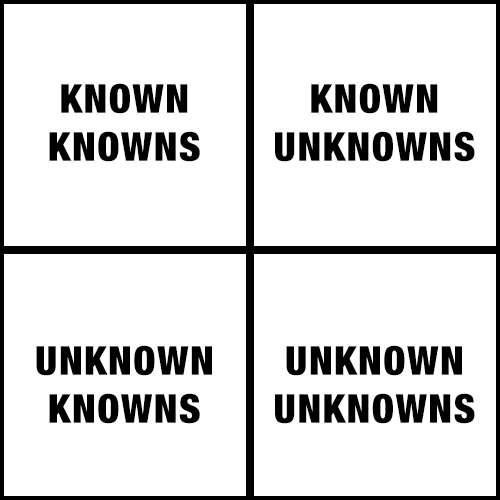
What am I going on about? Let’s look at what can be called a Rumsfeld square or Rumsfeld matrix. It’s named after Donald Rumsfeld, who famously said, “there are known knowns; there are things we know we know. We also know there are known unknowns; that is to say we know there are some things we do not know. But there are also unknown unknowns—the ones we don’t know we don’t know.” (Some people have characterized this as incomprehensible, but I have no idea what they’re talking about.) If we diagram it out in Greimas style, we see there’s a fourth square he doesn’t mention:

The existence of known knowns, known unknowns, and unknown unknowns implies the existence of unknown knowns. It’s right there. Yet people don’t seem to talk about them* – perhaps that’s why they’re unknown.

But the fact we have a space for them in the matrix doesn’t mean that they actually exist. Putting things into tidy diagrams and taxonomies can be rewarding, but it doesn’t necessarily add information any more than organizing your bookshelf adds information about what’s in the books. Mainly, it tells you about how your mind – and the structures it has learned – views and organizes things. But inasmuch as it describes aspects of reality, it may also be a heuristic for discovering things we aren’t aware of yet, or at least for knowing where to look for them – or, as the case may be, for becoming consciously aware of them.

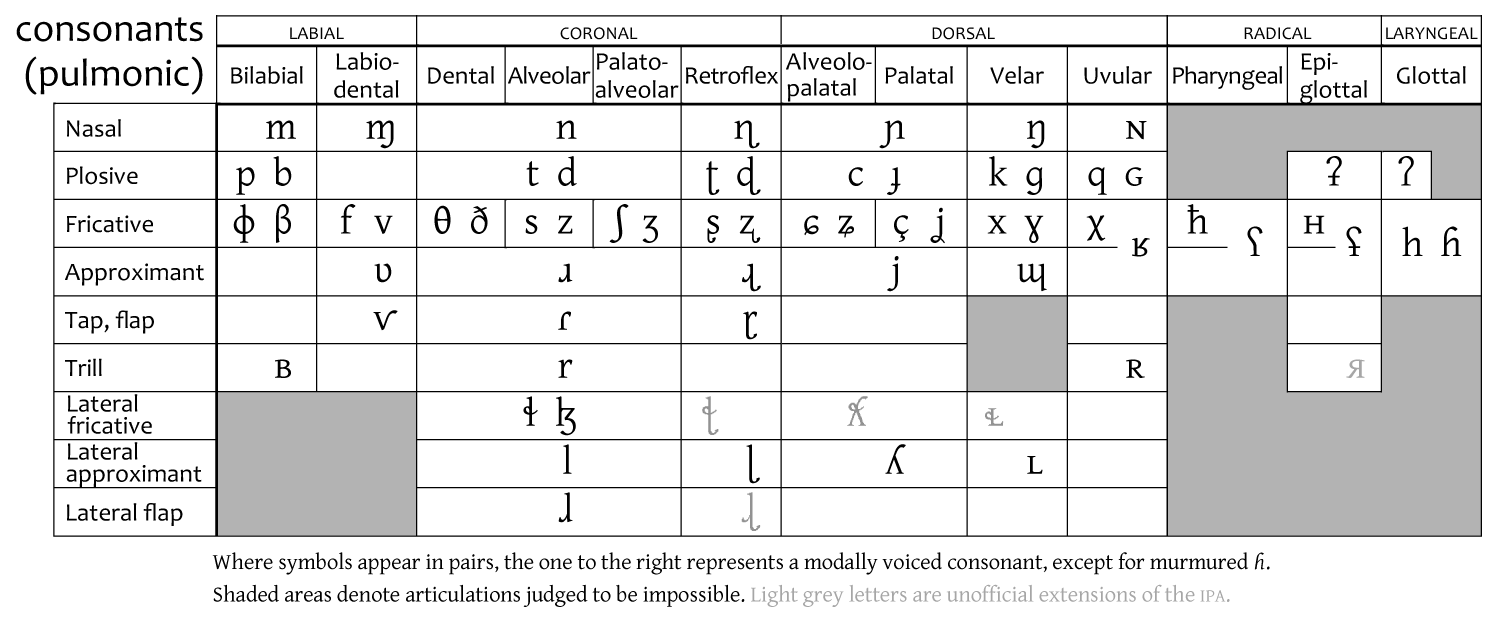
Linguistics is a great place to look for this kind of example, and I mean that in several ways. Here’s a table of the International Phonetic Alphabet symbols for consonants (thanks to Kwamikagami on Wikimedia Commons):

I won’t explain all the terminology because we don’t have all night. But you’ll see that this chart has grey areas: those are sounds that are considered impossible. A pharyngeal lateral fricative, for instance, would require having your something like the tip of your tongue stuck back deep in your throat – which, even if it were physically possible, would stimulate your gag reflex. So the grey areas help us confirm aspects of reality. They also force us to clearly define what we mean by our terms. For instance, “lateral” it means going around the side(s) of the tongue, like the sound [l]; a labiodental lateral fricative is impossible because it would require going around the sides of your tongue without using your tongue, because “labiodental” means using a lip and the teeth (and not the tongue). If “lateral” could mean the side of something other than the tongue, such as air going out the sides of the mouth while biting your lip, the labiodental lateral fricative box would not be grey.

But it still might be empty, like the labiodental trill, which is considered possible (I think it would take practice!) but no known language uses it as a speech sound. But look right above that empty box, and you’ll see the symbol ⱱ, which represents a labiodental flap: a sound you make by flipping your lower lip out brushing it past your upper teeth. That box was empty until fairly recently, when the people who agree on the chart were made aware of an African language that uses the sound as a distinct speech sound. 

In a way, an empty box is a challenge to fill it – just as a grey area is a challenge to prove it wrong, or to scrutinize the definitions. So these taxonomies help turn unknown unknowns into known unknowns, and sometimes eventually to known knowns, and they also help us understand how we know – but they don’t produce the data themselves; you still have to go find speakers of real languages for that. 

But our choice of what to include in the grid – what questions to ask – can still leave unknown unknowns unknown and unknown, and it can also divert attention away from known knowns. For example, there is no column for linguolabials (tongue and lip), which is altogether possible (you could do it right now: touch your tongue to your upper lip). In this case, it’s not because they’re judged impossible, nonexistent, or unimportant; it’s just that they’re treated as variants on bilabials and coronals, and so are represented with a mark under a letter: [n̼] and [l̼], for instance. They’re known knowns but more easily overlooked because they’re not given equal weight in the taxonomy – which effectively makes them lesser-known knowns.

But there’s one more thing that linguistics tells us about all of this. Every linguistics student comes in feeling sure they know all about the sounds we make in our mouths and how we make them, and every linguistics student comes to realize they were doing things they weren’t aware that they were doing. For instance, before I encountered phonetics, I knew how to say “pot” and “spot” like a usual English speaker, but I didn’t realize that, like a usual English speaker, I was making a puff of air after the p in “pot” but not so much after the sp in “spot.” Every introductory linguistics course has one class where the students are all holding their hands, or pieces of paper, in front of their mouths and discovering that they’re doing something that they know to do but don’t know they’re doing. This is was what is often called tacit knowledge.

In fact, most of language is tacit knowledge for most speakers. We know how to put together a sentence, but we aren’t really aware of how we do it or why some things sound right and others sound wrong. And we learn rules in school and think that anything that doesn’t follow those rules doesn’t follow any rules, when in fact “nonstandard” varieties of languages have grammars that are every bit as developed and constraining as “standard” varieties. 

Some of the things we learn don’t just block knowledge, they put in false belief in place of accurate knowledge. If you say “doin’” instead of “doing,” for instance, we typically say you’re “dropping the g,” but there is no g. The difference between those two consonant sounds – [n] versus [ŋ] – is only a matter of where they’re said in the mouth; it just happens that we don’t have a separate letter for [ŋ] so we write it as ng, which also sometimes stands for [ŋg].

That’s not just an unknown known; it adds a whole new dimension to the Rumsfeld square. As the popular saying goes (seen in many versions, and often inaccurately attributed to Mark Twain), “It ain’t so much the things that people don’t know that makes trouble in this world, as it is the things that people know that ain’t so.” But I’m not going to redraw the diagram with veracity versus delusion as another dimension right here and now, because that would be a very mentally taxing digression.

Beyond linguistics, and beyond tacit knowledge and knowledge blocked by falsehood, there are also other unknown knowns in life. I think of the time more than 20 years ago when I was looking for a job and a friend said a friend of his needed someone to do some proofing corrections on HTML. So I phoned the friend-of-a-friend and we chatted a bit and he told me to come in. When I walked in the door to the office, this person I had chatted with already on the phone looked at me, and I looked at him, and we both said, “I know you!” We had had a great long conversation at our mutual friend’s place at a party some months earlier, but had not learned each other’s full name, so when we were talking on the phone we didn’t know we knew each other. The knowledge wasn’t tacit, and it wasn’t blocked; it was transiently and accidentally obscured. (He remains one of my closest friends.)

And then there’s the Karate Kid kind of moment. In the first Karate Kid movie, the hero wants to learn karate, so he apprentices himself to an old Japanese man who makes him do menial tasks such as washing and waxing the car according to very specific instructions and painting the fence with exact strokes. When at length the hero complains that he hasn’t learned anything and is just being used for free labour, the master throws some punches at him, which by reflex he blocks using the muscle moves he had internalized through doing the scut work. He knew how to do it, but he didn’t know he knew. This, too, is tacit knowledge, but not one that had already been demonstrated, like speech knowledge; it was first manifest at the point of awareness.

That’s also how I learned how to do structural editing. I picked it up through researching and writing essays and through evaluating and grading very large numbers of student essays as a grad student and instructor. I wasn’t fully conscious of the sense of flow and structure and the intuitions I was developing, but when I first sat down to actually edit articles and books, I realized that I knew how to do something I hadn’t known I knew. Of course, once it’s a known known, it can be further developed – but I have to watch out that I don’t start misleading myself into “knowing” things that aren’t so!

And then there’s the ultimate unknown known: the “enlightenment” (satori, kensho) of Zen practice. If my sense of it from accounts I have read is accurate, it involves seeing the world and realizing that you always knew its true nature, but you just didn’t know you knew… because you were too busy putting it into boxes and matrices and categories and words. Which reminds us again that while logical deductions and categorizations can lead us to discoveries, they can also lead us away from them.

Unknown knowns are some of life’s greatest pleasures, its greatest serendipities. There are also, yes, great discoveries of unknown things you either suspected might exist (as a known unknown) or had no idea would be there like that (unknown unknown). But as T.S. Eliot wrote in “Little Gidding,” 

We shall not cease from exploration 
And the end of all our exploring 
Will be to arrive where we started 
And know the place for the first time.

In an important way, our lives are a course of coming to know ourselves and our worlds – of coming to know the things we had always known but had not been aware we knew. The unknown knowns.


* Well, Slavoj Žižek has – he has used the term for “the disavowed beliefs, suppositions and obscene practices we pretend not to know about, even though they form the background of our public values.” These are not so much unknown as “unknown” – we agree to pretend not to know them so as to avoid cognitive dissonance. He was responding to Rumsfeld’s use of the idea of unknown unknowns to justify attacking Iraq.

“Pay no attention to that man behind the curtain”

Originally published on The Editors’ Weekly, the national blog of Editors Canada

What’s missing from this sample text?

A set of subjects, n = 180, were surveyed using a predetermined questionnaire. Statistical analysis of the responses revealed a statistically significant pattern of association of low-frequency polysyllabic lexemes with greater intellectual value.

It’s not short on words, nor on syllables per word, nor on grammatical complexity. It’s an imposing and impressive display. But who chose and surveyed the subjects? Who predetermined the questions? Who conducted the statistical analysis?

It’s like the Great and Powerful Oz. You’re supposed to pay no attention to whoever’s behind the curtain, making it happen.

What you’re seeing is the effect of a language ideology, the ideology of objectivity – an underlying belief in the association between detachment and authority. It’s a belief that humans are messy, subjective bags of feelings, and that to achieve real, authoritative, reliable, unquestionable truth, you remove people: these facts were not worked out by fallible humans; they were just… revealed. It’s one reason so much academic writing is so hard to read.

It’s not the only reason, of course. There are other ideologies at play too. The effects of one of them are described in the example text above (not quoted from a real study, however): the ideology of mental effort. We know that complex ideas take extra mental effort, and so we assume that greater mental effort is an indicator of greater intellectual value.

Complex syntax is equated with complex thought, and, as the example says, long and uncommon words are associated with rare and rarefied ideas. If something is easy to read, how impressive can it be, really? And, more to the point, if you make the reader sweat to figure out what you’re saying, they might not notice that what you’re saying is really fairly trivial. Once again, watch the Great and Powerful Oz, and don’t look behind the curtain!

This is not to say that everyone who writes that way is consciously trying to be the Great and Powerful Oz. Most authors, academic or otherwise, write in a way that’s considered appropriate for the type of text, and questioning why it’s “appropriate” might itself seem inappropriate – isn’t it obvious that in a research paper you don’t say “really fun,” you say “highly enjoyable”? We seldom stop to look at what’s driving our assumptions about the intellectual value of the way we phrase things. The real “man behind the curtain” is language ideology itself.

But there is no language use without language ideology: we believe that certain qualities go with certain kinds of language. It’s part of how we understand language in its context of usage. And our ideas about language are always ideas about the people we envision using that language. We don’t all agree all the time; there can be competing ideologies, for instance, about whether colloquial speech is a mark of unintelligence or of honesty. But we never come to language without baseline assumptions about what it says about the people who use it – even if it’s language that pretends they’re not there at all.

And from time to time, we can all benefit from pulling back the curtain.

Rules and laws

For Grammar Day, I want to talk briefly about laws and rules, and the fact that some people who should know better get them confused.

Let’s start with laws of nature. Say someone holds a rock in front of them and lets go of it. It flies upward instead of falling. Do you say, “No, you’re doing it wrong – the rock is supposed to fall down”?

Then there’s criminal law. Let’s say that instead of dropping the rock, they throw it through a store window. You might say “Hey!”; a cop who is nearby might arrest them – or they might get away with it.

That’s sort of like the rules of sport. Say the person is playing football, and they throw a rock instead of a football – or maybe they just throw a football the wrong way. The player will get a penalty – if the referee sees it.

But how about the rules of grammar? Let’s say someone writes a sentence: “Person the throw rock football and window at.” Your reaction on reading it is probably something like “Huh? That doesn’t even make sense.”

So let’s say instead that the sentence is “Smashing a window, the person throwed rock and football.” If you’re like a lot of people, you’ll readily utter a correction of one or more errors, even if no one asked you to. You may also say something about the intellect of the writer.

The law of gravity, like any law of nature, doesn’t need anyone to enforce it. If you see a law of nature being broken, you’re wrong: either the law isn’t really being broken (it’s an illusion, or some other law is relevant) or the law as you know it is inaccurate or incomplete and your understanding needs to be revised.

Civil and criminal laws do need enforcement, because they’re human creations. Some of us may believe that laws are there to enforce laws of nature (or of God), but really at most we’ve just appointed ourselves to try and keep people behaving in accordance with our ideas of those laws, which is an us thing. Civil and criminal laws are like the rules of sports, but with broader application and stronger enforcement mechanisms.

And rules of grammar? Ones like in the last example, such as that it’s “threw,” not “throwed,” that you shouldn’t use dangling participles, and that you should be careful with definite and indefinite articles, are also like the rules of sports: in published texts, editors typically serve as referees, following specified style rules; in a broader social context, enforcement is mostly not formalized. The rules may have a certain tidiness, but that tidiness is not a natural law, nor is it inevitable – any editor who works with multiple house styles knows that.

But what about more basic rules of grammatical conmprehensibility, such as the ones broken by “Person the throw rock football and window at”? Those, too, are human creations – just at the level of social norms that we rarely stop even to inspect. Using the rules of some other languages, that weird sentence would be entirely coherent. English puts the definite article (“the”) before the noun, but Scandinavian languages tack it onto the end of the noun as a suffix. English can be very fussy with verb conjugations (“throw,” “throws,” “threw”), especially irregular ones, but other languages are less so, and some – such as Mandarin Chinese – don’t conjugate at all. English requires indefinite articles (“a rock,” “a football”), but Gaelic doesn’t, and Slavic languages don’t use definite or indefinite articles. And English expects “and” to go between the things it combines, but in Latin its equivalent can be tacked onto the second item, as in “Senatus Populusque Romanus” – literally “Senate People-and Roman” (in English, “the Senate and People of Rome”).

So, in short, the rules of grammar, even the most apparently essential rules, are not inevitable. Grammar, even the most fundamental grammar, is not a natural law; it is like the rules of a sport. The way you say a thing is not the one logical, inevitable, natural way to say it, even if – within the variety of the language you’re speaking – it’s the only “proper” way to say it. Even the idea that a double negative equals a positive, which seems plainly logical to modern English speakers, seems otherwise to speakers of languages such as Spanish or Italian, where a negative requires agreement (e.g., “No vale nada” and “Non vale niente”: “It’s not worth nothing”). After all, it can’t be a negative statement if it’s positive in some places. Logic!

But some people, even some otherwise well educated people, seem unaware of this. Editors and linguists are wearily used to people priggishly “correcting” them with simplistic grammar rules and ideas that they recall from school, as though those rules were basic truths like natural law. I’ve seen it even from people who have graduate-level educations and clearly ought to know better.

And why does it matter? I’ve written before about how this kind of dogmatic position is used to license social aggression (see What do we care about, really and Why all English speakers worry about slipping up), but the boorishness of grammar snobs is not the biggest thing. The idea that there is one correct, natural, logical grammar gives cover for not just class discrimination but also racism (because different social groups use different varieties of the language) and even sexism (in particular ideas about such things as pronouns and grammatical gender – I’ve given talks on this several times; a video of one time is at A Hidden Gender?). 

A person who understands the socially decided nature of grammar rules can understand that someone who’s using a kind of English that’s not “proper” is not inferior, and that different varieties of English are grammatically coherent even if they’re different from the schoolbook standard. Knowing this also broadens a person’s expressive repertoire.

Does all this mean that grammar is a free-for-all, or that there’s no point in teaching it? Of course it doesn’t mean that. We teach people about the rules of sports and the rule of law. We also teach people about dress codes – there are certain things you just don’t wear in certain places and occasions, not for any matter of intrinsic suitability (sweatshirts are no less functionally suited to formal occasions than tuxedos), but just because of the social implications they have come to have. Likewise, if you use a library, you learn how the books are arranged on the shelves, and it’s a tidy, systematic, enforceable order, but it’s not an inevitable one: the choice of Dewey versus Library of Congress, just for instance, will give quite different orderings. 

Tidiness can be good, and consistent, well-defined rules can be useful. I make a nice bit of money every year tidying up text. But rigidity and narrow-mindedness are bad. And believing that the simple rules you learned in your simple youth are the only true rules is a mistake that will limit your effectiveness – and, on the larger level, can limit others, and our effectiveness and potential as a society. Learn rules – as many different sets as possible – and use them judiciously.

Oh, and have fun.