conspectable

There are some things that seem so obvious. You look, and they’re there. They seem obvious to other people too. But obviously different from what you see. A different perspective gives a different conspectus. This does not conduce to consensus or common respect.

Words can be like that. We see the same thing (and hear the same thing), and yet they have different flavours for different people. This is why even onomatopoeia is still conventionalized. It’s also why a game like Balderdash can be the kind of fun it is.

I haven’t played Balderdash in years, but I remember playing it a few times when we lived in Edmonton. The game goes like this: for each turn, one person (a different one each turn) pulls a card and reads the uncommon word printed on it, and the players write down definitions. The first person collects them, reads each prospective definition (not in respective order) along with the real definition, and each other player guesses which one is right. Each vote your definition gets nets you a point. If you submit a definition that is pretty much the same as the real one, it doesn’t get read and you get two points.

One word I remember coming up was conspectable.

This word has parts that seem obvious enough to me: con, ‘with, together’, spect, ‘see’, able. I seem to recall I wrote a definition that was passably close to the real one and got two points. But what stands out for me is that one person’s invented definition was on the lines of “a policeman who goes around ensuring people respect each other.” A respect constable, in other words. A politeness cop, you might say. Someone who helps make sure people see it each other’s way, or at least understand one another’s points of view.

The definition given by Balderdash, as I recall, was (roughly) “visible from multiple points simultaneously.” Which really does seem obvious from the parts, doesn’t it? Just like the word itself: seen equally by all players, but seen from different sides. But those of us who grew up in the mountains know well that this does not mean the people are seeing the same thing. Seen from Exshaw there is a mountain we called Sproule’s Nose, after one of our teachers. Heading out of the mountains a bit east of Exshaw, there are two flat-faced mountains facing each other across the valley: Yamnuska on the north and Barrier Mountain on the south. It was years – honestly well into my adolescence, I think – before I realized that Barrier Mountain was Sproule’s Nose, seen from 90 degrees different. The flat face was the underside of the nose.

And some 25 years after conspectable came up in Balderdash, I find myself looking at the Oxford English Dictionary and seeing conspectable, with a obelisk on it (signifying obsolescence), two citations from 1727 and 1822, and the following definition: “Easy to be seen, obvious.”

The con, you see, is not the con in chile con carne. It is the con in conspicuous, confute, and convince, among others: an intensifier. It has the same origin, but Latin sometimes used prefixes such as per– and inter– and con– to mean ‘thoroughly’. Why use ‘with, together’ to mean ‘thoroughly’? For the same reason we use altogether, I rather think.

So. We all saw it. And it was obvious. I thought. Well, it was obvious. But as much as it can be seen from different points of view, it is not seen quite the same way. I was not conned by the contradiction; it was beyond my control. I just hope that, having inspected the difference, we can respect it.

nifty

You know what’s nifty? This word.

OK, OK, but seriously: a word like nifty is a nifty thing. Toss it in and you get just the right feeling – it’s a nifty little language trick. It doesn’t have any obvious relation to other words, and it doesn’t get used all that often, but it just fits neatly in its niche.

Its niche, for its users, is largely defined by the words it’s most often seen with: according to the Corpus of Contemporary American English, these include little, trick, features, pretty (as in pretty nifty little trick), gadgets, stuff… You notice the tone and usage context of these words: not exactly formal; more endearing, fun, like things you use to charm a person (e.g., yourself) into buying a thing. Its synonyms (thanks, Merriam-Webster) include boffo, choice, crackerjack, groovy, jim-dandy, keen, neat, primo, righteous, swell, top-shelf, and a number of more formal words up to and including supernal (which might be a bit strong and self-regarding, to be honest).

But where does it come from? Hmm, that we don’t know. Its first published use – in 1865 – declares that it comes from Latin magnificat, but that is, as the Oxford English Dictionary puts it, unlikely. More likely it has influence from the sounds of other words: natty, thrifty, spiffy (and perhaps the nif in magnificent); it has a nice lift to it, and though it may have some sounds of iffy and shifty, that neat nose of an n seems to set it up more nicely and endearingly. The /ɪ/ vowel is high, but not as high as /i/, so it’s small and sweet but not saccharine. The /ft/ is a soft touch, of course, and the y suffix adds a bit more diminutive potential. So it’s niftily put together: a clever little lexical doodad that serves the turn, not just denotation but connotation and a certain sense of fondness.

The ensemble of it may seem almost more to match style than substance: not so much intelligent as fashionable. Fair enough; although it has meant ‘ingenious’ for a long time, its first sense was ‘stylish, attractive’, a sense it has retained in some quarters up to the present. So you can call someone’s bowtie nifty and mean that it is pleasing to the eye or that it is stain-repellent and doubles as a beer opener. Either way, it’s smart… at least in the eyes of certain beholders.

Wines, the world, and so on

I love wines. Especially good ones. From all over. Aina and I go on trips just to taste wines. My serious wine education started when I was 19 (thanks, cousin Sharon). For the past 16 years I’ve edited the website of Tony Aspler, Canada’s wine guy, and that was where I got the idea of doing word tastings.

So, naturally, when I got the opportunity to write an article for a travel website about wines to choose for a starter wine cellar, I very happily took it. And I sure enjoyed writing it. Here it is. If you don’t enjoy reading it, have a glass of wine and try again (I recommend a chilled sparkling wine – a blanc de noirs from Champagne if you want to spend the money, or a Gloria Ferrer from Sonoma, or a crémant de Loire or, heck, why not Seaview Brut?).

The world in your home: How to build the ultimate international wine collection


Squamish

On a scale from squamous to squeamish, how would you rate Squamish?

Do you know where it is? Or what it is, even?

For me, Squamish is where you can buy Whistler day passes at a discount and get your coffee on the way. For at least one person I know, it’s where Quest University is. For a lot of people, it’s the midpoint between Vancouver and Whistler: It’s at the north end of Howe Sound on the Sea to Sky Highway.

But what makes it stand out is not Howe Sound but how it sounds. It doesn’t have the V-neck verve of Vancouver or the crisp sifflation of Whistler. It has the sounds of squat and squeamish and qualms and a balance of the scaly words squamous and desquamation and such like. And it sounds so wishy-washy at the end, not firmly squam but just squamish. If it were an English word, it would likely have flabby, queasy connotations.

But it’s not an English word. It’s a rough rendering of the name of a Coast Salish people, more accurately written Skwxwú7mesh. What’s that 7 doing there? It represents a glottal stop. And the w’s represent rounded labial coarticulation of the previous sound. And the x represents a voiceless velar fricative. For those who are squeamish about all of the foregoing, you can click and hear it pronounced at the beginning of https://en.wikipedia.org/wiki/Squamish_people.

So the town is named after the people, but in a somewhat desquamated version. But what about the townspeople? Members of the Squamish tribe are Skwxwú7mesh, but that’s not who lives in the town. It’s full of the same sort of people descended from invaders and immigrants that make up most of the population of Canada. And what do they call themselves?

It turns out that this has not been firmly decided. Eva van Emden sent around the results of a poll of residents by the local newspaper, choosing between four options: Squamites (31%), Squams (13%), Squamcouverites (8%), and Squamptonians (48%). It seems the echo of the Hamptons is pleasing, although perhaps it’s more an echo of Compton, given the vowel rhyme; Eva notes that there are local bumper stickers and T-shirts that refer to Squampton. I note that Squamians was not on the list of options. Wikipedia lists two demonyms: Squamoleon (with a source request on it, meaning Is this for real?) and Squamite. The ite ending seems quite popular in western Canada; I know from my own youth that people from Banff are Banffites and people from Canmore are Canmorites, and although quite rationally people from Exshaw ought to be Exshavians, they most certainly are not: they are Exshawites, which doesn’t look very good on paper – you do not pronounce the w in it.

At any rate, although the sound associations may not be great for the average Anglophone, and although for many a tourist the town is a sprawl of stores and stoplights along the highway, those who live in Squamish seem enthusiastic: Squamsome! can be seen on promotional material.

And what about members of the Squamish people? We ought to call them Skwxwú7mesh, of course, although few of them speak the language anymore, thanks to the dominating effect of English. They have been an important presence from Vancouver through Whistler and beyond. It’s all on their traditional territory, seized but unceded. There are fewer than 4000 of them now, and little of the land is allocated to them, though their culture persists. But in the grand tradition of naming places after whatever or whoever was displaced to make way for what’s there now, we have not only Squamish but also various places named after Joe Capilano, whose Capilano is from a Skwxwú7mesh toponym, Kiapila’noq.

Omitting periods? It’s about genres.

Originally published on The Editors’ Weekly, the national blog of Editors Canada.

Period. Full Stop. Point. Whatever It’s Called, It’s Going Out of Style,” declared a New York Times headline. Noted linguist David Crystal had made some comments noting that the period is not requisite in text messages, and as such is used only “to show irony, syntactic snark, insincerity, even aggression,” as article author Dan Bilefsky paraphrased Crystal. From this, Bilefsky – who, just to be cute, left the period off the end of every paragraph in the article – drew the conclusion that the period is going out of style in English generally. As did (obviously) the headline writer.

Which is rather ironic. Tell me: how often are periods used at the ends of newspaper headlines? (Rarely, in case you’re not sure.) And yet this insistent omission has not, over the course of the past century, ushered in the demise of periods in the language generally, or even in newspaper articles in particular. (Bilefsky’s is an ostentatious exception, but that is not because its headline doesn’t end in a period.) Nor has the programmatic omission of forms of ‘be’ in headlines led to their omission elsewhere, although they are left out in other forms that are equally “telegraphic” – for the same reason: economy of space trumps smoothness.

And there is the point. Not all occasions of use of English (or any other language) are the same. Different occasions of communication for different purposes use different components, structure, vocabulary, grammar, and – yes – puncutation. In short, different purposes use different genres. Of course they do! You don’t write a shopping list like a personal letter (“Dear Me: It has been a while since I’ve been shopping, hasn’t it? Could I by any chance manage to pick up some eggs, milk, onions, celery, and fenugreek? That would be splendid if I could. Thanks so much, Yours, Me”). You use what you need, add things as befits the occasion (for politeness, clarity, ornament, what have you), and leave things out for the sake of effect or efficiency.

And if you have declared a particular item unnecessary for the run-of-the-mill functioning of the text, you have it available to use for special effect. Your full name on a government form is a simple requirement of the genre; your full name when spoken by your mother is not required, so it can carry a connotation of concern or disapproval. Poetry, with its line breaks, has less need for capitals and punctuation, so their use and omission can have stylistic significance.

And so it is with periods in text messages. As they are superfluous to the needs of the genre, they have gained expressive potential. Since a simple “end of message” is conveyed by (wait for it) the end of the message, a period can be extra firm, pointedly conclusive. Wilf Popoff has recently given us some instruction in this and similar details of the text message genre, and Frances Peck has addressed the related sub-genre of email salutations. These genre-specific recastings of pieces of punctuation are not losses to the language or even the genre – how can an increase in expressive potential be a loss? But it is also unlikely to spread to genres that need periods to separate sentences in paragraphs, such as the body of news articles… even if it has long since been a feature of headlines.

The Donald: The podcast

You may recall that I recently wrote an article on Donald Trump’s language techniques. We’ve made that into a podcast now, so you can listen to it rather than just reading it – if you can stand the sound of Trump’s voice.

How Donald Trump hypnotized America


deuce, trey

Now, where the deuce is that book? I want to blog about it. Did I lend it to someone? It’s a hardcover, so it should be on the top shelf…

Ah, wait. Let me turn this pile of books aside for the reveal…

Can you quite see it? There are two books side by side there that are my own copies of books I first discovered in the Banff Public Library when I was a youth and spent much enjoyable time sitting in that glorious wood-and-carpet high-ceilinged room reading (the library has since moved and the building it was in is now a museum).

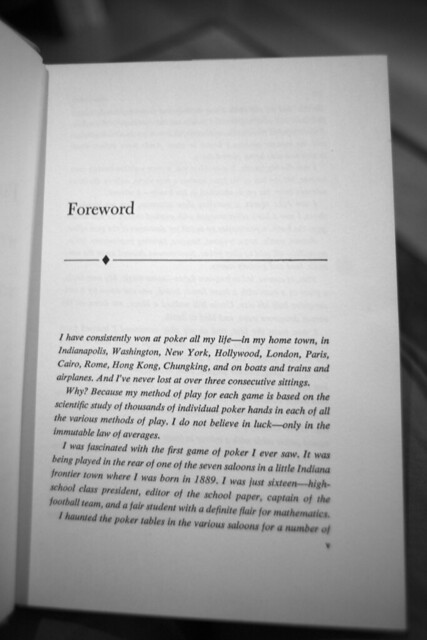
Not the Machiavelli book – that was grad school. No, both of these books promise knowledge unknown to most but valuable to initiates. Secrets arcane and possibly even a bit louche. For one of them, the time and place I got my copy is a forgotten secret. For the other one, I happened to remember it one time maybe a decade ago, and so I decided to look in the used bookstores here in Toronto for it. The first store I went into was Ten Editions, on Spadina not far south of Bloor. I walked in, looked for the relevant section, and there it was.

I mean, talk about luck.

Frankly, the odds of just walking into the first store and finding a nice copy of this 1957 book waiting for me were surely a bit less than the odds of filling a full house by drawing a three-of-a-kind to a pair of deuces.

Full houses have cost me a fair few dollars over the years, too, I should say. Even ones that I was holding. (When you have a full house in Texas hold ’em, the odds of someone else having a better full house or even a four-of-a-kind are better than you might think.) This book, on the other hand, cost me $15. It’s written in pencil on the flap.

Poker, by the way, is a game of chance in about the same way as Scrabble is a game of chance. But most people don’t bet on Scrabble. Poker is only a game of pure chance if you’re not a very good player. Being a good poker player isn’t just about knowing the odds. It’s about knowing the people. It’s about thinking about what they’re thinking. This is similar to the advice I used to give when I taught test prep for the SAT, GRE, LSAT, and GMAT: think about what the test takers are trying to make you think. Get inside their heads.

Who is this Herbert O. Yardley, the author of this book?
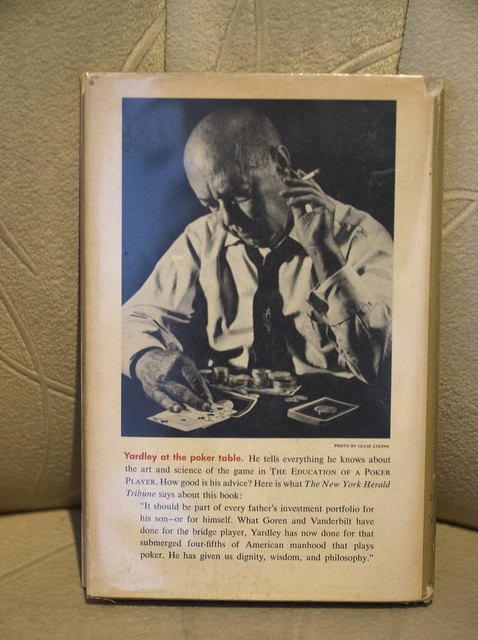
If you looked at the smaller print on the front cover – which you would have had to click on to see in a larger version – you learned that he was a cryptographer. He cracked secret codes governments were using. You have to be smart to do that, but you don’t do it just by being a mathematician. You do it by thinking of what the other guys are likely to have been thinking of. And that is what makes a person good at poker.

What makes a poker book good reading, on the other hand, are good stories.

Of course, many people – including some of my relatives when I was a kid and (I think) even now – consider cards to be instruments of the devil. And gambling? Entirely unacceptable, sinful, satanic. (Let’s not go into how much of their retirement savings depend on the stock market.)

But if you like to figure things out, and you like to find out more about things you’re not supposed to know about, and louche things maybe attract you a bit as long as you’re not in danger… poker has a certain appeal.

It also has a certain vocabulary.

Some of them are for kinds of sets of cards (“hands”) you can have. A straight is five cards in numerical sequence, regardless of the suit. A flush is five cards of the same suit, regardless of the numbers. (If two people have the same kind of hand, though, the one with the highest card wins.) A full house is a pair and a three of a kind (e.g., two jacks and three 7s). A straight flush is a straight where all the cards are the same suit. A royal flush is the highest straight flush. In all my years playing poker, I’ve seen a royal flush in actual play exactly once. It beat a full house.

Some of the words are for cards. Ace, king, queen, jack, sure, you know them. The ace can be the lowest or the highest card, depending on the game. But there are two other special words for low cards. One is common; the other is not often used.

A trey is a three. It comes from Old French trei (standard modern French is trois), and is of course related to Italian tre and Latin tres. It is not commonly used by poker players now, but in Yardley’s time and place (early 1900s Indiana to start with), it was the standard term. Not that having a trey would give you anything on a tray, silver or otherwise. A trey isn’t even worth a try. If you have three treys, well, you have a three of a kind, and that will win often enough, but watch out.

A deuce, on the other hand, is always a deuce. In poker today you may well call a trey a three and you will be like everyone else, but if you call a deuce a two you are probably either naïve or joking around.

In general, a deuce is of no use. A pair of deuces has insufficient uses. Three deuces is a three of a kind, which will beat anyone who has a pair or two pair, but is otherwise the crappiest halfway decent hand. Four deuces is a four of a kind and will win almost all of the time, but you will almost never have it. Especially if you’re playing a version of poker where you start out with two cards and more are dealt after, because you’ll be building it from a pair of deuces, which is a hand you should fold unless you’re eager to give someone else your money.

You can also have a deuce in dice – the side with two spots on it – which is either fitting or ironic, etymologically. You see, dice is a singular that was reinterpreted as a plural and had a singular die backformed from it, while deuce is respelled with a c from earlier s: Old French deus (modern French deux). Not that it was a plural (aside from two being dual), but it is a movement in the other direction.

In tennis, if you have a deuce, that means both players have reached 40, which is really just 3 points – 15, 30, 40 – but it’s not a trey, it’s à deux, a deuce, and one of the players has to win by two more points.

And if you have a deuce coupe, that means you have a souped-up two-door car. Deuce because two doors.

It’s funny that deuce comes from Old French deus. In Latin, deus means ‘god’, while in English deuce is also a word for the devil. You may even have seen, in some older novel or play, a line such as “To the deuce with you!” This does not consign a person to a losing poker hand. Well, not directly. Its use for ‘devil’ came from its use for ‘mischief, plague, misfortune’, and that in turn came from… hmm, we’re not entirely sure, it’s the most deucèd thing… but it seems to have originated (in English or another Germanic language) in the deuce being the lowest card.

By the way, while Benito Mussolini may have been a devil, his nickname Il Duce does not come from deuce or a related word. It means ‘captain’ or ‘leader’ and comes from Latin dux, from duco ‘I lead’. Now, yes, depending on the card game, you may lead with a deuce, but in poker, a deuce is more likely to lead you to loss of money. But, hey, you gotta pay your dues one way or another. Just don’t reduce yourself by chasing deuces again.

melliloquent, melliloquence

Sweet words butter no bread. But they may put honey on your crumpets, and isn’t that even a little bit better?

Who doesn’t want to have a bit of blarney, a silver tongue, the power to charm with shimmering lexis and lithe syntax? Well, I guess some people don’t – there are those who pride themselves in being plain-spoken. But even plain speech can have the power of persuasion, and some of the sweetest words are direct and unadorned.

What, in fact, is the key characteristic of honey-tongued speech? Is it apposite use of adjectives and epithets? Is it careful control of the phonemes and rhythms? Is it striking use of imagery? Is it flattery of the addressee? Which of these is the sweetest sentence: “The sight and sound of you pulls me like iron filings to a rare earth magnet”; “You are a cross of the best parts of Cate Blanchett and Jeremy Irons”; “Your clothing caresses the eyes and your speech is a fabric of electric sparkles”; “You are visually elegant and orally melliloquent”?

I’m sure it comes down to taste. Not even everyone likes the taste of honey, for that matter. But this is about melliloquence, and the mell in there refers to honey, just as it does in mellifluous. In English it also has an echo of mellow, which smooths it out like oak aging, but that is an etymologically unrelated word. So is marshmallow, but sweet soft words can be as marshmallows to the mouth and ear. And somehow we overlook the overlap with smell.

If you ask people what the most beautiful words are, some will choose words with beautiful senses, but others will hew towards certain sounds. The sounds typically lean in the same direction: flowing vowels, nasals, a few soft voiceless sounds, and especially the liquids /r/ and /l/. Add the crisp whisper of voicelessness and the ll of Welsh is a sure-fire charmer, but we in English don’t have that phoneme. It’s no great surprise that Tolkien based his two Elvish languages on Welsh and Finnish (see namárië). I recall one person’s list of the most beautiful words – well, I recall two of the words it included: Shenandoah (a popular choice, I think) and diarrhea. Which does have a nice sound to it, the word I mean; its denotation detracts a bit much for many people.

A word that was not on the list was melliloquent. I feel confident that this was at least in part because the author didn’t know it. It is a beautiful word, isn’t it? It starts with that soft, warm nasal, and then flows through parallel liquids; a crisp stop in the back moves into a glide, then another nasal and a stop. On the page it has those stripes llil and it is such a nice long word. And it means something so nice: sweet words, honeyed speech. Who doesn’t like to hear nice things? Well, I guess some people don’t, or at least not invariably – some dislike hearing good things about competitors, and some are uncomfortable with receiving praise, even though to others compliments are the ultimate honey (entrappingly so – even more than a spider’s web, honeyed words lead to the undoing of many flies).

I suppose the ultimate melliloquence would be words that have all of the above: praise, strikingly beautiful imagery, evocative and novel vocabulary, and an exquisite ensemble of sounds. And, of course, sincerity.

I hope you weren’t expecting an example. I kinda suck at that stuff.

Anyway, different people like different things. I’m sure each of you has encountered examples of exquisite melliloquence. I won’t mind hearing of any that you might recall.

teem

There are many different things one can taste, and many different ways of tasting them. When you taste wine, some wines give you all they’ve got right away: you may love it or you may hate it, but if you taste it again and again and again, you will get the same thing every time. Other wines give you something new with every approach: Yes? Ah, plums, leather. Yes? Ah, blackberries, blueberries. Yes? Ah, coffee, and that girl you used to know. Yes? Tannins around your tongue like a ring of soft thorns. Yes? A line of bittersweet down the middle like a stripe of chocolate. Yes? A 20-year-old bomber jacket. Yes? Your grandmother’s bookshelf. Yes? That one Christmas in the country. And so on.

Words are like that too. Some – typically ones of which you have less knowledge and ones that connect to less in your life – don’t bring a whole lot. Some bring so many things they’re like the grey murmur of a large crowd in a swimming pool. Some connect to a few things, then a few more things, then a few more. They are doors to libraries; they are Proustian madeleines.

Pictures can be like that too. I like photography, and I try to get photos that engage the eye, that bring a moment or a clear tidy story. But I also love photos that you can spend a lot of time looking at and digging into. Photos that you really have to see in magnification to catch every detail. And yet that you have to see in one broad view to get a sense of the structure, the occasion. Imagine if the events of a novel were laid out before you in the dimensions of space all at once, rather than along the line of time, and you could wander through them and look here, look there, look in different orders. Or imagine if it were not about one person’s narrative but about all the things that occur in a place at a time. This is a picture that teems with detail, information, events.

We all know some paintings and drawings like this. As children, we may have looked at Richard Scarry books. We may have gone on to spend endless time with Where’s Wally books, not only looking for Wally but enjoying the endless little actions and interactions Martin Handford put in. As museum-going adults we may have gone swimming in paintings by Hieronymus Bosch and Pieter Brueghel the Elder.

The Germans have a word for such pictures: Wimmelbild. I have been made aware of this word by Ming Thein, an excellent photographer and blogger. Read his article (it’s in English, don’t worry) and look at his photos at https://blog.mingthein.com/2016/06/24/wimmelbild-im-fotografie/ . No, really, read it. I consider it required reading for this. Do it now, then come back and continue.

Wimmelbild is a German word made from two German words: the verb wimmeln and the noun Bild. Bild means ‘picture’; wimmeln means ‘teem’.

Teem. This is a word that teems with meaning and overtones. It is more than one word, even. Of course it sounds like team – and team comes from the same root, etymologically. Team is a word for a group or set or lot of people; teem is a verb for a lot of people, or a lot of things. Or a lot of rain. If something is teeming, it is abounding, overflowing, florescing, crawling with… or pouring with so much rain the drops are like avid army ants by the billion. And that is the other root: the abundance sense comes from Old English teman (with a long e), which also gives us team; the rain sense, which also has a related sense of ‘pour’ as in molten steel, comes from Old English temen (with short e’s). The two have converged; history has led them to meet.

I do not like being in crowds. But I esteem that which teems when it is a thing I can examine at length and leisure. A crowd like a cloud of steam, perhaps, each individual like a droplet in its own path, meeting other droplets backward and forward, all viewed frozen in time or at a comfortable distance. Or any picture that you need to click on to go to the full-size version that you can inspect at length. Perhaps a sweeping array of roofs.

Or a crowd in a square.

Or a crowd in an art gallery full of paintings of teeming crowds.

Or a rink full of skaters in motion, Heisenbergian in its denial of fixed detail for those that are moving, and denial of movement for those with fixed detail.

Or perhaps even just an evening scene of diners on a patio. Does this teem enough? So many stories, moments, invitations to look and read and speculate.

Or flowers and leaves, a symposium all posing and peering at you peering at them.

Or windows – a building side of windows, each with its own life. I would like a wall-size photo of a building side of windows that you could peer at closely almost like an Advent calendar, the prizes being the lives and stories within.

Or people arrayed across a beach. Perhaps an assembly stitched from several exposures – can you see where the same person appears twice? Who is with whom? What will come next? Don’t forget to click to see the full-size view in all its megapixels!

Or books. A whole library of books. Spines with names. A universe of universes. A team of literature, a teeming of literature, an esteeming of literature.


aperture

The dimmer the light, the harder a time I have of seeing things. I spent nearly half an hour trying to find this book.

Can’t see it? Let me sharpen things up a little.

Still can’t see it?

Neither could I. I knew where it was supposed to be but… Turns out it was between the Bernini and Holzer books. Behind the Doonesbury box set. Bottom shelf, near the post.

Here, this book. Photography with Large-Format Cameras.

I’ve set it on the futon in our guest room. Let me sharpen up more of that for you.

It’s a book I “borrowed” from my dad. It covers clearly but in good detail the optics of cameras, and notably of large-format view cameras – cameras that allow you to shift and tilt the lens. I don’t currently own a large-format camera, and I can’t afford the time or money to use one either. But an understanding of the principles is valuable to any photographer’s understanding of the technical details of photography.

The reason the second picture has more in focus than the first is the same reason I see more sharply in brighter light (as does everyone, but you notice it more when your eyes have a more limited focal range). It’s also why people sometimes squint to see more sharply. It’s something mentioned on page 9.

Closer…

Can’t see which word I have in mind?

That isolates the subject a bit more, doesn’t it?

Aperture. From Latin apertura, from aperire, verb, ‘open’. An aperture is an opening.

We’re always looking for an opening, right? And we always want to keep our eyes wide open for one?

In a camera lens, the aperture is a roughly circular opening in the middle that constrains the light coming through. It keeps it within a certain distance from the exact middle point. The bigger the aperture, the more light gets through, but the less precise the light that gets through. Any part of the picture that isn’t exactly in focus gets even less exactly in focus, so that you notice the blurriness more and can make out the details less. In technical terms, the circle of confusion is larger for any given distance from the plane of exact focus. (This means what should be a dot is a circle due to the imprecision of focus at that point.)

Paradoxically, when there’s less light let in, you can see more details of more things (the circle of confusion is closer to being a dot); you can make out the foreground and background in more detail too. Just as long as you expose for longer or increase the sensitivity to make up for the reduced light level. But you have to watch out: when you increase the sensitivity, you can lose detail through noise – from overinterpreting the limited light that comes through. And if you narrow the aperture too much, diffraction effect starts to reduce the sharpness of everything. It may be in equal focus, but it’s in equally iffy focus.

When everything is in sharp focus, nothing stands out as much. The constraint of a narrower aperture is great when you have a lot that you want to be equally in focus. There is less “confusion” but less differentiation. When you want to isolate something more, draw the eyes to it, de-emphasize the less important parts, you don’t want everything in equal focus. You open up the aperture and the field of acceptable focus narrows down. The more wide open your pupils are – or the diaphragm (iris) on your camera lens – the more clearly one thing stands out and the more the rest is blurred out, confused. It allows you to focus on a pertinent part, whatever appertains most… or, if you mishandle it, to single out something malapert, to let it erupt at the expense of the broader parts. We can be enraptured by it… or trapped.

On a camera, you can control the aperture: let in as much light as possible and one thing stands out, or restrict the light and make more things come into focus. With your eyes, it’s involuntary (aside from what you can achieve by squinting). The brighter it is, the more your pupil contracts, the more things are in sharp focus. The dimmer the light, the more your pupil dilates, the fewer things you can see clearly and the more just a little bit stands out. And not necessarily the bit you want.

So yes, in a way, we are looking for the right opening. But we don’t always want to keep our eyes wide open. Or our lenses. Sometimes, yes. But let’s keep our options in sight.