So it goes

This is my third sentence tasting. Shall I write a book of them?

Kurt Vonnegut survived the cataclysmic firebombing of Dresden, at least one suicide attempt, and seventy years of smoking, and then fell down in his house and died from brain injuries. So it goes. He wrote fourteen novels, almost all of which I read when I was younger, and some large number of short stories, most of which I have not read. In his fiction he suggested numerous epitaphs for his various characters and for himself, perhaps the most famous of which was for Billy Pilgrim in Slaughterhouse-Five: “EVERYTHING WAS BEAUTIFUL, AND NOTHING HURT.” It was a lovely lie. Other people have that epitaph, thanks to him. They are also dead. So it goes. Many people think Vonnegut’s grave has that epitaph. But no one (except, I suppose, his family) knows where he is buried, so it’s probably not true.

Kurt Vonnegut’s most vaunted novel is Slaughterhouse-Five, which features an awkward man named Billy Pilgrim, who, like Kurt Vonnegut, survives the firebombing of Dresden in 1945, and, unlike Kurt Vonnegut, as far as I know, is later abducted by space aliens from Tralfamadore and spends some time in a zoo on their planet and learns that time is not a one-way trip. The book ends like this: “One bird said to Billy Pilgrim, ‘Poo-tee-weet?’” The bird says this because, as Vonnegut says early in the book, “Everything is supposed to be very quiet after a massacre, and it always is, except for the birds. ¶ And what do the birds say? All there is to say about a massacre, things like ‘Poo-tee-weet?’” The bird says that because it is in Dresden just after Nazi Germany has surrendered, but also because it is a bird and that is what it says.

In Slaughterhouse-Five, Kurt Vonnegut says the book “begins like this: ¶ Listen: ¶ Billy Pilgrim has come unstuck in time.” This is not true. I can say that it is not true because Kurt Vonnegut says that before the book says that, which means that the book says the book says that before the book says that, although in saying that it says that it also says that, which is like coming unstuck in time. But I can also say that because there is a whole chapter before the book says that, and almost a whole chapter before the book says that it says that. And that first chapter begins “All this happened, more or less.” It’s an introduction, not part of the story as such, but it’s there, and it’s chapter number one. And Kurt Vonnegut himself appears in cameos later in the novel, so it’s in-world.

There’s one other thing that the book says, which means Kurt Vonnegut says in the book, over and over again, and that one thing is the sentence I am looking at today, the sentence that is the title of this article: “So it goes.”

Continue reading
bubble wrap

In 1960, a company formed that would change the way we pack things.

In 1957, Alfred Fielding and Marc Chavannes tried to create a three-dimensional plastic wallpaper. At some point they realized that it was better for other purposes, and in 1960 Fielding co-founded Sealed Air. And in the intervening six decades, millions of porcelain figurines have survived thanks to them, millions of people with excess nervous tension have found an outlet through popping plastic bubbles, and millions of other people who happened to be sitting near those millions of people have found a cause of nervous tension.

In general, December is a bumper month of bubble wrap, although in 2020 every month is a bumper month of bubble wrap. It’s true that many companies now have more sophisticated means of packing, but if you’re shopping on eBay or Etsy, bubble wrap is still the thing you look forward to seeing (because if it’s not bubble wrap, it’s either newspaper plus broken porcelain or it’s foam popcorn and Hell). I have bought numerous old camera lenses on eBay (numerous, I say), and nearly all of them have come wrapped in a volume of bubble wrap equal to or greater than the volume of the lens. There is a certain pleasure in cutting through the tape with a utility knife and peeling away the bubble wrap to reveal the beauty within. At times, however, there’s a bit more cutting and peeling than I really feel is necessary.

Some people do use too much bubble wrap. And it’s not free like air, you know! One time when my family were moving we had some people helping us move, and we noticed how a whole (not cheap) roll of bubble wrap we had bought had gotten used very quickly. When we unpacked, we realized why: someone had used the entire roll to wrap one lamp and put it in a big green plastic garbage bin that we were also moving (don’t ask).

Bubble, by the way, is an old Germanic word that you can also see in languages such as Dutch (bubbel) and Swedish (bubbla). Wrap may also be an old Germanic word, though its origins are little less clear; it may be related, way back, to warp and to Latin vertere, source of divert and pervert.

But, speaking of words… there is literal bubble wrap, and there is verbal bubble wrap. And notwithstanding that verbal bubble wrap is fun to say, what it names is less fun to read, especially when several layers obscure one source of illumination.

We all use it sometimes, verbal bubble wrap. It’s that excess verbiage that we use to cushion the impact of something we would otherwise think too sharp or too fragile or too exposed. It’s so much reused wallpaper. Like this:

There are, of course, as we all know, times in a person’s life when they feel unduly vulnerable, when something just happens to strike them a certain way, a combination of the moment and the mood and their place in life and the various stresses they encounter. We all have surely had a moment of this sort at one time or another, or at least something approximating it. I at one time when I was in university found myself, on a foggy evening when I had been out for a walk by myself and was feeling in some way moody or vulnerable, looking up at a single red-lit window in a church belfry and being moved towards tears, and perhaps I shed a few before moving on. I don’t mean to say that this was truly significant, but somehow it felt that way to me.

When we encounter literal bubble wrap, we may want to pop the bubbles, and when we encounter verbal bubble wrap, we may similarly want to let the air out of this or that little bit of it. We might take “There are, of course, as we all know … stresses they encounter” from the above and turn it into “There are times for all of us when we feel vulnerable.” But the thing about popping bubble wrap is that when you’ve finished popping it, you still have all that plastic in the way, and it’s even less likeable. Instead of popping it, just peel it away and set it aside, and you will get what’s within:

Once, on a foggy evening when I was a university student out walking alone, I looked up at a single glowing red window in a belfry and burst into tears.

Literal bubble wrap is useful, because you don’t want to the mail to deliver broken things that don’t work. But verbal bubble wrap is seldom of any value, because what makes stories work is brokenness.

wedding

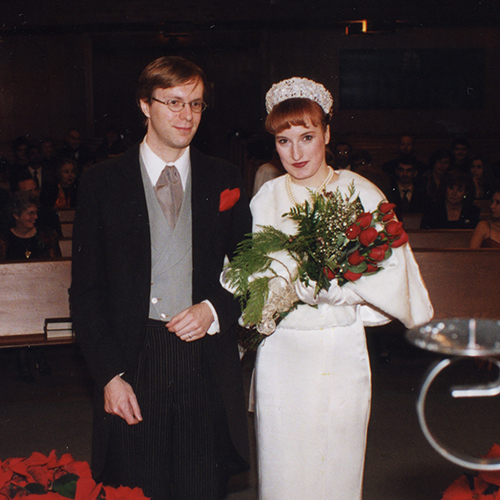
photo by John Flanders

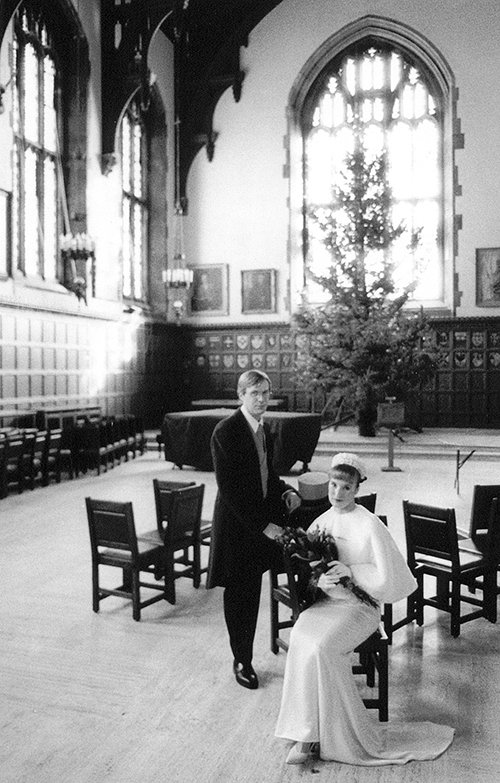
On December 9, 2000, I wed Aina Arro. We said to each other “I plight thee my troth” and assorted other things, did the necessary paperwork, and officially began our life together. I sure am happy we did that.

Wedding is the gerund of the verb wed, as in “With this ring I thee wed.” It’s been in English as long as there has been an English for it to be in, and it has relatives all throughout the Indo-European language. It traces to an Indo-European root meaning ‘pledge’. It became Latin vas, ‘surety’ (or ‘bail’). It became the modern Irish noun feidhm, ‘function, use’ (pronounced like “fame,” which has its uses). It went into Balto-Slavic languages meaning ‘lead’ and became the modern Latvian verbs vest, ‘lead’, and vadīt, ‘drive’; Aina’s mother is Latvian, so she would know both of these (and on the one hand, Aina leads me well, but on the other, although she is a very driven person, she has not driven a car even once in more than 20 years). It made it into French as gager, ‘guarantee’ or ‘wager’, and that is also the source of English engage. It also came down to English as wage and wager – and into Dutch as wedden and German as wetten, both meaning ‘bet’. And I am happy to say that getting engaged to Aina was a worthwhile wager, and it has paid good wages.

Wedding, by pure coincidence, is also the name of a district of Berlin. It’s not related. I don’t think we visited it when we were in Berlin.

A wedding is a lovely occasion, both solemn and joyful, expensive and gainful, sober and utterly intoxicated. Quite a few years ago, when Aina and I had been married a mere three or four years, someone I knew asked about readings for weddings. Various ones were suggested, some good, others impossibly idealistic and fraught. I decided to write one. I still like it. Here it is.

A reading for a wedding

Romance is fun but exhausting. Like drunkenness, you eventually tire of it. Every so often you feel like a bit more again, and a little is fine, but you need to be careful that you don’t end up with your head spinning and your stomach lurching, wishing you had been wiser.

It is common but foolish to equate romance with love. Romance is something you can’t ignore when it’s around. Love is like the air: you’re not conscious of it most of the time, except when it’s disturbed, but you would notice its absence in one breath. And holding it back is as bad as having it withheld.

When two people are united, they do not become one, contrary to romantic myth. Two hearts do not beat as one; you will always be surprised and comforted to hear a different heartbeat so close to your ear. Two minds do not meet as one; you will always have disagreements – how could you broaden your own mind without another to force it open? Two souls do not join as one; you will on occasion look over and be surprised that you are actually living with this person, this wonderful, beautiful, frustrating person. Two voices do not sing in perfect harmony, especially not without a lot of rehearsal; the singers try to make music even of the discord, and to learn from the off notes.

If you want someone to join you in the fire, very well; be careful not to get burned. If you want someone to join you on the highest peak, make sure to bring ropes and oxygen. If you want someone to swim with you in the deepest ocean, mind you don’t get the bends. If you want someone to dance with you in ecstasy for eternity, bring water bottles and liniment. Me, I want someone to join me in bed, in the kitchen, for strolls, for dinner, at family events. I want someone who is worth not climbing mountains, swimming oceans, braving fire, or dancing in ecstasy if that’s not what that person feels like doing at the moment, however much I might want to.

I don’t want just a best friend. I don’t want just a lover. I want to be husband and wife.

photo by Warren Harbeck

More thank-you gifts

I’ve already mentioned that I’m going to send a copy of my photobook PAINT to everyone who’s sponsoring me on Patreon for $5 or more per month. Since I announced that, my number of Patreon sponsors has gone from 16 to 15.

Um.

So OK, I have lots of copies of my other books sitting around, already bought and paid for, and so I’m going to send a free copy of your choice of Songs of Love and Grammar, Confessions of a Word Lush, or 12 Gifts for Writers to everyone who is sponsoring me on Patreon for $2 or more per month (and yes, that means that the $5 or more people get PAINT plus one of those books). If you are sponsoring me for at least $2 a month as of January 1, 2021, you will just need to send me your address and tell me which book you want and I will mail it to you.

If you’re sponsoring me for at least $1 a month, I am extremely grateful, and you get a free PDF of PAINT and advance views of some blog posts, but I can’t quite afford to mail you a printed book for free… but I will send you one for the cost of postage if you want; just message me on Patreon.

Maybe next year I’ll have a book in the pipeline that you can buy in an actual physical bookstore… and maybe you’ll even be able to go shopping in one!

mishaptics

You probably know what haptics is: touch; the study of touch; interfaces that make use of touch, including those that stimulate and simulate touch – electronic devices that give feedback through vibrations, pressure, and such like. The word comes from Ancient Greek ἅπτω haptō ‘touch, grasp, fasten to’.

Well, as Adriana Cloud (@adicloud) pointed out today, haptics implies the existence of mishaptics.

Yes, yes, mishap is not actually related to haptic (it uses the same hap that shows up in happen), fine, blah blah blah. Play with us. There is plenty of use for mishaptics. If you have a video game controller that vibrates for feedback but goes out of control, that seems like mishaptics. If someone uses that vibrating controller for unapproved purposes and experiences difficulties as a result, that is also mishaptics. If a surgeon is using a haptic interface for remote or laparoscopic surgery and the feedback is incorrect, causing things to be cut that should not have been cut, that is most certainly mishaptics.

But it goes beyond that. Remember, haptics is touch and the study of touch, not just in electronic devices but in the wider world as well. It’s when you reach to shake hands with someone and miss. It’s when you try to hold someone’s hand in a dark theatre and stick your hand in their soft drink. It’s when you’re out on the deck in the dusk and you reach for your beer and grab a raccoon instead. And, I think, it’s every time you step barefoot on a piece of Lego.

But yeah, it’s definitely when unexpected electronic haptic interface things happen. Virtual reality losing its virtue. The field of teledildonics opens up mind-blowing possibilities.

So, uh… anyone got any particularly good mishaptic stories to share?

nytel

You ever have one of those days where you spend all your time faffing about, trying different things with various degrees of disaster and disappointment, and at the end of the day you’ve accomplished jactiate? Just nothing real to show for it at all, and plus in addition as well too also you feel kind of bad and beaten?

Oh.

Well, aside from today, and yesterday, and… um, you ever have more than five days in a week like that?

Of course there’s a word for it. It’s not a German word, either, though it’s not really a modern English word. It was used back in the Middle English period, and the spelling hasn’t been updated since then because people haven’t been using it. So it’s in the Oxford English Dictionary as nytel. That looks like it should be said to rhyme with Keitel or, um, buy sell or something, but it’s safer to assume that it rhymes with little, and if it had been in regular use between now and then it would probably be spelled nittle or nittel.

Where does it come from? It’s not entirely certain, because the paper trail for its usage is, um, exiguous, and many hours of research would likely be so much nyteling (or nittling), but the best speculation is that it’s from nite- ‘not know’, which is from ne ‘not’ plus wit ‘know’ (as in unwitting), and then the -le suffix that indicates repeated action, as in crackle, sparkle, and so on. So just as sparkle means ‘spark a whole bunch over a period of time’, nytel thus means ‘be unwitting a whole bunch over a period of time’. In other words, ‘be clueless a lot for a while’. 

Which… sounds pretty familiar, doesn’t it?

ahush

As December rolls in, the world of commerce and entertainment is usually all abuzz and ahum and aquiver and atwitch with excitement and energy. All is aglitter; doors and mouths alike are agape, and a time of amazement is anearing. You pretty much can’t avoid its appearance, and it can be a hassle to get away. But if you do allow yourself a little apartness, you can find yourself in a grove or a park, perhaps watching snowflakes alight as all is ahush.

For at least some of us this year, there is an almost astounding difference. In my home city, Toronto, offline commerce is largely closed at least until the winter solstice. And so the manic mall has instead entered apartments and homes, as we all scroll our browsers. But if we chance to exit – for me, to take the elevator down, to walk past the moraine of Amazon boxes in the lobby, and to go out onto the street – we can soon find ourselves out in the cool, fresh, uncrowded air, and at night if snow is falling all is again ahush.

Is ahush a word? Of course it is; it has been seen in texts for at least a century and a half. It’s not often used, but it’s a regular formation from the a- prefix you see on so many other words (etymologically related to on – this is not to say you could say afleek, but it’s not to say you could not) plus, of course, hush, a word that English has had for more than half a millennium and that I should hope needs no explanation as to its formation (as far as can be seen it really did come, like shh and whisht, from sounds people made to indicate silence).

I may seem, to some who encounter me, as someone so voluble, loquacious, even garrulous, as not to appreciate silence at all. In truth, there are few things so sweet to me as a lovely, soft, well-textured quietude. You are not so likely to see me enjoying it, for the simple reason that it’s more easily had when there’s no one else around. But here: here is a piece of music celebrating the wonder of the world when it’s ahush.

PAINT

I’ve made a book. It’s a book of photos, but it has words in it, because they’re photos of graffiti. Not clever or funny graffiti, just graffiti that I find very visually attractive: the colours and textures and patterns. The book is available at Lulu.com in softcover (a hardcover will be coming, but due to factors beyond my control, the list price will be excessive). But I’m also going to send a copy of it to everyone who is supporting me on Patreon for $5 or more per month as of December 31, 2020. Also, I’ve made a PDF of the book that’s available for free to all Patreon supporters regardless of level. (I have almost 20,000 subscribers to Sesquiotica, but right now I have only 16 – sixteen – patrons on Patreon, and most of them are at $1 or $2 a month. It barely covers the cost of running the website.)

And I’ve made a video of the book. Take a look! (Advance warning: there are some vulgar words in it, because of course there are, it’s graffiti.)

foible

It is a foible of mine that I am a connoisseur of etymology and of historical sound changes, and that I like to reconnoitre them – and write about them.

Foible? In truth, it’s as much a strength as a weakness, isn’t it? I mean, you’re here reading this, after all. But perhaps you don’t think of foible as a synonym of weakness, not quite. More like quirk or silly detail or something like that – after all, it has the oi that shows up in springy words like boing and less pleasant words like oily and moist, plus the ble that shows up in wobble and quibble and, um, feeble

Feeble? Ah, hello, meet your long-lost twin, foible. Yes, these two words are doublets, peeled apart by the fallibility of historical language change – oh, hello, fallible, you’re at a different table, sorry. Oh, don’t cry! That’s our business at this table.

Feeble and foible, you see, are alternate forms of the word that came from Latin flebilis, which meant ‘weepable’, i.e., ‘to be wept over’. That in turn came from fleo, ‘I weep’, which traces back to an Indo-European root reconstructed as *bʰleh₁-, which also has the modern English descendent bleat. You will notice that flebilis lost some bits in the passage: the -bilis became -ble, as it always did (like goats to cows – “billies” to “bull”), but it also lost the l after the f, just because. And then that vowel stuff happened.

That vowel stuff happened a lot in French. Latin e sounds sometimes stayed e but sometimes became oi, as in voir and noir and quite a few others. But that oi in turn sometimes kept going – and sometimes English took the word at the oi stage but French moved it on to ai. (The shift in pronunciation from /e/ by way of /oi/ and /we/ to /ɛ/ can be inferred by those who care enough about it.) For example, françois became français except in the name François; reconnoistre (from Latin recognoscere) became reconnoître and was taken by English as reconnoitre, but then moved on to reconnaître in French; connoisseur (a noun formed from connoistre, which is reconnoistre without the re) stayed that way in English but became connaisseur in French. And Latin flebilis became Old French fleible, which became feble and foible, and feble came into English and became feeble while foible came into English and became the noun we know and love, foible; meanwhile, in French it moved on to become modern faible, which has a much broader sense of ‘weak’ (including instances we would translate as low or minimal).

So there it is. More alacrity than lachrymose, more sweeping than weeping, as far as I’m concerned, but, then, I’m the sort of person who spends a Friday evening on this kind of thing.

apricity

The capricious asperity, even rapacity, of the winter weather – prompting precocious crepitations and intemperate tremor – is relieved, only on insufficient occasions, by an aperture in the obnubilation, allowing a pleasing apricity: the warmth of the sun in winter-time.

Let it not be doubted that infrared radiation conveys heat. Step between shade and sunlight and you will know the difference. And while in summer the sun is often excessive, and we seek shadow, in winter overt sun can be all that makes a day tolerable. If the winter ground is a cold stone, apricity is the flesh of an apricot on it.

Apricity is not related to apricot as far as anyone can tell – well, not genetically, though perhaps by marriage. Apricot traces in an anfractuous rhizome of connections through French, Portuguese, and Spanish, and even Arabic and Greek, to an ultimate source in Latin that is also the root of modern English precocious – because apricots ripen early. But in the Arabic between Latin praecox and Spanish albaricoque the p became a b, and it likely only turned back to p in English because of a false etymology tying it to in aprico coctus, ‘ripened in a sunny place’. Which aprico is, yes, from the same root that gives us apricity.

To be precise, aprico is the dative form of an adjective apricus meaning ‘sunny’, which in turn comes from aperio, ‘I open’ – also the source of both aperture and overt. Nowhere in Latin does it specify ‘winter’ in this opening to sun; that detail was given to us by an Englishman named Cockeram in 1623 (though perhaps he got it from someone else). Well, winter in Italy is not as unpleasant as winter in England.

Both Oxford and Wiktionary assure me that this word is obsolete, but I beg to differ. It’s true that it’s not in common use, but it is one of the more coruscating gems in the lexical jewel-box. It often shows on people’s lists of favourite words – it was one mentioned when I asked last year for words people love irrationally much, so I worked it into a poem – and, like petrichor, it gets displayed as a pendant from time to time just to brighten the occasion, as for instance today by the BBC’s ray of weather sunshine, Owain Wyn Evans. We may not get enough of apricity – as we do not of what it denotes – but it still shines through.