Chapter 2. Inflammable populists

“Your husband is literally starving to death,” the emergency room doctor said. She looked almost exactly like the doctor emoji on an iPhone, blonde female version, right down to the stethoscope hanging like a fox fur stole. “When was the last time he ate?”

“Last night!” Cathryn said. “And I swear, he was f—ing fine, he was f—ing healthy… argh, no, I don’t swear, but he was fine, he was healthy, and suddenly he was like this.”

“This doesn’t happen suddenly,” the doctor said, in that medical-professional-patiently-levelling-with-you way that is probably a one-credit course all of its own in med school. “This is the result of a long period of not eating properly. Or at all.” Continue reading

Chapter 1. Literally decimated

It was a bright fall Sunday with a crisp fresh taste of cool decadence in the air when the first head literally exploded. Spots of overnight frost marked the capybara-coloured leaves that lay on the pavement now misted with a bright aerosol of blood. Dogs rushed to inspect the fallen body and the stoplight-red pool that it was making. A screaming came across the parkette.

This is all very unpleasant, though. And Cathryn was nowhere near it at the time. Let’s move on. Continue reading

Definition

I’m writing another serialized work of fiction, as I have for the past two years in November. I make no promises as to how long it will take; you can’t count on the last chapter being timed to arrive on the last day of November. But I’m publishing each chapter on Patreon a day before it goes live on my blog, just to give a little plus to my paying subscribers – and an incentive for potential new subscribers.

Coming up tomorrow (and already available today on Patreon): Chapter 1 of Definition.

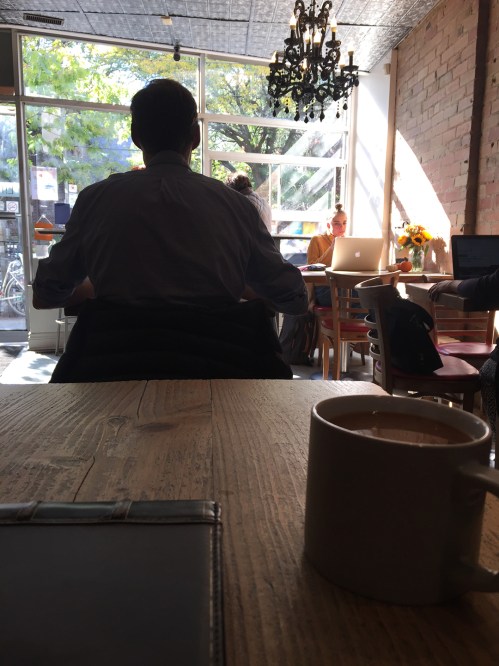
Red Eye Espresso

IMG_8860

The view from the office, complete with Bombon

Listen to the podcast version of this on Patreon

Get the Bombon.

It has condensed milk.

The Bombon at Red Eye Espresso is like a flat white, but it has condensed milk in it. Not a lot! It won’t kill you! But it makes a difference.

Oh, that’s not the only reason to come to this cute, arty little coffee place on McCaul south of OCAD. There’s also the fact that it’s cute and arty. When I say “cute” I don’t mean cloying or twee. It’s just the sort of place that fine arts students feel instantly comfortable in. (I know: I was one.) Continue reading

Watch out for the theta roles!

Never mind passive voice — it’s all about your cast list

This article was originally published in NINK, the magazine of Novelists, Inc.

Listen to the audio version of this article on Patreon.com

We have all been taught to be leery of the passive voice – sorry, make that we have all learned to be leery of the passive voice – because passive voice focuses on the recipient of the action rather than the actor. But we often get it wrong – for example, when a news story or headline is criticized for using the “passive,” odds are high that it’s actually written in the active voice; it’s just evasive in some other way.

Consider a few real-world examples of active voice misidentified as passive. When Janet Jackson had her famous “wardrobe malfunction” at the Super Bowl, one writer tut-tutted another for using the passive by writing A snap unfastened and part of the bodice tore. But although that sentence doesn’t name Justin Timberlake, it isn’t passive voice either – to be passive, the sentence would need to say a snap was unfastened. Other typical examples of misidentified passives include An accidental discharge of the firearm occurred and Boy dies as troops fire on demonstration. In spite of writers inveighing against other writers for using “the passive,” these sentences have no is or was and no past participle – to be passive, they would have to be written as The firearm was accidentally discharged and Boy is killed as troops fire on demonstration.

So how did we get so far off base in telling the passive voice from the active voice? The answer is that we’re not off base at all; we’re asking the wrong question. It’s not really the passive we should be looking out for. It’s the theta roles.  Continue reading

captiolexis

“To better serve you, we have added the following charges to your account…”

To better serve who? Oh: To better serve you up to our shareholders as a revenue stream. Gotcha.

There’s a word for that. Continue reading

focal

It’s all a matter of how you see it. In what context you see it. From what distance. And how much it contrasts with what’s around it.

This is the word of my life: focal. More than almost any other word.

No, wait. These are the words of my life: focal and focal.

Focal, in English (and French and Spanish and Portuguese), means ‘of or relating to focus’. It comes from Latin focalis.

Focal, in Irish, means ‘word’. Is é focal an focal i gcóir focail. (‘Word is the word for a word.’) It looks like it could come from Latin vocalis (source of English vocal), but it doesn’t – although it is distantly related. It comes from a Proto-Celtic word that traces back to a Proto-Indo-European root for ‘voice’, wṓkʷs. Along with the Latin vox set, that root also led to the Irish word fuaim, ‘sound, noise’, and to many words in many other Indo-European languages, such as German erwähnen ‘mention’ and Dutch gewagen ‘report’. Continue reading

Dublin

Dublin. Dubh linn.

Dubh, say it to rhyme with “groove,” means ‘dark’ or ‘black’.

Linn, almost rhymes with “sing” but is really like a slice out of “well in your soul,” means ‘pool’.

Linn, said no differently, also means ‘a span of time’. Also means ‘with us’. And so can mean ‘belonging to us’. Continue reading

Lit Espresso Bar

IMG_8796

Fiat lux. Et coffee.

Listen to the audio version – trust me, it’s worth a listen – on Patreon. For free.

The east side of Roncesvalles is lit. Continue reading

Cork

A cork is an important thing. You don’t taste the cork itself – you don’t want to taste it! – but it keeps what’s in the bottle fresh. You have to get past the stopper and taste what you can pour out.

The word cork, once you open up the etymology, comes from Latin cortex, meaning ‘bark’, a tree’s interface with the outer world, because corks are made from the bark of the cork oak. Cortex is also the word for the skin of your brain, its involuted outer layer, the part that is so important in consciousness and memory, your awareness of your interfaces with the outer world.

Cork, the city in Ireland, is not named after cork bark. Its Irish name is Corcaigh – pronounced like “corky” in most of Ireland but a bit closer to “corkage” in Cork’s own region. It means ‘swamp’ or ‘marsh’ – well, it’s the dative form, so it means ‘to the swamp’. Which sounds like an instruction to go find a wet place. Continue reading