ombud

I’ll assume you’re familiar with the word ombudsman, which refers to a person who arbitrates complaints for a newspaper, government agency, or similar organization. It comes from Swedish, where it’s been a word for a good long time, descended from Old Swedish umboþ ‘commission, order’ plus man. English borrowed it in the late 1800s.

In the late 1800s, and for a while after, every ombudsman was in fact a man. But by the later 20th century there were ombuds…women? But it seems a bit clunky to have to specify the sex of the ombuds…person? But, then, why say man, woman, or person at all? We already resolved this neatly with chair, which replaces chairman, chairwomanchairperson with a nice bit of metonymy (like using crown or state to refer to government things). And whereas chair is a thing of its own and so in some contexts may be ambiguous, there is no ambiguity if we say ombud. It’s clearly a short form of ombudsman (or whatever). K?

Question, though. If we take man off ombudsman, that makes it ombuds, not ombud. But then what’s the plural? Ombudses? But if we make it ombud, which can pluralize to ombuds if you ever need to, where’s the original s? But the in the original is a genitive, not a plural; it allows ombud (or in the original umboþ) to modify man.

But do we have a real basis for changing ombudsman in the first place? This question has come up on various occasions, and various people have had various things to say about it. A colleague pointed me to a briefing paper from the Northern Ireland Assembly that quoted a couple of people weighing in on it as certain kinds of people will:

Put simply, the word ‘Ombudsman’ is not an English word: it is Swedish. It does not therefore lend itself to conversion to the ‘ombudsperson’ or ‘ombudswoman’ that the manual suggests… it makes it meaningless because such suffixes are not recognised as Swedish’.

“Ombudsmand”, a Scandinavian word, has the etymological meaning a “man who is asked for something”, ie, help or redress. Washington has shorn the title down to a meaningless “ask-for”.

There are… problems, let’s put it nicely (why?)… with these objections. Ombudsman, borrowed into English, is no longer a Swedish word. If I call either of the persons who made this objection ignoramus, I’m not saying in Latin “we don’t know,” which is what Latin ignoramus means; I’m saying in English a noun that describes the person as pointedly ignorant. If I see him in a restaurant and ask the maitre d’ to show the ignoramus out, he can object all he wants that maitre d’ is meaningless because it just means ‘master of’ (with the original hotel deleted), but he’s still going to find his butt (and the rest of him) on the street, hopping the next bus. And even though bus is short for Latin omnibus, which is a dative Latin plural of the adjective omnia ‘all’, and even though the bus is part of the inflectional ending and not the root, the short form bus is not meaningless for us. We know exactly what it means in English, regardless of what a Latin speaker might have thought.

But what about the objection that in Swedish man doesn’t mean ‘man’? We don’t change human to huperson or hu, after all. But, then, we don’t say “hu man” as though it’s another kind of man; we say it as though it’s an adjective derived with the suffix –an from hume. (In fact, that’s pretty close; it’s from Latin humanus, derived from homo, which is indeed gender-neutral; ‘man’ is vir.) Well, what is the word for ‘man’ in Swedish? Why, it’s man. Man is also the word for ‘husband’, and it is not the word for ‘woman’ (that’s kvinna) or ‘wife’ (fru). Swedish for ombudsman is ombudsman, using that same man; the spelling ombudsmand comes from Danish (there is no language called Scandinavian; the several Scandinavian languages do have differences in their words). Swedish man is directly related to English man – by which I mean it’s the same word used in the same way in a not-that-distantly-related language. The fact that man is used broadly in Swedish the way it used to be used broadly in English does not mean it’s gender-neutral; it means Swedish is still masculine-normative in this regard.

So we borrowed ombudsman into English, which really means we borrowed ombud(s) and already had man. And when we hear it, we hear the man at the end, and it is masculine-normative. If it weren’t really from man, there would be a different argument to make – should we change a word just because it sounds like something problematic?* But it is from man. It is accurately read as English man and is received and dealt with as such.

Editors know that if there’s a tricky phrasing, one that leads to syntactic vexation, the best solution is to rephrase. And if there’s a turn of phrase that might upset some people, you’re best rewording if you can. An important tool in the editor’s toolkit is a nice sharp sword for cutting Gordian knots. Ombudsman is a place to use that sword. Slice true and clean and you get ombud and ombuds. And if anyone objects too strenuously, the sword is still sharp; let them look to it. Any complaints can be addressed to the ombud.


*That’s a fun debate, but if you want to cut to the chase, we already do that in various ways. Newscasters say harassment and Uranus in ways that avoid saying ass and anus per se, and the British pronunciation of bomb is no longer identical to that of bum, as it once was. There are other examples I probably don’t need to list of words that sound like even less acceptable words; though unrelated, they’re often avoided, because why bring unpleasant things to mind? Like it or not, we do it, because we can hear it.

Chicago

Hog Butcher for the World,
Tool Maker, Stacker of Wheat,
Player with Railroads and the Nation’s Freight Handler;
Stormy, husky, brawling,
City of the Big Shoulders
—from “Chicago” by Carl Sandburg

Chicago was a big, young, driving, thriving city in 1914 when Sandburg wrote that. It had already been the home of the first skyscraper and was destined to be home of many more; it had seen its famous fire in 1871, and the World’s Columbian Exposition in 1893 (which gave us the term midway); it was already a mid-continent commercial nexus and had for a time been the fastest-growing city in the world; it already had its famous elevated train loop around the central district. It had not yet seen the roaring ’20s and their gangsters; it was not quite yet the place about which the musical Chicago (set in the 1920s) was written. It did not yet have its famed deep-dish pizza, which first hit plates in the 1940s. It was not yet the town of the 1964 song “My Kind of Town,” made famous by Frank Sinatra. But it was all there, sprouting and growing, like a bulb (or perhaps a whole field) of wild garlic in the heart of America.

I recently had the pleasure of spending a few days in Chicago for the conference of ACES: The Society for Editing. We were at the Palmer House, now a Hilton hotel; it’s in the middle of everything, pretty much. It has a glorious lobby, a dimly lit cross between Grand Central Terminal (or should I say Union Station, since it’s in Chicago) and the Sistine Chapel, dominated by a busy cocktail bar. Up a grand staircase is the Empire Room, which through the heart of the 20th century hosted every entertainer who might perform in such a room (their photos line the hallways by the guest rooms) and this past week hosted a spelling bee for editors as part of the ACES conference (I was one of the judges, having won the event at last year’s conference). We also had events in the Chicago Athletic Club, which is no longer an athletic club – it has a hotel, bar, and event spaces in its classic old building.

Chicago is home to many classic old buildings. It has shiny newer buildings, to be sure, including the second and third tallest in the US, but it has not gotten rid of its gems from its booming years, all the American art deco and prairie style designs, all the steel and stone. This is a city that never stops reminding you that it was the epitome of architectural chic several decades ago.

Which is not where its name comes from. Chicago is a French-style rendition of a word from the language of the Miami-Illinois, an Algonquian people: shikaakwa, the name for a plant that grew abundantly in the area. The Latin for the plant is Allium tricoccum; it is more commonly called ramp, wild leek, or wild garlic. It’s smaller than a leek but larger than garlic.

To me, Chicago feels like a cross between Toronto and New York – it’s smaller than New York, more comfy and manageable in its central area, and with a nice lakefront, and often reminds people of Toronto in ways, but it has the urban grit and American empire feel of New York. I took some pictures at the conference. You can see the whole album on Flickr, but here are a few.

Pronunciation tip: São Paulo and Rio de Janeiro

Learning to pronounce Portuguese – and especially Brazilian Portuguese – is straightforward: Whatever you think it should be, it isn’t, and whenever you try to say something, you’ll make a mistake.

OK, that’s a slight overstatement, but only slight. The odds are good that for a long time you won’t be able to get through a sentence without slipping up. That’s because it looks like Spanish with maybe bits of French or Italian, but it’s not like any of them. I’m not going to try to get you pronouncing it all smoothly, but I can start you with the two Brazilian place names you’re most likely to want to say. Ready?

Walk away from this sentence

A colleague called my attention to the following sentence in the article “Trudeau gives his definition of ‘national interest’: Chris Hall”:

Why is Justin Trudeau investing so much in a single pipeline that his officials met on Friday in Toronto with Kinder Morgan executives, who issued the threat to abandon the project while the prime minister was travelling to a vigil in Humboldt, Saskatchewan, for the hockey players and others killed in that tragic bus accident, and who can still walk away from it on May 31 if they aren’t satisfied?

If you’re left reeling and trying to figure out if it’s saying the hockey players killed in the bus accident can still walk away from it, you’re not alone. And yet the sentence is perfectly grammatical and makes sense – once you take it apart and set the pieces on the table. Which is not to say it should have been published as it was.

Let’s start by making it a fun exercise in field-stripping a sentence. Continue reading

manxome

This lexeme is meant to be vexatious.

It is in a class with a nice few others, all invented by Lewis Carroll for his poem “Jabberwocky” from Through the Looking-Glass. In that poem we learn that a sword can be vorpal, that thought can be uffish, that a wood can be tulgey, that a boy can be beamish, and also that toves can be slithy, borogoves mimsy, and Bandersnatches frumious (but can Cumberbatches be benedict?). And we learn that a foe can be manxome.

And we have precious little other than context and form to guide us on the senses of these odd words, as they are all isoglosses, deliberately so – or, anyway, were at the time they were written: confections all, dropped as hot congealing sweet goo from the sugary mind of Charles Lutwidge Dodgson (Carroll’s real-life name). For some of them, comments made elsewhere give hints; for instance, brillig (as in “’Twas brillig,” the first two words of the poem) is not an adjective of quality such as bright or brilliant or something like that but merely a reference to the time of the day: around 4 pm, the time to begin broiling things for dinner, as we learn from Humpty Dumpty just after the poem in the book. But manxome? No hints.

There are ideas, of course. Manx appears to the eyes right away, but why the Jabberwock should have anything to do with the Isle of Man is perfectly unclear; no one has found anything to say that Dodgson hated the Manx. Some suggest it could come from manly plus buxom – bearing in mind that until fairly recent times buxom could be applied to anyone or anything and meant ‘pleasing, amiable, compliant’ (from Old English buh ‘bow, submit’ and sum, the source of the same suffix we see on gladsome, noisome, fearsome, etc.). But I do not think any sense of buxom Dodgson might have used could suit a daunting foe.

The Oxford English Dictionary has its thoughts (though, amusingly, Wiktionary does not, nor does Urban Dictionary). It suggests that it traces to manky, which means ‘gross’ or ‘crappy’ or ‘yucky’. Manky might trace to an old word mank meaning ‘maimed’ or ‘mutilated’, or it might trace to French manqué, ‘missing, wanting, defective, unsatisfactory’. Or the mank could just be echoing rank and dank and stank. In any case, the mank crosses swords with some to give us manxome, and in any case, the hero of the poem would be going off into battle against a shoddy, gross, disgusting, generally unpleasant foe, probably a wonky and jabbering one at that.

What we can say we know is that manxome describes some unpleasant characteristic of a foe. And it intentionally defies clear understanding (that’s the point of the poem). It is vexatious and ‘vexatious’, it seems, most clearly defining itself by its own lack of clarity. That is to say: it is not its definition but the nature of its indefinition that defines it.

What, you think that’s impossible? If you can’t believe impossible things, to quote Through the Looking-Glass again, “I daresay you haven’t had much practice. …Why, sometimes I’ve believed as many as six impossible things before breakfast.” Some of them rather manxome, I might add.

fewtrils

“‘I ha’ paid her to keep awa’ fra’ me. These five year I ha’ paid her. I ha’ gotten decent fewtrils about me agen. I ha’ lived hard and sad, but not ashamed and fearfo’ a’ the minnits o’ my life.’”

That’s from Hard Times, by Charles Dickens. And the obvious question is…

Fewtrils?

Is that some sense of the future details? Or a few things that give nice scents to your nostrils? Is it that he’s managed to get a few thrills, even if cheap ones? Or is it some flowery tendrils? This word has that accordion-file w in the middle of it and I really want to dive my hand into it to find some little thing that will tell me what sense it holds.

I don’t have to, though. I can just look in that little (no, large) shop of lexical geegaws in which I found it: the Oxford English Dictionary. Or I can pick up my massive Webster’s Third New International Dictionary, Unabridged, which also has it. Webster tells me it’s ‘odds and ends’ or ‘trifles’. But I like Oxford’s definition better, which comes from a 1763 quote: ‘little things’. (Or, yes, ‘trifles’; Oxford allows that too.)

Life is a sort of packing exercise. First you get the big things in, home, food, you know. Big pieces of furniture. Essentials, the anchor tenants of your life. Then you add the medium-sized things: more chairs, some kitchen appliances, various necessaries. What lets you live a functioning existence without having to run out or go wanting. But you are not comfortable until you have the little things.

Take a big box and put in big rocks. OK, you have a box of rocks, but will you rest on it? Not for the sake of your back. Add some middle-sized rocks. Fill in the space with pebbles. Better now? Now you can sit on it if you must. But wait: pour in sand, those millions of little grains. Now you can lie back, perhaps.

But in the structures of our lives, we don’t need millions of little things. We just need a few. A few thrills. Just a little bit of an eye to the future details. A few pleasant passing scents to make passable sense to our nostrils. A few flowers to take root in our hearts. Fewtrils.

No one’s quote sure where fewtrils comes from. Oxford hints that there may be a connection to fattrels, ‘ribbon-ends’, from French fatraille ‘trash, trumpery, things of no value’.

But those little things of no value… how often we value them the most! Everyone deserves a few thrills and some fewtrils. Not too many – just a few – but they are the trills in the songs of our lives.

Pronunciation tip: Celebes

I was wondering what to do my next pronunciation tip on, so I went and got a coffee. And the answer was right in front of me.

lush

It is mid-April. April is supposed to breed lilacs out of the dead land. It is supposed to be, at least nascently, lush.

What it actually is, in Toronto today, is slush.

Such a difference one little sound makes! It’s the difference between flush and blush, which mean opposite but related things, or between plush and lush, which seem quite well matched. Flush and slush sound so similar and are both watery; blush and plush differ only in the voicing at the beginning, but at least both belong in a boudoir. But in all of them is lush, which has one less sound but conveys the most richness. It is, as words go, luscious.

Well, the adjective lush is, anyway. The noun lush is another thing. It showed up in the late 1700s to refer to alcoholic drink, and by a century later was referring to alcoholic drinkers, the habitually and excessively intoxicated. But at least a lush is usually thought of as somehow luxurious, not quite like a sot or any ordinary drunk. The sound surely has something to do with that.

Lush, the adjective, was one of the first words I tasted when I started this exercise in 2008. Words are intoxicating, and this blog has been a bibliographic binge, a lexical bender, for a decade so far. It is lucky that there is no harm in being a word lush, soused with lush words.

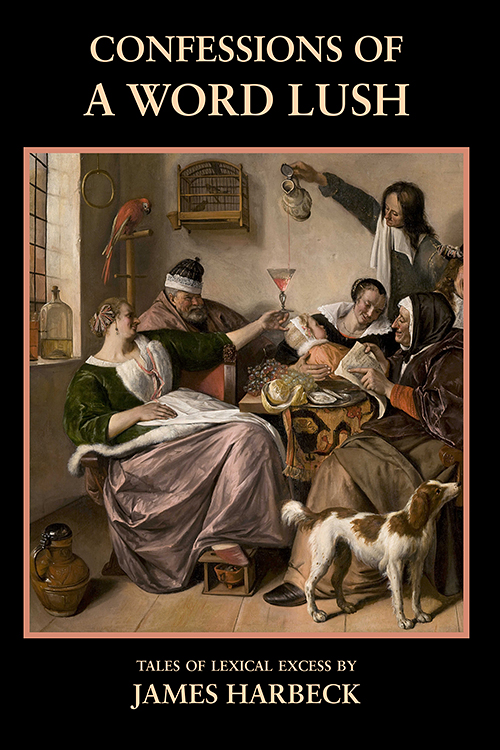
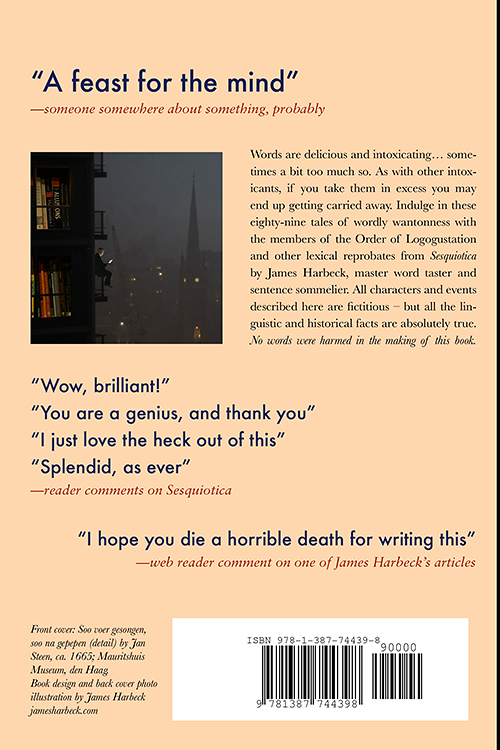
What there is in it is a book. More than one, but so far one. Eliot says April mixes memory and desire, and in that respect this book is fitting. For a few years I regularly wrote fictional vignettes that played out interpersonal foibles focused on a particular word; I had always meant to collect them into a volume, and now I have. I’ve left out a few that do not look so good to me now, but there are still 89 to pour out and pore over. It’s available as ebook and paperback. The cover is at the bottom of this post; it features a painting by the 17th-century Dutch master Jan Steen.

I’ve tasted well over a thousand words since beginning this blog. I want to put together at least one more book assembling the best of the non-narrative ones. But I don’t think I should just trust my own judgement. So I ask all of you who have read them over the years: which ones do you remember most fondly? Help this word lush pick the tallest poppies from his lush garden and make a proper opiate of them.

confessions_cover_back_500

awful

The world can be awful, and words can be awful.

Wait! Things change!

The meanings of words, for one thing. Take awful for example. It’s a word bequeathed to us from Old English, made of the parts that have become our words awe and full.

So wouldn’t that mean that something that is awful is full of awe? So that if something inspires awe in you you’ll be awful?

Well, yeah, there are many people who use being awestruck to excuse awful behaviour. But the earliest sense of the word, by centuries, is ‘awe-inspiring’ – and by ‘awe’ we can also mean ‘dread’ or ‘fear’. It’s as though awe is a thing that its possessor imbues its beholders with, like radiation.

That sense, and that sense alone, was what the word held until the late 1500s, when it finally gained the sense of ‘filled with awe’. Both those senses were current in Shakespeare’s time: In Henry VI, part 2, we get “Thy hand is made to grasp a palmer’s staff, And not to grace an aweful princely sceptre”; in Richard II, speaking of kneeling before a king, “how dare thy joints forget To pay their awful duty to our presence?”

Not until the early 1800s did the negative sense emerge, and even then it still conveyed dread at first – awful was used conversationally (especially in New England) to mean ‘dreadful’ in a sense initially literal but soon somewhat bleached… like dreadful, and terrible, and other things such as lousy (rarely used to mean ‘lice-infested’ now). The path of awfully has been similar: first ‘causing reverence or fear’; only in the early 1800s used as a general intensifier.

Such is the way of words. Senses change over time, and there is no use in fighting it; as in the world, so with the words: we are the speakers of the language, and so we make the trouble, and the enemy is us. We would do better to make light of it. Look, for instance, at old poems with the earlier sense intended. See Kiping in 1899 rhyme off this:

Lord of our far-flung battle line,
Beneath whose awful hand we hold
Dominion over palm and pine

That dominion does seem awful to us now. See Walter Scott in 1820 call the Bible “that awful volume,” a sentiment that has remained popular with the shifting sense of awful (but never forget that it is the book that tells us that peacemakers and gentle people are blessed). And consider a more sesquiotic reading of this bellicose verse from 1785 by William Cowper:

Should England prosper, when such things, as smooth
And tender as a girl, all essenc’d o’er
With odors, and as profligate as sweet,
Who sell their laurel for a myrtle wreath,
And love when they should fight; when such as these
Presume to lay their hand upon the ark
Of her magnificent and awful cause?

Many things we used to think were awful have turned out to be, yes, awful. There can be much that is awful in the world and in the words.

But never forget: there can be much that is awfully good too.

Do you want to use a Germanic feature, or do you prefer using a Celtic one?

Originally published in The Editors’ Weekly, the official blog of Canada’s national editorial association

Learning other languages is fun. And to learn another language is to learn more about your own language – especially when it takes on the aspect of learning more about your family tree.

You’ve probably had the experience of meeting new relatives or learning about ancestors and thinking, “Oh, that explains something.” Well, consider this: English was brought to Britain by invaders from what is now northern Germany and was learned by the resident Celts; then Scandinavians invaded and had a significant influence on the language; then the French invaded and had a major influence; then the English started invading other places and stealing their words. So discovering these other languages is discovering English – to get to know them is to get to know our own weird tongue. Such as why we can use either a gerund – learning, discovering – or an infinitive – to learn, to discover – as the subject or object of a sentence.

In French, you learn that this function is served by the infinitive. If you want to say “Seeing is believing,” you say Voir c’est croire, using the infinitives: “To see is to believe.” German has it the same way – Sehen heisst glauben – and so does Norwegian: Å se er å tro. These languages also have in common that they don’t use a present progressive tense as we do: “I am walking” translates to Je marche, Ich laufe, Jeg går – “I walk.”

On the other hand, when you learn Irish or Scots Gaelic you find they have a thing called a verbal noun. “I am walking” in Irish is Táim ag siúl, “I am at walking.” Irish uses the present progressive much as English does, and it uses its verbal nouns where English would use gerunds. (Irish happens to have its own idiomatic phrase for “Seeing is believing”: Is é a chreidiúint, “It’s believing.”) The Celtic inhabitants of southeastern Britain when the Angles and Saxons arrived from Germany weren’t Irish, of course; the language displaced by English was the ancestor of modern Breton, which is still spoken by descendants of Britons who fled to northern France (Brittany). It has the same verbal noun feature, worn down a bit by the centuries and the influence of French.

English, given a choice of two influences, chose to keep both of them. Typical.

English isn’t the only Germanic language that normally uses a present progressive, by the way, as you will discover if you learn Icelandic. Icelandic’s version uses the preposition plus the infinitive, but in the same way as Irish uses its verbal nouns: “I am walking” is Ég er að ganga. Oh, and it just happens that early Icelanders brought over a lot of Irish and Scottish people to, um, help around the house. Nearly two-thirds of the maternal gene pool and about a quarter of the paternal gene pool in Iceland is of Irish or Scottish descent.

So there you have it. In languages as in families, to learn is to discover, and seeing is believing.