Monthly Archives: July 2014

iridescent

Imagine an eyeshadow like the wing of a butterfly or the coruscating scales of a tropical fish, shimmering, sprinkling your eyes parallactically with a shower of the spectrum. When you look at it it looks back at you, into you, and you see it is a rainbow, and the pot of gold itself is the eye, the iris, the pupil, locking you in as it licks you lightly with the glittering mist. You are irrigated by it; it is the sprinkler and the rainbow, a light alighting under the eyebrows. It is eerie, almost indecent, but it is strangely becoming, this dissent from the stably perceptible; it irradiates you with a delicate psychedelic cycle, a descant on the clear colours of daily life.

It is iridescent.

It is like a fine wine’s bouquet on the nose, shifting from one thing to another: I ride scent, ride it like a dragon through the empyrean. I am the enticed sir.

It is instinct, a tincture of desire.

It is a riddle; it indicts as it indites.

It is intense, a sidereal incense or salitter for the occiput.

It is (Visual Thesaurus tells us) opaline, opalescent, nacreous, pearlescent; it is changeable, it is chatoyant.

It is not just the half-arc or a rainbow. It is the entire disc.

The disc of the iris. The disc of Iris.

Iris, the swift messenger of the gods, rider of rainbows. Iris, a rainbow, a ring for the irriguous. Iris, the rainbow of the eyes, the ring between limbus and limbo, the messenger that heralds and draws you into the singularity: the pupil that learns and teaches.

Iridescent, iri{s|d}-escent: becoming like an iris. Becoming like Iris. Shimmering with the many colours of the rainbow, bearer of infinitely mixed messages: a medium that massages and massacres. The eye.

And what becomes the eye. It may bow, or it may rain. Or both at the same time, as seen from separate eyes. It is whatever you discern in it, and always already also so much more.

A more delectable dictionary

Imagine a cookbook that only gave the ingredients for each recipe, with no instructions on how to put them together. Many dictionaries are like that: nothing but bare-bones denotative definitions for the words.

Now imagine a cookbook that included not just the instructions, not just different variants on how you can make the recipe, not even just menu suggestions and beverage matching suggestions, but also other recipes it would go with or remind you of or definitely not go with, and even things the food could or would make you think of – other dishes it would remind you of, other times and places and people.

I would like to have a dictionary that does all that for words.

Of course much of that is individual. Every word is one of Proust’s Madeleines, a key to places you have heard it and seen it and used it before. The way it sounds and how you feel about those sounds will provoke you differently from how it provokes others. But there are several aspects of a word’s extended meaning that users will have in common. Most of them show up in one kind of dictionary or another, but not all, and not all in the same place. Let’s look at how a dictionary that covers a fuller ambit of meaning and effect would handle… let’s say the words dude and fellow.

Connotation

An important dimension of words is what they say about the speaker, the hearer, the subject, and the relation between them – what effect the speaker is trying to have on the hearer and what he or she is saying about what’s going on between them and any third party spoken of.

dude: Casual, informal. Friendly or mildly contemptuous, depending on overall relationship constructed. As an emphatic vocative, expressing some kind of amazement within a pointedly informal frame. (Read this good article by J.J. Gould for more.)

fellow: Intended to be neutral, but can be more formal, often with a taste of condescension.

Register

Register is a key concept in sociolinguistics: your choice of vocabulary and syntax bespeaks a specific situation – it’s like putting on different clothes for different places and activities: clubbing, visiting family, working at the office, working in a hospital, etc. Words are known by the company they keep. Most dictionaries won’t go beyond saying something is formal, or colloquial, or medical jargon, if they go that far. But there is always more that can be said.

dude: Tends to be laddish, often with a sense of drug, surfer, or frat-boy culture; cowboy speech is also possible. Cannot be used for formal registers, except in archaic senses (meaning dandy or greenhorn).

fellow: Broadly usable, but in youthful and casual contexts may sound old-fashioned or formal. Suitable for friendly or pseudo-friendly versions of more formal speech. As a title (e.g., Fellow of the Royal Society), suitable for the most formal speech.

Collocations

Many words have well-known travelling companions – common collocations, as linguists say. These are a word’s circle of close friends. There are dictionaries of collocations, often meant for students of English to help them know how to match their ties and socks, so to speak; there are also corpus databases that list words that tend to show up more often with them. Here are some results (mutatis mutandis) taken from www.wordandphrase.info:

dude: cool, fucking, sorry, funny, awesome, skinny, tall, like, weird, straight, ranch, dude, surfer, shit, fuck, chick, Chicano

fellow: senior, young, old, little, poor, visiting, postdoctoral, fine, nice, honorary, research, craft

Cultural references (including quotations)

Some words have the ability to call forth films or books or historical moments. Berliner can make a person think of Kennedy; cheeseburger can make many people think of endearing kittens with captions; frankly can call up Gone with the Wind. Traditional sources such as Bartlett’s should be complemented with current culture resources such as knowyourmeme.com and the auto-complete in Google searches (which can also be good for collocations). Note that fellow (noun) may arguably call forth references to fellow (adjective).

dude: Jeff Bridges as “the Dude” in The Big Lebowski (quote: “The Dude abides”); Dude, Where’s My Car? (movie); “Dude Looks Like a Lady” (song)

fellow: “Hail fellow, well met” (Jonathan Swift); “Alas, poor Yorick! I knew him, Horatio: a fellow of infinite jest, of most excellent fancy” (Shakespeare); “fellow traveller” (mid-20th-century euphemism for Communist sympathizer); “Write me as one who loves his fellow-men” (Leigh Hunt, “Abou Ben Adhem”); “my fellow Americans” (standard in US political speeches)

Etymology

Etymology is not inherent in our experience of a word; many people are quite oblivious to where their words come from, even as many – often some of the same – have the mistaken idea that a word’s “true” meaning is determined by its “original” meaning. But if you have an idea of a word’s origins, it will influence how you think of the word. This is true whether your idea is accurate or inaccurate. The words picnic and nitty-gritty are poisoned for many people who have false beliefs about their origins; the same people would never use bulldoze again if they knew where it came from – but most of them don’t. Many dictionaries supply etymological information, so I invite you to look it up on your own! And you will find that sometimes not all that much is known.

Rhymes and other echoes

Words will make us think of other words. Not just synonyms, which thesauruses and some dictionaries handily provide. And not just rhymes, which have their own dictionaries. There are other echoes that may contribute in some measure to the effect of a word – words that the word has some resemblance to in sound or appearance. Some non-rhyme examples:

dude: dud, dead, dad, deed, pube, dada, dildo, doobie, redo, stupid

fellow: fallow, follow, fuller, filler, fell, fail, allow, hello, willow, well, low, flow, cellophane

Phonaesthetics

And then there’s the issue of the aesthetic effects of sound qualities, still a bit controversial, but some effects are well known, such as the association of high front vowels with smaller things.

dude: The main vowel sound is a low, hollow sound (it has the lowest resonances of all the vowel sounds), often associated with dullness and stupidity; the d sounds are not as crisp as t sounds but are on the tip of the tongue, which makes them comparatively light.

fellow: The e is fairly open and bright, while the l is soft and liquid, and the f is the quietest of the fricatives; the final ow is darker and more withdrawn but allows sustain.

Obviously a dictionary that included all of this would be rather thick, and would take a long time to put together. Some of it might benefit to some extent from a wiki-style approach, though one does have to be careful. But any added attention to these aspects of how a word communicated would help us all be more fully conscious and engaged users of the language – and would surely make our words more delectable.

Our changing language: When does wrong become right?

Iva Cheung has done up a nice, cogent, accurate summary of my presentation at the 2014 Editors’ Association of Canada conference. You can read it at www.ivacheung.com/2014/06/our-changing-language-when-does-wrong-become-right-james-harbeck-eac-conference-2014/.

The PowerPoint I used for the presentation can be downloaded from www.harbeck.ca/James/harbeck_wrong_right.pptx.

Badly broken words: the podcast

My article on words that are badly broken has been converted (in shortened form) to a podcast. Give it a listen if you want – it’s at theweek.com/article/index/264020/5-words-that-are-badly-broken.

Brugge

Where Brugge is:

  1. Belgium.
  2. Get a map.

How to get into and out of and around Belgium:

  1. Thalys. The Belgian high-speed train. Belgium is too small to need high-speed to get around it. The trains exist to get you in and out. Book first class in advance and save money. First class comes with food and beverage that, outside the train, would cost up to half your ticket price.

    Lunch with Thalys

    Lunch with Thalys

  2. Any other train, if you like moving slowly and don’t feel like eating or drinking for some reason. Or the Thalys doesn’t go there when you want to go there.
  3. Well, it’s not that big a country anyway.
  4. I really don’t see why you’d want to drive. What’s relaxing about that? Also, beer. This is Belgium.

Things to do in Brugge:

  1. Beer. Germans made beer pure; Belgians made beer interesting.
  2. Chocolate.
  3. Beer.
  4. Look around.
  5. Beer.
  6. Take photos.
  7. Beer.

    Beer

    Beer

  8. Chocolate.
  9. Some other food who cares French fries or something with one of the eighty-three sauces you can put on it maybe a sausage too if you must.
  10. Beer.

How to get around in Brugge:

  1. Walk. The old cute part is not very large. The streets are medieval-style: stone, not all that wide, pedestrians and vehicles often mixed together watch where you’re walking and what’s coming at you there are cars and they go fast
  2. Local bus. Good to get to and from the train station. Goes on the same streets as you walk on. Somehow manages to go in both directions on a street not quite wide enough for one.
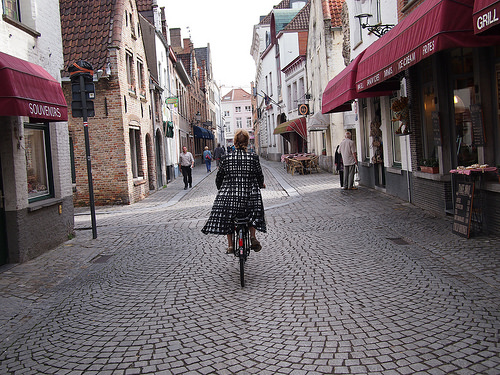
  3. Bike. Stay at a hotel that has bikes. Bike in the park along the canal that rings the oval heart of town. Bike up and down the streets. Pro tip: when a sign says Uitgezonderd it means “excepted” – so if the sign is a No Entry or One Way sign and it has a picture of a bike and it says Uitgezonderd, that means you can go that way even though the cars can’t. Oh, by the way, watch out for the cars holy cow.

    Follow that woman. She will lead you to beer

    Follow that woman. She will lead you to beer

  4. Take a horse carriage if that sort of thing turns you on and you have the money flopping around and you forgot you were going to buy beer and chocolate with it.
  5. Drive? Not. Don’t do it. Locals blast through in their cars. You are not local. There are canals and stone walls and people. And you will be drinking a lot of beer.

What to see in Brugge:

  1. Brugge.
  2. Look, dude, it’s an outrageously cute medieval town. Bring a camera. You’ll only be taking the same pictures as one hundred sixty-five other people today, but you’ll want pictures to remember it by, especially if you drink all that beer, and to prove to other people that it exists.

    Congratulations! You are the 5,783,624th person to take this picture. The slight tilt gives an authentic impression of squiffiness

    Congratulations! You are the 5,783,624th person to take this picture. The slight tilt gives an authentic impression of squiffiness

  3. Bruges.
  4. Yes, Brugge and Bruges are the same place. We call it Bruges but that’s the French name and they all speak Flemish (Dutch) there so I prefer to call it Brugge, which also allows me to surreptitiously clear my throat on the gg, because that’s how you say the gg. But if you say Bruges people think of that movie.

    They only take the plastic off when company is coming over

    They only take the plastic off when company is coming over

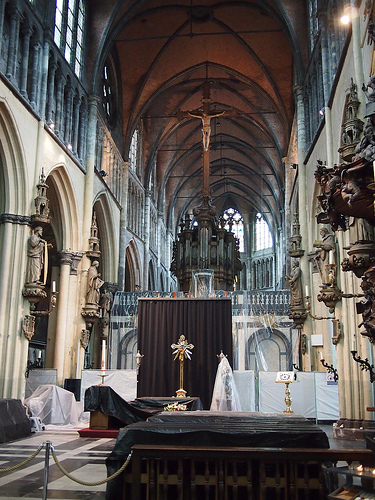
  5. OK, you want specifics? See the churches. See the streets. See the canals. See the bridges over the canals. That’s what the name of the place comes from, the Flemish word for “bridges.” Walk walk walk walk. Bring a map or you are doomed, even though you can see the Belfort tower on the market square from many places in town. Seeing it and getting to it are different things.

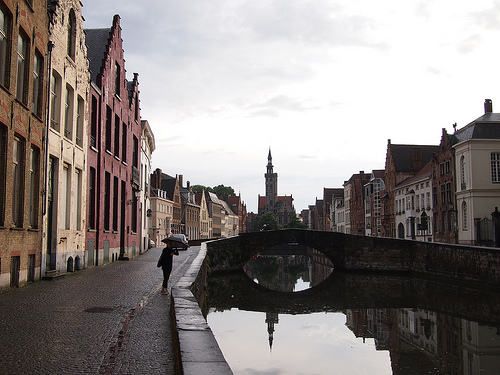
    Brugge is canal retentive

    Brugge is canal retentive

  6. The inside of a brasserie.
  7. Chocolate shops. These are easy to find. Simply start walking. You will see several soon enough. If you don’t succeed, go to the market square and follow a horse-drawn carriage. You will pass some. Watch where you step, these are real horses, with asses behind them… sitting on the carriage, driving.
  8. The inside of another brasserie.

What to eat in Brugge:

  1. Beer.
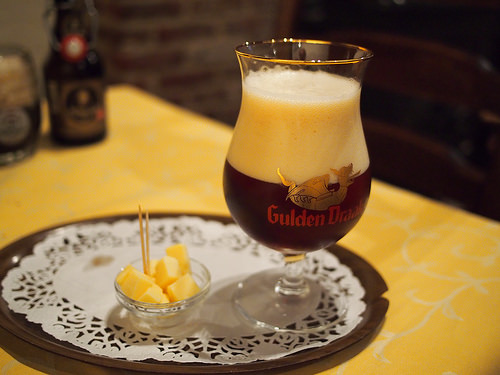
  2. The little dish of cheese they bring with the beer.

    Food

    Food

  3. Chocolate.
  4. Frites, maybe from a truck in the market square, doused with a sauce you would never have thought of putting on French fries but is good. Curryketchup? Samurai? Andalouse? All of the above? 50 cents each.
  5. Seriously, did you skip the part about beer? Have a sausage. Whatever.
  6. Yes, of course they have restaurants. Are you there to eat or are you there to drink beer?
  7. Beer.

What beer to drink in Brugge:

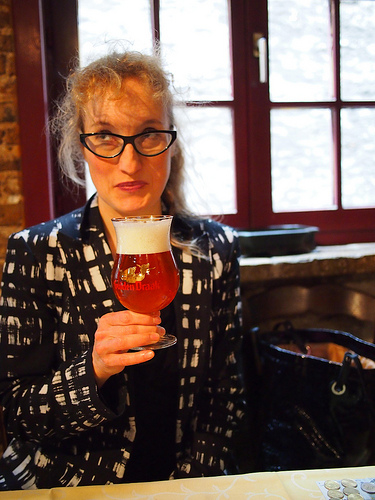
  1. Tripel Van de Garre. This is the house beer of Brasserie van de Garre. It is sweet with lemon notes and a lasting ring of bitterness around the back of the tongue. It comes with a big head. It is 11% alcohol. They limit customers to three each. You get to Brasserie van de Garre by going along Breidelstraat just off the market square, through a little doorway off the south side, and down a rough cobbled alley. This alley is a sobriety test. If you can’t make it to the brasserie, you’re done for the evening. If you’re in the brasserie and can’t make it out, well, shucks.

    Abandon all sobriety, ye who enter here

    Abandon all sobriety, ye who enter here

  2. Anything by Gulden Draak. Nice, caramelly, and strong.
  3. Anything by Boon if you like sweet fruity beers. Kriek means “cherry,” by the way. Do not expect the fruity beers to be strong.
  4. Definitely have a lambic. Anyone’s lambic. Lambic is made by sticking the wort (liquid) up in the attic and throwing open the window and letting the local airborne yeast get it going. Look, you’re not in Germany. Belgian beer is Saturnalia for your mouth.
  5. Gueuze. Heh heh.
  6. Oh, did I mention that gueuze is really sour? I gueuze I forgot. Well, it is. And super interesting. You just ordered one and you can’t finish it? Fine, give it to me, I’ll finish it for you.
  7. Literally anything else that looks interesting. Especially if it’s on tap. Unless the bartender makes a little face when you ask about it.

    Tripel van de garrulous.

    Tripel van de garrulous.

What to buy in Brugge:

  1. Seriously?
  2. Don’t bother with clothing unless you have a pressing need. It’s the same as everywhere else and no cheaper.
  3. Don’t bother with trite souvenirs unless you have friends who really like them, in which case go ahead, there’s plenty to be found.
  4. …um…
  5. Chocolate, obviously! Some for you, some for your friends, and some for you.
  6. Yes, beer. Buy some bottles in a store too, for when you get back to your hotel.

    Our hotel room

    Our hotel room

Where to stay in Brugge:

  1. Well, we stayed at the Adornes Hotel, and it was nice, we would go back. Good breakfast too. Yes, yes, OK, we had real food at breakfast, cold cuts and fruit and cheese and pastries and muesli and tea and juice. Then we went cycling on free hotel bikes and then we went beering.

    Before beer and bike, breakfast

    Before beer and bike, breakfast

  2. If you want to look at other options, go on TripAdvisor. Look at the reviews. Make sure to look at the pictures. If many of the guest pictures of a hotel feature a steep, narrow, long staircase, that means you will have to drag your bags up and down it. Our hotel had an elevator, although you had to cower at the back as though hiding from a hitman or you would interrupt an electric eye by the door and it would stop.

Whether Brugge (Bruges) is like that movie:

  1. Yes.
  2. Minus the hitmen. I think.
  3. And the dwarf.
  4. Have another beer, you might see them anyway.

otter

“We are game-playing, fun-having creatures, we are the otters of the universe. We cannot die, we cannot hurt ourselves any more than illusions on the screen can be hurt. But we can believe we’re hurt, in whatever agonizing detail we want. We can believe we’re victims, killed and killing, shuddered around by good luck and bad luck.” —Richard Bach, Illusions

I think Richard Bach is the person who came up with the phrase otter of the universe. It has gotten around some since.

When I first saw it, used by someone else, it struck me as a useful play on author of the universe. Many people want to know who the author of the universe is. They want to find out how everything got here. They want to understand the author’s intentions.

When children approach a playground, how many of them ask themselves what things the designer had in mind, and try to do only those things? The ones who do (there may be some) are the annoying ones who suck the fun out of it. They probably grow up to be grammatical prescriptivists or similar dogmatists. Or I should say fail to grow up, because while play is childlike, dogmatism is just plain callow.

Otters don’t show up and try to establish first causes. They just look at what can actually be done. And one thing that can be done is play. Otters reallyliketo play. They make good use of what’s around them. And by good I mean fun.

The first time I saw otter of the universe was actually about the first time I became aware of otters as playful animals. I had always thought of otters as just sleek aquatic animals with a name that sounded like a ruler when you hold one end of it against a desk near the edge, bend and release the free end, and pull the ruler back towards the desk: “ott-tot-tot-tt-tt-ttttrrrrrrrrr.” Wooden, rigid as a rudder, a hard sound at odds with the water in which the animals moved. I oughta have known better.

The word otter is easily played with, after all. It’s practically made for a Dr. Seuss treatment: If an otter bites the butter that a potter put on platter for his daughter, will the potter hit the otter with a putter or a rudder? Will the potter’s daughter titter at the otter’s pitter-patter? Will the bettered, battered otter battle bitterly for butter? Or do otters bite on potters’ pretty daughters’ butter patties just to put on pity parties when they’re battered by the potter with a butter-splattered putter as they skitter to the water?

There’s more than that, though. The word otter comes ultimately from the Proto-Indo-European root *udr-, ‘water’. This water has followed many courses: the hydro- root we get from Greek (and that multi-headed water serpent, the hydra); some of the words for ‘otter’ in some other languages (Slavic languages in general have something in the line of vidra; Latin had lutra, which has shown up variously changed in Romance languages); and of course various words for ‘water’, including water.

So this word has flowed around and frothed and leapt like water – and like otters in the water. Do the various flows and changes of words over time seem like utter madness? I’d say they’re more like otter happiness.

Language is my favourite sport. A word isn’t worth much in my world if it can only mean one thing at a time. Rules are made to serve communication, not the other way around, and sometimes what’s being communicated is first of all “Have some fun with this.” And sometimes that’s the best thing to do – whether or not the utterer thought of it, go with what the otterer will do with it. I want to frolic in the stream of consciousness. I want to push language play to the otter limits. And beyond!

And then, at the end of the day, we can rest like otters in the water, floating, holding hands, allowing ourselves even in sleep some play in the stream.