Monthly Archives: June 2018

soray

She pulled her lips at last back from mine, her hand resting on my chest, and looked at me from a few inches away. “I’m going to miss you… when I go.”

Her parents’ family room was in gathered darkness behind her, old couches and upholstered chairs, coffee table, probably a television somewhere in it all. After a very long evening of chatting and playing games and other things I recall mostly by conjecture and probability, we’d run out of excuses for me not to leave, so at last I’d put my arm on her shoulder and leaned in to make the bold and long-expected move. Our first kiss was five or ten seconds that filled more hours in my mind than the whole evening before. It was then or never: she was leaving to take an opportunity to study overseas. A lucky break. Literally: she had given up ballet because of a stress fracture. I didn’t know then how successful she would be in her new career – the answer, as the intervening thirty years have played out, is “very” – but I wished the best for her as she left me behind.

I don’t remember exactly what I said. I’m sure it was commonplace words said with portentous feeling. I know didn’t say “Soray.” But I could have.

Soray. A word you can say in valediction when a parting makes you ache with sadness at the loss of the person and with joy at what they are going to. And a noun to name for the occasion. A soray may be when you release a captive animal into freedom, hopeful that it won’t meet one of the abrupt disasters that await the unprepared. So a soray happens myriad times every September as parents see their almost-adult children off to university for their first year, even though soray is not now a word most of them would say. A believer in heaven could say it to a dying beloved, but no one does.

What is this word, anyway? Conjecturally it looks like a blend of sorry and hooray but it is not; that’s just a backformation, and a clumsy one at that. It rhymes with foray but that just makes it suitable for poetry. It is tempting to trace soray to the same source as sorry and sorrow – Old English sarig and sorgian – but this is a sweet sorrow of parting, sweet not in hope for rejoining but just in rejoicing for hope.

But Scots Gaelic gives a more tempting clue: soraidh, meaning ‘farewell’ – the parting wish, but seen in soray with the sure belief that the person will fare well. “Ae fond kiss and then we sever,” Burns wrote, but his “warring sighs and groans” are replaced in a soray by tears of your own loss but also of your joy at the other’s gain: the most noble tears ever shed.

The truth of soray’s origin is known, though, and it’s none of the above, though they all have come to bear on it in its history. Take out a bag of Scrabble tiles; pull out five face down, and turn them over one by one: S, O, R, A, Y. That’s what I did an hour or so ago, and then I hit my reference shelf to see what history I could give it, what manufactured or borrowed memories I could endow this newborn lexeme with.

Sorry. Until just now, it was never a word. But now it is, and a word for something that deserves one. And now it is out of my hands, out into the world, sent hopefully. Soray!

This is but the first of a series of new old words: lexical replicants with invented or borrowed histories. I’ll still also be tasting words that have existed before. Personal anecdotes and other stories illustrating the new old words may or may not be true, and I won’t tell you whether they are.

Pronunciation tip: Sauvignon

You probably know how to say sauvignon, though every so often I hear someone who doesn’t. But do you know why there are two very different wine grape varieties with it in their names (Cabernet Sauvignon and Sauvignon Blanc) and why in French plus equals o?

aspersion

Water carries not just minerals and particles and viruses and bacteria; it carries blessings and hexes as well. It transmits light but in such a way as to make clear your own influences and expectations.

Consider: If you look down in a swimming pool at your legs, you do not see them where you expect. You’re used to the way air carries light, but water makes it arrive at other angles. They’re not lies; they’re just differences in the refractive index, the same thing that allows me (and many of you) to see more clearly thanks to curved glass having similar effects.

Consider: If you walk into a cool mist on a hot day it will refresh you. But if someone near you in a public place sneezes, the aerosol produced – just another mist, and a smaller one – can carry something to you that will make you sick.

I am not here to cast aspersions on the dispersion of water droplets. That would be redundant, since every aspersion is a spray, a spatter, or a mist opportunity. Aspersion, noun, comes from asperse, verb, also seen as asperge, from Latin ad ‘to’ plus spargere ‘sprinkle’. A synonym used by Oxford and Webster is bespatter– but typically with intent: a priest may asperse you with holy water, spraying blessings on you with a brass aspergillium or perhaps a moist branch; an enemy or frenemy may cast aspersions on your character or aspirations, spattering you with metaphoric mud (dirty water).

Look at this picture, taken of a fountain on a breezy day. The park it’s in is popular because it is blessed with this dog-themed three-tiered asperger. Unlike public fountains of old, it supplies no household water for drinking or washing; it just glitters water on its surroundings without stopping or discriminating. I held up my camera and the lens received droplets. And those droplets refracted light, making little lenses on the surface of the lens, and those revealed what you would othewise have missed: hexes.

Why hexes? The hexagons you see are due not to the water but to the lens – the aperture in it, the diaphragm (or iris), has six blades that cut off light. That is what I brought to it: with my receptivity to light, a restriction of the light received. The aspersions show me hexes, but they are my hexes. I am hexing myself, and the water is just making it clear by being slightly less clear. As with all aspersions, the spatters just water what’s already there.

Bighill Creek, the stream of consciousness

I was back in Alberta last week visiting my parents. My dad writes a weekly column in the Cochrane Eagle and he asked me if I’d like to write a guest column for him. I said “sure” because asking me to write something is like asking me if I’d like a glass of champagne. I decided to do something on the lovely little creek that stitches together the parkland at the heart of the town. It’s on his website as “Our blue stream of consciousness joins past and future” with one photo by me, but since this is my blog and I have room, I’m going to give it to you here with four photos.

Day by day, high and far on its edges, Cochrane grows. And instant by instant, in the town’s green heart, a blue past and future flows.

Bighill Creek comes to air above town and wanders down to see what’s here. It sashays past the old RancheHouse, swerves under a footbridge, swings wide, sighs at the glittering graffiti under the highway and slides under another footbridge and the tracks. Nourishing grasses and trees as it passes, it ducks under Glenbow Drive and plays peekaboo with the red paths of Glenwood, William Camden, and Riverfront Parks: eight more bridges and two culverts. A jogger out with the dogs will cross it and cross it again, and again, and again. And then it becomes Bow water.

I visit Cochrane and the Bow Valley landscape of my youth every year, and every year I walk and run along and across Bighill Creek. As I change, and the people I know change, and Cochrane changes, the creek is more or less the same, depending on the season – but, like any stream, its water is different from moment to moment.

But it returns as I do, as the seasons do. Water evaporates from its surface and soaks the ground from its bed, and the plants it refreshes breathe it into the air. The water in the air dreams itself into clouds; the clouds rest down as snow and rain; the snow and rain feed the springs and the creek. And so, although most of the creek flows on like the countless instants we lose to memory in time, some of it returns.

And after another year, I return. I am the same person but not quite the same, and Cochrane is the same town but not quite the same. I stand on a bridge and reflect on the creek. And the water flows by like mind into memory, some of it newly met and some coming back to me.

hosta

I love words. And I love plants. But for some reason, I really suck at remembering words for plants. This may be for the same reason that I have trouble remembering the names of people I meet (or have known for even quite a long time). Which may be for any of a host of reasons.

It’s not that I’m hostile to them. Quite the opposite. Every afternoon, I go sit in a coffee shop (a different one each day) to work, because it’s hard for me to get through a day without having people around me, just as I don’t like going through a day without going somewhere where there are plants around me. I enjoy their presence. They’re nice to look at. But I don’t talk to them much. Not the plants, either.

So what do I do when I’m at a party, for those many times I’m not talking? Same thing as I do when I’m in a garden: I bring a camera. Some silly person once said a picture is worth a thousand words. I think this is true just in the sense that every picture I take obviates a thousand words of talking. But there’s no actual conversion. If I put a Warhol print in your kitchen cupboard I don’t expect you to eat it. Look, I know words, and I love words, but I also know and love visual arts, and I know the limits of words. And I know how nice it is to have a friend you can sit with and not talk because you don’t need to fill the air with verbal packing chips because you’re just there together.

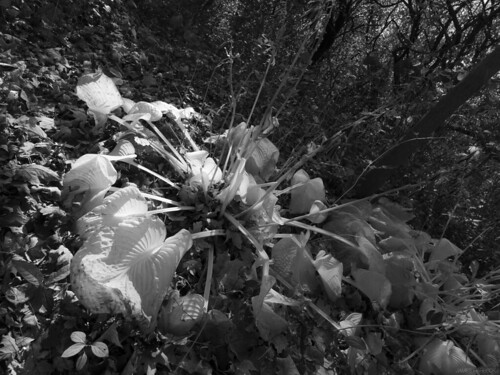
Even when I’m a host of a party, I don’t need to spend all my time talking with people. I’m happy being not a wallflower but a leaf in the book-garden of the event. A leaf with a camera. Taking nice pictures of nice people, often in marmoreal monochrome to bring out their lights and shadows, with life shining on them like dewdrops on leaves.

And so, too, plants. I love green, so you might think I would always take pictures of plants in colour. But there is one plant of which it turns out I have always put my pictures in monochrome to bring out its lights and shadows. True to form, I didn’t actually know what it’s called until, yesterday, I asked some friends. It’s a hosta, they told me.

The hosta is not one type of plant. It’s a whole host of them: it’s a genus of which there is an uncertain number of species (botanists disagree) and more than 3,000 cultivars. The website of a local greenhouse offers me 233 different kinds. They’re all lovely. And many of them are named after people: Abby, Allan P McConnell, Amos, Amy Elizabeth, Andrew, Barbara Ann, Brother Stefan, Captain Kirk, Diana Remembered, Empress Wu, Frances Williams, Hans, Katie Q, Lacy Belle, Lady Isobel Barnett, Lakeside Meter Maid, Lakeside Shoremaster, Leading Lady, Margie’s Angel, Marilyn Monroe, Mr. Big, Paul’s Glory, Queen of the Seas, The King, The Queen, Veronica Lake… It’s like a whole party right there. And an interesting one at that. I wonder who would host it.

Never mind, I know who: either the person who named the genus Hosta or the person after whom the genus is named. It was named by the Austrian botanist Leopold Trattinnick in 1812 in honor of the Austrian botanist Nicholas Thomas Host. It’s not that the plants didn’t have names before, it’s just that they hadn’t been grouped into a genus before.

It’s tempting to think of N.T. Host as the genial host of a party of plants, and perhaps he was, but that’s not where his name came from. Our English word host traces to Latin, while the German and Austrian family name Host is apparently a toponym: there are villages by that name. Alas, my etymological resources run out of words at this point, and so I don’t know just how the villages came by the name.

But it’s OK. Not everything has to have a lot of words. Especially things that aren’t in a hurry to use them back to you. Hosta leaves have such a beautiful play of shadow and light, and they host raindrops and dewdrops so nicely, shining on them like life.

Minnewanka

What pasts and presents we drown in pursuit of our futures.

Minnewanka is a name of a lake near the town of Banff, Alberta, Canada. I visited it a week ago for the first time in decades and walked a path on its shore that I don’t remember ever walking before. The path starts paved, then becomes well-worn dirt, and over its course gradually roughens as it traverses roots and rocks. Within a half hour you’re at a bridge over a small canyon, and then the trail climbs up to bend around the mountain and follow the farther shore from on high. Past a certain point you are advised to travel in tight groups in case of bears; hikers can continue to overnight campsites many hours of bootsteps farther on. But up to the bridge, it is well worn and friendly.

At the trailhead is a parking lot and a snack bar and a motorboat rental. You may, if you will, speed across its surface, a score of metres above ghostly streets where people used to walk and talk and kiss and eat. You may, if you will, strap on a can of atmosphere and dive down to look at a town drowned seventy-seven years ago, a town on a site where people had lived even ten thousand years earlier. See the video with this article from Smithsonian – you may find it spooky and wonder what waterlogged ghosts are over your shoulder.

There has always been a lake here, though it wasn’t always this big. A long, long time ago it was bigger, but glaciers and moraine rise and fall and so do lakes. By 1888 it was eighty feet down from where it is now, and a hotel and then a town were built on its shore: Minnewanka Landing. Fifteen years later, up the hill, a mine was started and a town of a thousand souls sprouted up there. It was called Bankhead and had a power plant that supplied power for Minnewanka Landing.

In 1912 a dam was built on the lake to store water for another power plant. In 1922 the Bankhead mine closed and its power plant shut down. A new power plant was built to replace it. The houses of Bankhead were mostly unmoored from their foundations and moved to nearby towns, leaving a cluster of concrete lumps in the woods for local schoolkids to visit on field trips and a small selection of buildings with interesting pasts mixed in with the others in Banff and Canmore.

But in 1941 there was a war on, and more power was needed. A dam was built across the end of the valley for a new power plant, and everyone in Minnewanka Landing had to leave. They didn’t get to take their houses. Fifty-three years a town, ten thousand years a place people passed through and sometimes lived, now a dim dreamworld like a far-gone childhood, walked in only by people long passed, seen from above darkly by the eyes of our time.

As we ever see other worlds darkly. Their sacred fabrics become burial shrouds. Look at the name of this lake. For a time, the European settlers called it Devil’s Lake. Beyond its end is a place called Devil’s Gap (now also the name of an establishment in the town of Banff where you may buy bites and spirits). A sign near the snack bar will now tell you that Minnewanka comes from local Native words meaning ‘spirit lake’. One website I found declares it’s from “Minn-waki (Lake of the Spirits).” But that’s not quite it.

How do I know that’s not quite it? The local language it’s from is Nakoda, or (in settlers’ terms) Stoney. That’s the language of the people on whose land I grew up. It’s a language I don’t speak, alas – but my dad does, quite well. So I asked him. The name of the lake in Nakoda is mînî wakâ, which means ‘sacred water’. The circumflexes indicate nasalization – the sort of thing you hear in French and Portuguese when an nor mis written after a vowel. So mînî, which means ‘water’, has nasal vowels, and wakâ, which means ‘sacred’, has a nasal vowel just at the end.

Did you catch that? If it were wâka it would sound like “wanka” to English ears, but it was wakâ, more like “walk on” without fully saying the n. We’ve shifted the sound. Just as we’ve shifted the sense, from ‘sacred’ (a fluid quality) to ‘spirits’ (individual beings) and then, for a time, because we feared the spirits of the people we invaded, to ‘devil’. We forced it with our own constructions just as we forced the water when, in one of our wars, we stopped it from flowing freely and used its holy fabric to shroud the ghost of a town because we wanted power.

But it’s still there. It’s all still there. For us now it seems a pleasant thing to look at when we’re not looking at our screens, a fun thing to invade, a present of nature from our past selves and our ages-old planet, but it’s still there. And when we have walked on, when we have drowned our last memory and spent our own futures, and the evidence of our passing slowly drains out of time, it will be still there. Mînî wakâ.

Pronunciation tip: Calgary

You might think that Calgary would be a straightforward thing to say. Well, you can say it as you see it and be understood, yes, but the odds are pretty good you’ll immediately sound like someone not from around Calgary. Here’s a quick tip – less than a minute – on how Calgarians say it.