Monthly Archives: July 2018

aptuse

This is a word that means so much it means nothing at all. It’s so shallow it’s profound. It’s like that old (probably misattributed) Yogi-Berra-ism: “Nobody ever goes there anymore – it’s too crowded.”

It’s not just like that, though. It describes that. It’s a word for things that make perfect sense even though they’re prima facie senseless. They’re so obtuse they’re apt.

But it’s also a word for things that are so apt they’re obtuse – things that sound very clever and mind-expanding but are the toilet paper of wit, dissolving if you so much as wipe a tear or blow a nose with it. So aptuse also describes George Bernard Shaw’s famous aphorism “The reasonable man adapts himself to the world: the unreasonable one persists in trying to adapt the world to himself. Therefore all progress depends on the unreasonable man.” The first kind of aptuseness uses loutish-seeming language to license sensible behaviour; the second-kind uses sensible-seeming language to license loutish behaviour.

Does it seem an inapt use of language to have a word that means two contrary things, senses that cleave apart even as they cleave together? Well, this word does not. It has two times two contrary senses, because each of its two contrary senses conveys a contradiction in sense between form and substance.

The etymology of this word is no puzzle, yet it is still an entertainment. Apt is from Latin aptus, ‘suitable, fitting’, from the past participle of an earlier conjectured verb apere, ‘attach, fasten’. The use is used from not use, of course, but obtuse, ‘blunt, of an angle greater than 90˚’, which comes from Latin obtusus, past participle of obtundere, ‘deaden, dull, beat against’. So the two words are attached while their senses beat against each other. They’re mashed in a portmanteau, overstuffed like a Vonnegut blivet.

You may not have seen it too often, but this is a word for our times, don’t you think? So many clever unclever and unclever clever things being said. It’s a good thing it spilled out of my Scrabble tiles tonight so I could confect it for you. It’s a new old word. Use it aptly.
Versus Coffee

This is another coffice space article. Hey, I go to a different one every day, you know.

Listen to me read this to you for free on Patreon.com.

Lookit the mess those jagoffs leave behind after 5 minutes. And they take up a lot of space per person too.

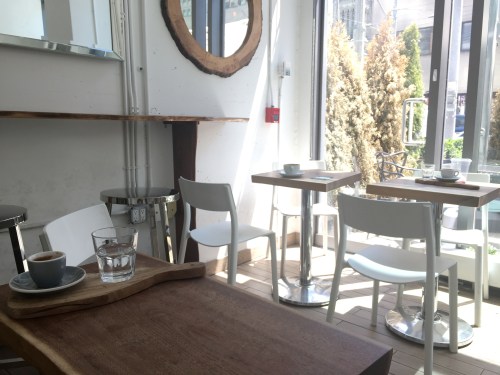
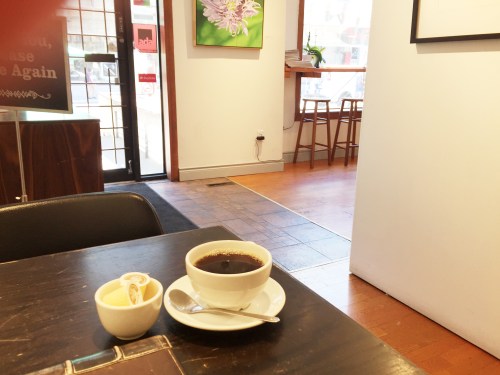
It’s early afternoon in Versus Coffee. The dudes in suits sweep through like a quick city summer storm, making a lot of noise and leaving a dirty mess behind but not really refreshing or invigorating the local flora and fauna. And then it is quiet again, except for the sound of keyboards tapping, staff chatting, and that thumping sweary music they’re playing, whatever it is. Continue reading

Art Square Café

Time to do some work.

Listen to me read this to you for free on Patreon.

Every weekday afternoon I go work in a coffee place. Not the same one every day. I go back to some of them fairly often, but almost every week I try at least one place I haven’t been before. And I’m not close to running out of places yet. Toronto has hundreds of them, and I mean literally literally hundreds. This city runs on caffeine and not everyone gets theirs from Tim Hortons and Starbucks.

So I’m going to start writing about them because I feel like it. And also to taunt everyone who doesn’t live in Toronto or doesn’t have the chance to go work in a different coffee place every day. I’m calling this series Coffice Spaces because it’s for the squillions of text workers and other wandering drudges who use the co-office coffee spaces in town.

The first one I’ll write about is the one I’m sitting in as I write this, Art Square Café, which I have not been in before.  Continue reading

dudgeon

Have you ever heard of someone being in low dudgeon?

When someone’s in a dudgeon, when they leave a party or premises in a towering snit, when their dignity has been endangered and they will hold more grudge than an ordinary curmudgeon, if the altitude of their derangement is mentioned – and it often will be – it is always high. Continue reading

Season your fiction just right

This article was originally published in NINK, the magazine of Novelists, Inc.

Can you tell when and where (America or England) these passages were written? (And I promise the answers will be revealed.)

  1. When we were summoned to dinner, a young gentleman in a clerical dress offered his hand, and led me to a table furnished with an elegant and sumptuous repast, with more gallantry and address than commonly fall to the share of students.
  2. She wore the hood set back off her square honest face and showed her hair, dark brown with a tinge of Tudor red. Her smile was her great charm: it came slowly, and her eyes were warm. But what struck me most about her was her air of honesty.
  3. I was so vexed to see him stand up with her! But, however, he did not admire her at all; indeed, nobody can, you know; and he seemed quite struck with Jane as she was going down the dance.

Continue reading

Pronunciation tip: jalapeño and habanero

I made a little trip (two blocks) to my greengrocer at the St. Lawrence Market to shoot this pronunciation tip, just so I could illustrate it. It was a one-shot deal… and not without technical difficulties. But hey, I say the words, I eat the peppers. What more do you want?

wect

…Then we were wect,
Riding on the moment-stream
As twoseafarers moonlight-wrecked
And gazing after fading steam,
Naked on an unknown shore
And walking in a waking dream
Unmoored from after and before…

I almost want to stop there, with those lines from Emily Saint Christopher’s “Late Diversion,” but a characteristic of being wect is that you keep on going, drawn forward as by an invisible thread or wafting on a thin streamer of smoke.

Wect is a word that appeared in English almost as if from a dream made real: it’s not quite clear where it came from, but it may be related to wake – if by ‘wake’ we mean the feeling you have after parting the curtains of a deep afternoon slumber and wandering sleep-stoned in the waning daylight. But really it is, as Emily Saint Christopher wrote, “Walking in a waking dream Unmoored from after and before”: a timeless state of mind, narcotized by the infinite moment. Awake but as if dreaming.

It is a word for the most magical summer evenings, when every passing light is a fairy and every nearby voice is trapped in an amber of warm sorcery: an hour lying on the grass in the slowly swirling dark, exploring the contours of the ground and grass and of the person twined with you; a walk along the beach in viscous air through passing strands of talk and music, the only shocks of light coming from sporadic fireworks or distant electric storms; a stroll through James Joyce’s Circean Nighttown, the dimmer corners in orbit of Harvard Square under the dog star, a swim through the night crowd on Church Street in Pride, or the tail end of an evening at EPCOT; a dip in a warm pool lit by stars and underwater glow; a walk alone or in a pair on the high empty deck of a Caribbean cruise ship at midnight and a half, staring at the rushing white creases trailing away in the borderless bottomless rippling blackness. You are holding a little detached swatch of reality, and you will pocket it in your memory to take out later and rub gently in your hand and dab at the corners of your eyes.

It’s a crisp-ending word for such a smooth thing, but such is language. Not everything is as you expect it; take what comes to you. This word came to me tonight, drawn from random letters; the poem and poet are my invention. It is a new old word. Cherish it and walk with it.

Don’t die a critic of diacritics and special characters

Do you always get your accents and special characters right in non-English words? Or are you sometimes unclear on which is which, and maybe not sure what difference it makes?

Well, lucky you. I spent quite a bit of time recently putting together charts for a presentation I took part in at the 2018 Editors Canada conference. They list the most common ones, some of the languages you’re likely to see them in, and the kinds of differences they can make – cases where the presence or lack of a little mark can turn something innocent into something dirty (or vice versa, which is sometimes even worse).

Here they are. It’s a PDF, but it’s small: accents_characters_harbeck.pdf

cantrip


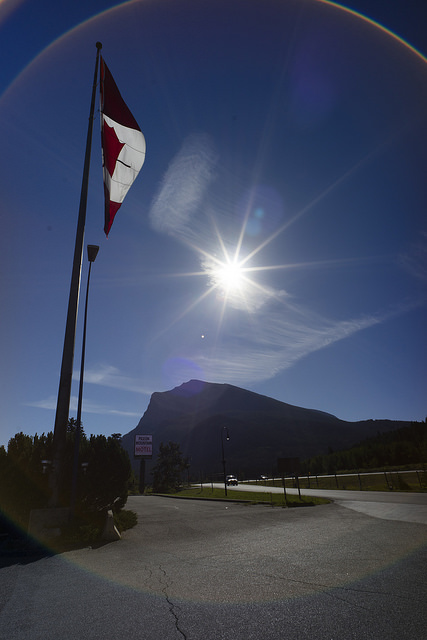
Canadian flag by the Trans-Canada Highway at Pigeon Mountain, Alberta

Is there really a Canada, or is it all a cantrip? Lines on maps can trip you up; best take a trip across so you can see.

Not that cantrip as a word is related to Canada or to trip. It refers to hocus-pocus, a witch’s spell, a charm, a trick, a mischievous device. But such captious catnip can come from maps and capitals. And since we are today celebrating 151 years of a country called Canada, let us just look and see whether it be not a trick of optics. Continue reading