Category Archives: photography

al fresco

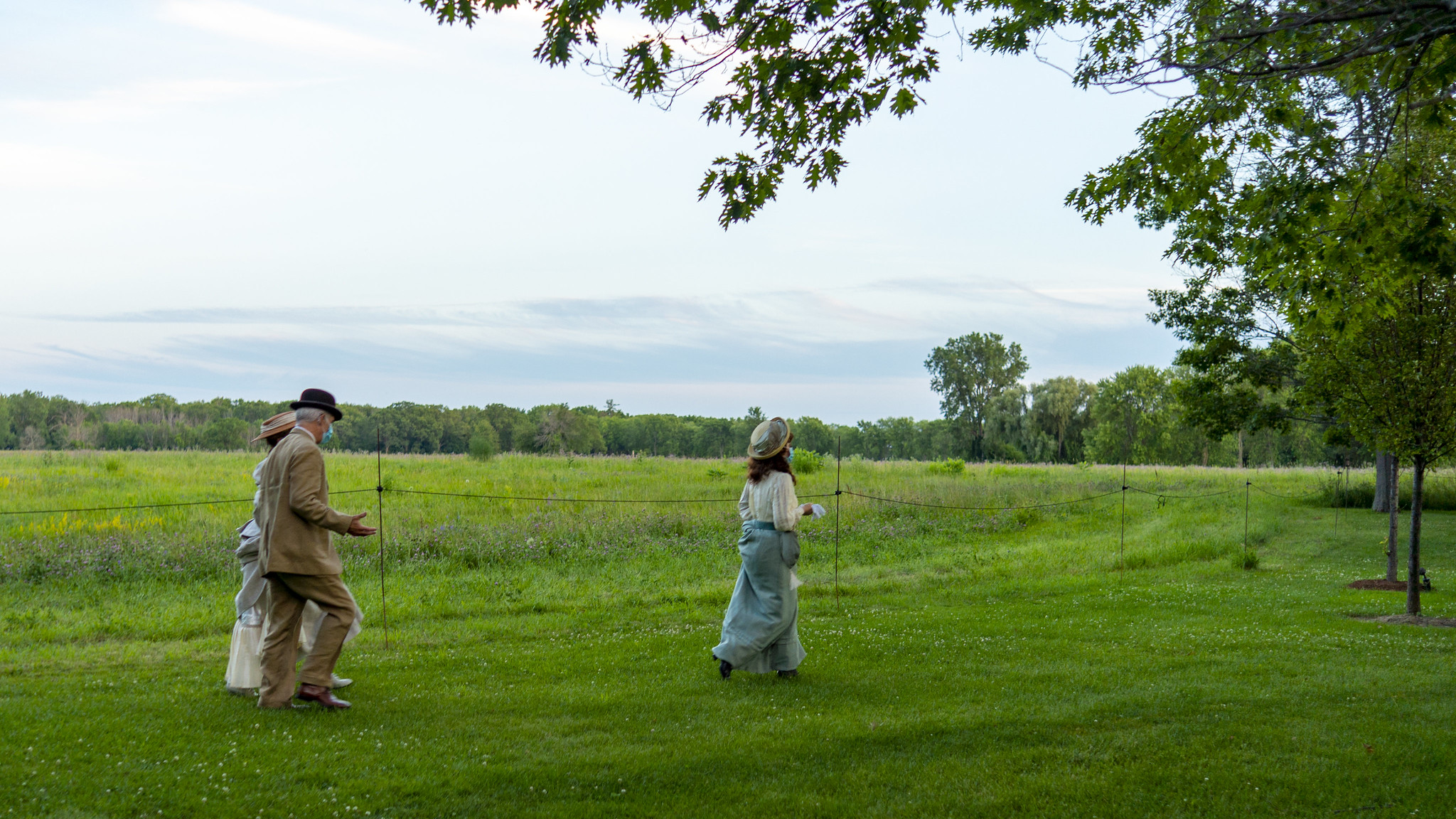
Yesterday, for the first time in 16 months, we saw a play. But this one had a fresh perspective: it was done al fresco.

Ontario is still easing out of its Covid lockdown, so indoor theatre is out – and so (for a few days yet) is indoor dining. But it’s warm enough that we can do these usually indoor activities outdoors, in the warm summer air. Al fresco. So to speak.

Al fresco: in the fresh air, right? Fresh and clean and clear, constantly refreshed by currents and so relatively free of the accumulated exhalations of indoor atmosphere? Well, yes, but there’s fresh and then there’s fresh. And that’s the ironic part. Well, it’s one of two ironic parts.

Fresco, you see (also fresca in the feminine), is Italian for ‘fresh’ (as in ‘fresh plaster’ in the kind of mural called a fresco), but it generally carries a sense of ‘cool’. If you dine al fresco, it’s in the fresh air, yes, but in particular in the cool (or cooler) air. That doesn’t mean that al fresco dining in Italy (or elsewhere) is only said to be such when the outdoors is cooler than the indoors, but there is that tone to it.

And, indeed, if we had made the phrase in English, in the fresh (as in “We’re dining in the fresh today” – sounds entirely plausibly English, doesn’t it?), there would also be something of that sense, because even though we use fresh more to mean ‘not cooked’ and ‘not stale or rotten’, we are still aware of the ‘cool’ sense – “A bit fresh out today, isn’t it?” But we don’t put it that way because, for one thing, we got the phrase from Italian, and for another, we like the Italian sound of it. “Would you like to dine in the fresh?” sounds like PG Wodehouse or EM Forster; “Would you like to dine al fresco?” sounds… inviting, really.
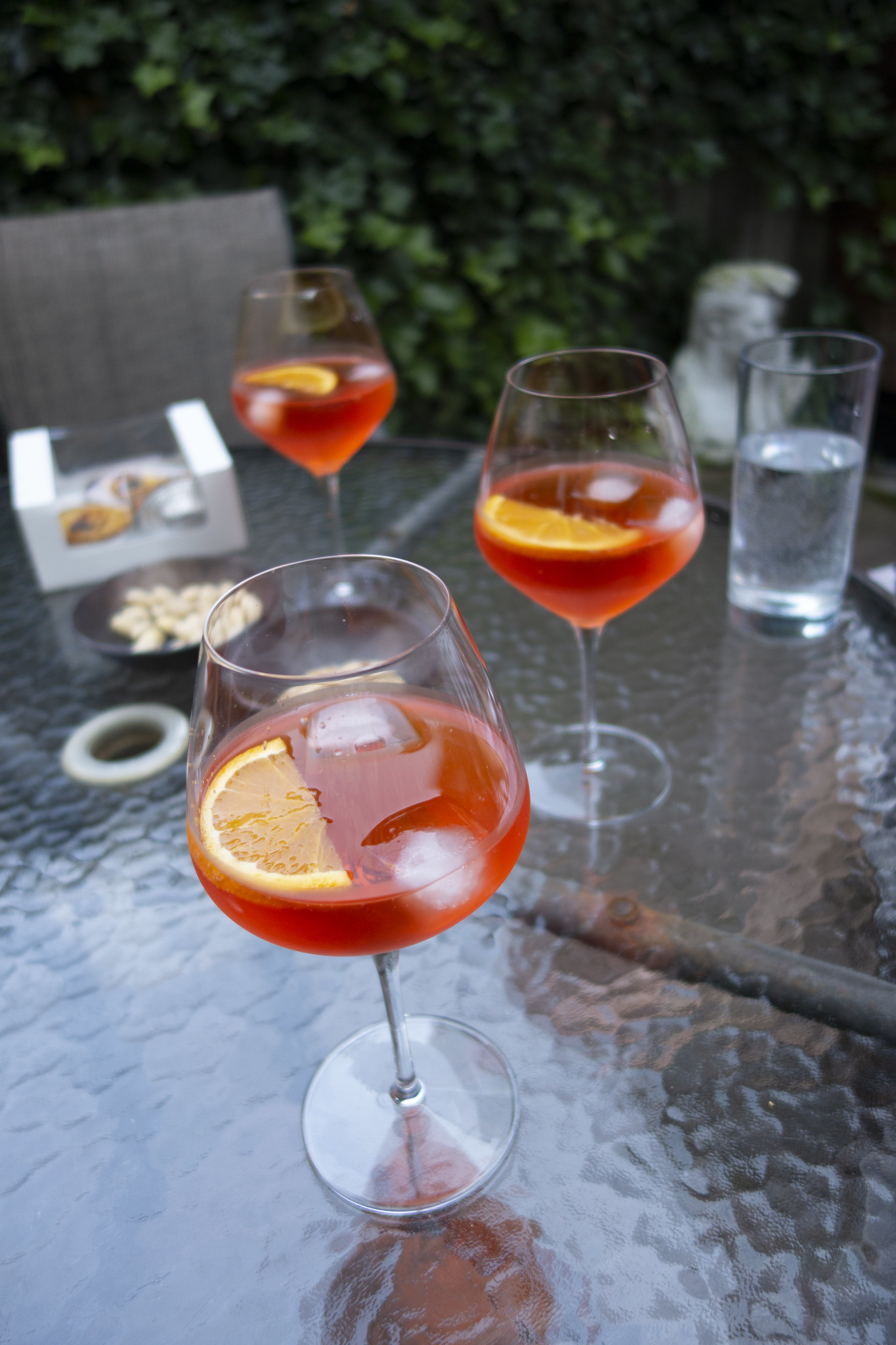
That, however, is the second ironic part. Perhaps you have noticed that fresh and fresco seem like they could be related. They are, but not because fresh comes from fresco. No, both words trace back to Proto-Germanic *friskaz; Medieval Latin acquired it as friscus through contact in Lombardy. And *friskaz meant… ‘fresh’ and ‘unsalted’. In other words, fresh as in fresh water, and fresh as in unpreserved food. The ‘cool’ sense followed on thereafter.

All of that, following through to the present (including the borrowing of al fresco into English in the early 1700s), means that we can have go from an air conditioned house onto a patio to eat bacon and other cured and salted meats, as well as cheese and cooked foods, in warm (even very warm) air, and it will be dining al fresco.

We can also go see a performance of an old farce in warm air, likewise al fresco. But you know what? It was refreshing.
conference

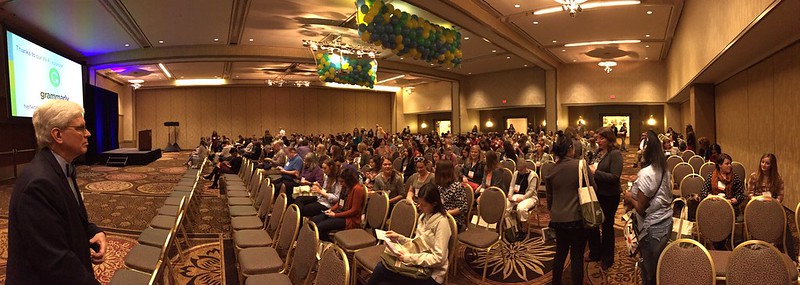
This weekend I’m attending the Editors Canada conference. And this year it has been… different.

Every year, I attend two conferences for editors, one in Canada, one in the US. In 2020, for reasons of global plague, both were cancelled; in 2021, both have moved online, at least for this year.

Before I became an editor, conferences I attended were academic ones – specifically theatre studies and performance studies. But the model was the same. Conferences are organized around speeches and presentations, some to smaller groups, some to bigger ones. You get to learn about all sorts of interesting and relevant ideas.

And then there’s what they’re really about.

Conference is a word that is used for more things than this sort of gathering, as we know; it can be a small meeting (between a lawyer and a client, for instance), or a grouping for the purposes of sports (the Eastern Conference of the NBA, for instance) or religion (e.g., certain sets of Methodists), or any of several other assemblies of people. Conference is the noun form of confer, which comes from Latin confero, from con- ‘together’ plus fero ‘I bear, I carry, I bring’.

And conferences are about bringing people together.

They’re about not just listening to information, but listening to it sitting next to someone interesting you just met. They’re about not just laughing at a witticism, but laughing about it in a room full of people. They’re about sneaking into a session late, sneaking out of a session early, standing listening at the back because the room is too full, live-tweeting, asking a question in person, sharing in the silent group indignation when someone goes on a rambling more-a-comment-than-a-question.

They’re about big rooms full of hundreds of people with a common interest, and smaller rooms with fewer people focusing on a niche subject.

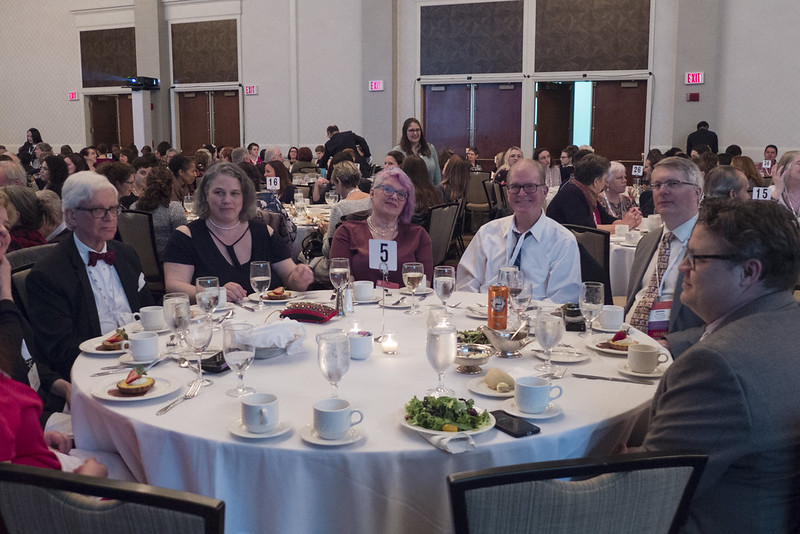
They’re about banquets, with their curious mix of pro forma, exciting, starchy, and awkward presentations, plus the infinite logistical vagaries of mass food.

They’re about standing in front of a room full of people, talking to them as a group, seeing their faces, hearing them respond, and then getting to chat with some of them afterwards.

They’re about sitting at a picnic table with people from several continents, having lunch and talking about whatever really interests you.

They’re about bumping into people at receptions. They’re about banquet table strategy. They’re about going out touring the town and seeing other people from the conference doing the same.

They’re about sitting in a lobby bar, or a local pub, or someone’s hotel room, until rather late in the evening, with people you get to see in person for three days each year, talking about what’s happened with you and what you’ve seen and how business is going and…

They’re about getting to meet people in person whom you’ve long admired from a distance – or, these days, long interacted with online (more or less mutually).

They’re about group outings, and silent auctions, and events such as dance-offs and spelling bees (yes, really), and playing cards or Scrabble (or both) in the lobby.

They’re about all sorts of human interaction and observation. (And they’re about the best occasion you could ever want for taking pictures of people.)

But when you can’t get together in person, they’re still about coming together. Webinars are justly reviled – from the audience perspective, they’re not very engaging, and from the presenter perspective, they’re talking into the void, disorienting, unnerving, panic-inducing – but they do let you slip in late and slip out early without being noticed, and they do make question-and-answer less susceptible to domination by the most aggressive. And the small-group meet-ups – I took part in two of them today – still let you talk to other people and see their smiling faces, not to mention whatever part of their residence is behind them. And they let people from many places come together with minimal expense or inconvenience.

But online conferences still bring only about ten percent of what I go to a conference for. They don’t bring the same togetherness.

So I look forward to seeing people in person again… next time!

solitude

Laurie Anderson said,

Paradise
Is exactly like
Where you are right now
Only much much
Better.

I have a similar thought about solitude: Solitude is exactly like loneliness, only much much better.

To put it another way, the difference between loneliness and solitude is that you hate the one and want the other.

I spent many years in corrosive loneliness, single, unattached, walking miles by myself hoping to find someone else but unable or unwilling or afraid to reach out. Now, I happily go for long walks or runs by myself, because I know there is someone there for me when I get back. I can be by myself because I know I have friends who will spend time with me. Being apart from others is no longer a subtraction; it is an addition.

Solitude, etymologically, means exactly the same thing as loneliness: sol- as in sole, solo, solivagant, plus -itude; lonely plus -ness, where lonely is lone plus -ly and lone in its turn is shortened from alone, which is from all one. (The difference between only and lonely, etymologically, is just that the latter has the last remnant of all.) Why have they gained different tones? I don’t know for certain, but I have a guess: poetry. Solitude comes from French, which took it (altered) from Latin, and poets for a long time, especially in the educated and courtly traditions, preferred the classically derived words. Lonely comes from base old English, the language of the commoners when, after the Norman conquest, the rich spoke French. Rich, well-educated people can afford solitude; poor peasants are stuck with being lonely.

There’s no shortage of poetry on solitude; just search “solitude” at poetryfoundation.org and see. You will also find enough entries for solitude in Bartlett’s Familiar Quotations. Some of it is very much the kind of mood I like, when I like that kind of mood:

That inward eye
Which is the bliss of solitude

—William Wordsworth

I never found the companion that was so companionable as solitude.

—Henry David Thoreau

She would not exchange her solitude for anything. Never again to be forced to move to the rhythms of others.

—Tillie Olsen

For those of us who have been too much isolated, solitude is not available, only loneliness. But for those of us who are well supported and have as much social contact as we need – or perhaps even more – solitude can be a sweet gift, a refreshing time away.

And it doesn’t need to be in the far countryside. It can be in the middle of a city. If you can be alone in a crowd, you can have solitude in the heart of a city.

I wish you as much solitude as you desire, and as little loneliness as you want.

More thank-you gifts

I’ve already mentioned that I’m going to send a copy of my photobook PAINT to everyone who’s sponsoring me on Patreon for $5 or more per month. Since I announced that, my number of Patreon sponsors has gone from 16 to 15.

Um.

So OK, I have lots of copies of my other books sitting around, already bought and paid for, and so I’m going to send a free copy of your choice of Songs of Love and Grammar, Confessions of a Word Lush, or 12 Gifts for Writers to everyone who is sponsoring me on Patreon for $2 or more per month (and yes, that means that the $5 or more people get PAINT plus one of those books). If you are sponsoring me for at least $2 a month as of January 1, 2021, you will just need to send me your address and tell me which book you want and I will mail it to you.

If you’re sponsoring me for at least $1 a month, I am extremely grateful, and you get a free PDF of PAINT and advance views of some blog posts, but I can’t quite afford to mail you a printed book for free… but I will send you one for the cost of postage if you want; just message me on Patreon.

Maybe next year I’ll have a book in the pipeline that you can buy in an actual physical bookstore… and maybe you’ll even be able to go shopping in one!

PAINT

I’ve made a book. It’s a book of photos, but it has words in it, because they’re photos of graffiti. Not clever or funny graffiti, just graffiti that I find very visually attractive: the colours and textures and patterns. The book is available at Lulu.com in softcover (a hardcover will be coming, but due to factors beyond my control, the list price will be excessive). But I’m also going to send a copy of it to everyone who is supporting me on Patreon for $5 or more per month as of December 31, 2020. Also, I’ve made a PDF of the book that’s available for free to all Patreon supporters regardless of level. (I have almost 20,000 subscribers to Sesquiotica, but right now I have only 16 – sixteen – patrons on Patreon, and most of them are at $1 or $2 a month. It barely covers the cost of running the website.)

And I’ve made a video of the book. Take a look! (Advance warning: there are some vulgar words in it, because of course there are, it’s graffiti.)

Elvis

August 16, 1977. A summer day 42 years ago. The King of Rock and Roll, Elvis Presley, was found dead in his bathroom. He was 42 years old. Continue reading

negative

Negative is a negative word. Right?

Are you positive? Continue reading

16 insights for photographers

I don’t earn much of my income through photography. People don’t pay me for advice on how to take pictures. However, I’ve been taking pictures – with proper full-control cameras in several film sizes – since I was about six years old.

I learned photography, including darkroom developing and printing, from my dad, who was a professional photographer at the time. I love photography, I look at a lot of photographs, I take a lot of photographs. I also love photographic equipment and I know a lot about it.

So, as a little cherry to put on top of my 12 days of gifts for writers, here – in one day – are 16 insights for photographers. If you’re a lifelong serious photographer, each of these is probably something you already either know or disagree with (or both). If you don’t care about photography, skip this. If, however, you like taking pictures but would like more thoughts and insights, here are some things I’ve observed that might be useful to you. (If you don’t like frank language, well, be forewarned.) Continue reading

philobiblist

Last weekend, Word on the Street happened at Harbourfront in Toronto. The lexically lascivious and philosophically bibulous went on a spree. Many a booth had many a book and many a buyer went on many a page bender, adding liberally to their bibliographic lists without the need of fiscal phlebotomy. Continue reading

Chicago

Hog Butcher for the World,
Tool Maker, Stacker of Wheat,
Player with Railroads and the Nation’s Freight Handler;
Stormy, husky, brawling,
City of the Big Shoulders
—from “Chicago” by Carl Sandburg

Chicago was a big, young, driving, thriving city in 1914 when Sandburg wrote that. It had already been the home of the first skyscraper and was destined to be home of many more; it had seen its famous fire in 1871, and the World’s Columbian Exposition in 1893 (which gave us the term midway); it was already a mid-continent commercial nexus and had for a time been the fastest-growing city in the world; it already had its famous elevated train loop around the central district. It had not yet seen the roaring ’20s and their gangsters; it was not quite yet the place about which the musical Chicago (set in the 1920s) was written. It did not yet have its famed deep-dish pizza, which first hit plates in the 1940s. It was not yet the town of the 1964 song “My Kind of Town,” made famous by Frank Sinatra. But it was all there, sprouting and growing, like a bulb (or perhaps a whole field) of wild garlic in the heart of America.

I recently had the pleasure of spending a few days in Chicago for the conference of ACES: The Society for Editing. We were at the Palmer House, now a Hilton hotel; it’s in the middle of everything, pretty much. It has a glorious lobby, a dimly lit cross between Grand Central Terminal (or should I say Union Station, since it’s in Chicago) and the Sistine Chapel, dominated by a busy cocktail bar. Up a grand staircase is the Empire Room, which through the heart of the 20th century hosted every entertainer who might perform in such a room (their photos line the hallways by the guest rooms) and this past week hosted a spelling bee for editors as part of the ACES conference (I was one of the judges, having won the event at last year’s conference). We also had events in the Chicago Athletic Club, which is no longer an athletic club – it has a hotel, bar, and event spaces in its classic old building.

Chicago is home to many classic old buildings. It has shiny newer buildings, to be sure, including the second and third tallest in the US, but it has not gotten rid of its gems from its booming years, all the American art deco and prairie style designs, all the steel and stone. This is a city that never stops reminding you that it was the epitome of architectural chic several decades ago.

Which is not where its name comes from. Chicago is a French-style rendition of a word from the language of the Miami-Illinois, an Algonquian people: shikaakwa, the name for a plant that grew abundantly in the area. The Latin for the plant is Allium tricoccum; it is more commonly called ramp, wild leek, or wild garlic. It’s smaller than a leek but larger than garlic.

To me, Chicago feels like a cross between Toronto and New York – it’s smaller than New York, more comfy and manageable in its central area, and with a nice lakefront, and often reminds people of Toronto in ways, but it has the urban grit and American empire feel of New York. I took some pictures at the conference. You can see the whole album on Flickr, but here are a few.