Petroselinum crispum, an herb both savoury and ornamental, in some cuisines seen fit to be a principal ingredient, as in tabbouleh; in some to be a key seasoning, as in its role as a component of a bouquet garni and as one of the four axiomatic herbs of English folk-song; and in some to be a garnish appended to a plate of steak and tomato and returned to the kitchen most often uneaten, therefrom perhaps to be recirculated. Continue reading →
Some lovely day, seven hundred and thirty or more years ago, sweet and heart came together.
Both were words that had been in English since before English was English, with roots far, far back, and cousins from India to Iceland.
Sweet, a word everyone loves, had grown from a Proto-Indo-European root that also became Latin suavis ‘sweet, delicious’, now bequeathed to us as suave, and Greek ἡδύς (hédus) ‘pleasant’, now at our masquerade ball as part of hedonistic, along with a swath of other words meaning ‘sweet’: स्वादु (svādú), soave, süß, zoet, søt, sætur…
Heart, which beats blood but also pumps emotions, had a similar history at the heart of languages strung between Kangchenjunga and Snæfellsjökull, from हृद् (hṛ́d) through καρδία (kardia, whence cardiac) and Latin cor (whence courage) and cœur and serce (whence serduszka as in “Dwa Serduszka Cztery Oczy”) and Herz (even if your heart beats at less than 1 hertz, it is still dein ganzes Herz) and hart and hjarta…
As when two famous and glamorous people are in the same restaurant at the same time, it was inevitable that these two would soon enough spot each other and come together. And by 1290 they had, as swete heorte, which is how they looked when they were young and wild and free. For Chaucer, the happy couple were swete herte; for Shakespeare, sweet-heart. And for Dashiell Hammett, sweetheart.
Like any famous couple, they show up in many places, even where you don’t expect them. You can buy small sugar hearts called Sweethearts, each bearing a message (like a confectionary fortune cookie); you can make a sweetheart deal if you’re negotiating a contract. They also have their imitators, such as the band Streetheart. And of course “sweetness heart”:
But you want your true sweetheart, especially at Valentine’s (which, as a celebration of romance, is newer than this word, sweetheart). And you will want your sweetheart to let you call them sweetheart:
That was a hit in 1911, and it kept coming back…
Sweet and heart, together once and forever in English, though their cousins in other languages have never paired off in parallel.
Not all sweethearts are forever, though we can hope. But all sweethearts are like sugar in the spirit, a treat to enjoy, even if just for one day, as Charlotte Mew wrote a century ago:
Fin de Fête by Charlotte Mew
Sweetheart, for such a day
One mustn’t grudge the score;
Here, then, it’s all to pay,
It’s Good-night at the door.
Good-night and good dreams to you,—
Do you remember the picture-book thieves
Who left two children sleeping in a wood the long night through,
And how the birds came down and covered them with leaves?
So you and I should have slept,—But now,
Oh, what a lonely head!
With just the shadow of a waving bough
In the moonlight over your bed.
It’s a Barmecide feast, a Potemkin village. It’s like internecine, comprise, meretricious, or one of Benjamin Lee Whorf’s “empty” gasoline drums. If you go by what it looks like, even by what you’ve seen other people treat it as, you will end up in Fulsome Prison.
“At the end of the day, this is, you know – and it’s important to have, it’s important to understand these things – but in the final analysis, we’re going to make sure that the people who work hard for their families, that when it comes down to it, there’s an opportunity, and I want, and I think you all understand and respect, but there are priorities, and we need to make sure we take action on what matters.” Continue reading →
The other day, while playing Scrabble, I saw that I could play the word RANTICLE… if only it were a word. Well, I want it to be a word. And obviously it’s a canticle that’s a rant, or a rant that’s a canticle. Or maybe it’s just a little rant. Whatever. Here is a ranticle for you! (Click on the audio above to hear me sing it.)
Here’s to the people you see every day
Who stop on the sidewalk, ignoring the fray,
In ones, twos, and sixes, and get in the way:
Watch what you do! What’s wrong with you!
Here’s to the chuckers of trash on the street,
Of wrappers and cigarettes under your feet,
Who think it’s for others to keep the world neat:
Watch what you do! What’s wrong with you!
Here’s to the grammar creeps stuck on correct
Who pounce on each error they chance to detect
But treat fellow humans with zero respect:
Watch what you do! What’s wrong with you!
Here’s to the journalists, eager for story,
Who haunt the bereaved any time it turns gory,
And zoom in on tears of the upset and sorry:
Watch what you do! What’s wrong with you!
Here’s to the drivers, lead foot on the gas,
Who hang on your bumper, so eager to pass
That if you slowed down they’d ram right up your… tailpipe:
Watch what you do! What’s wrong with you!
Here’s to the whiners who always protest
When some inequality might be redressed
And by “common sense” mean they get to be best:
Watch what you do! What’s wrong with you!
Here’s to the thoughtless, whatever their station,
In things of the neighbourhood and of the nation,
Who can’t spare two seconds for consideration:
Watch what you do! What’s wrong with you!
I can’t help falling in love. With words. With art. With artful words. With wordful art. So, with Ele Davis’s permission, I’m sharing with you one more of her paintings and word choices that I saw at The Gentry in Cochrane. It is a particularly enamored, smitten word, and a subject painted lovingly, with all the red and blue shades of the heart. All of which says forelsket. Continue reading →
Do you go alone? Do you step out the door – of your home, your hotel, your hostel, your hospital – driven by some vague motive, and put foot ahead of foot, seeing the street or the trail stretch ahead of you, the buildings or trees bleeding past in perspective, wanting to move and keep moving, to be the river through life? To see people and other creatures and walk through the waves of their breath and feel the hum of their bodies and minds as they move past? To wonder as you wander out under the sky? Are you thirsty for everything and nothing to be significant? Are you solivagant? Continue reading →
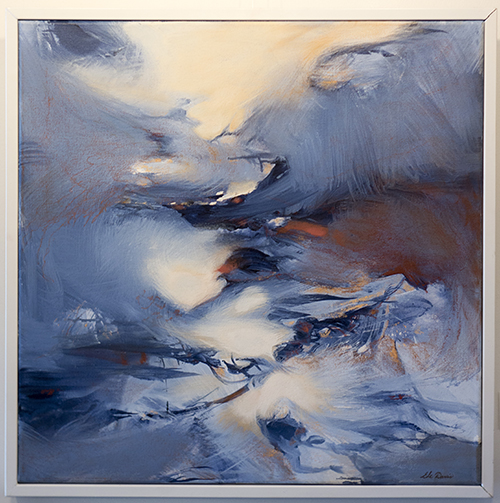
Beauty is useful but not necessary for a good artistic effect. There are many works of art that are beautiful, of course, but there are others that are not. What they all have in common, if they are effective, is that they make us stop and look, and look again: they draw us in, entice us to explore further, to see how deep our minds can get into them. It is like a glass of a well-made wine, or an interesting look on a person’s face, or a word that just charms us: there is more, and more, and more, and we follow it as it lures us onward.