Killarney

Sometimes memory and experience sanctify small details, even the dark and spiky ones. A little thing can make a big difference, and a gap may be a high point.

After we left Dingle in the late afternoon, we headed to Killarney for our overnight stay. A friend of mine had assured me that if I had time to kill or just wanted to take it slow, Killarney would be the place. Continue reading

bairdeán, barjaun

Tá se ina fhear dhrochbhéasach. Níl ann ach bairdeán.

That means “He’s a rude man. He’s just a barjaun.” (Or, more literally, “He’s in his rude man. Nothing’s in him but a barjaun.” Irish uses prepositions a lot more than English does.)

You don’t know what a barjaun is? You may be one! Most Canadians and Americans probably strike the average Irish person as a barjaun. In my experience, Irish drivers are far more polite on average than North American ones, and Irish people on sidewalks are also more considerate in general. This may be because the width of the roads and sidewalks forces it, but I’ll tell you this: When I was driving there, when someone had an opportunity to jam in ahead of me or cut me off, they rarely took it. Compare that to around here, where you just expect it. Most people around here drive like barjauns. (And don’t say “Well, that’s Toronto.” I’ve driven all over Canada and the US. And I’ve walked on sidewalks all over Canada and the US too. On average people are barjauns almost everywhere in these two countries.)

So, yeah, that’s what a barjaun is: someone who is disposed to, well, barge on. Or barge in. Grab a spot. Cut in ahead of you. Cut you off. Show no consideration for another person in the traffic flow. It’s so common in much of North America that you’re surprised when someone doesn’t do it. But it’s not usual in Ireland. Not from what I’ve seen, anyway. So we don’t find ourselves using a word for the kind of person who does it because they’re the default. But the Irish can use a word for it.

Barjaun is of course just an English respelling of bairdeán, which is pronounced the same way. That –án ending is a diminutive substantive suffix that is sometimes negatively toned. You’ll recognize it in leprechaun (Irish leipreachán). Another word that has made it into English is omadhaun, from Irish amadán; it means ‘fool’. (If you’re thinking, “Hey, Mike Oldfield made an album called Ommadawn, is there any relation?” the answer is yes! Oldfield asked the singer Clodagh Simonds to give him some nonsense syllables, and Clodagh gave him what is actually Irish. In the vocal section, you can hear something like “Taw may on ommadawn eg kyol,” which is really the sentence Tá me an amadán ag ceol, which means “I’m the fool making music.”)

Some –án words have transparent morphology – for example, beagán ‘little bit’ is just beag ‘small’ plus –án. Others trace farther back through time. Leipreachán has another form luprachán that is thought (though not by everyone) to come from Old Irish lú ‘small’ plus corp from Latin corpus plus –án to make lúchorpán, which swapped some sounds around over time. Amadán comes from an Old Irish word for ‘fool’ or ‘simpleton’ plus that suffix just to drive the point home.

And bairdeán? It might be related to bairdéar, ‘prison guard’ – a direct borrowing from English warder (in some contexts the becomes bh and is pronounced /w/ so bhairdéar sounds more like it). There’s no trail of evidence for that, though. Frankly, it could equally be back-formed from English barge on.

Frankly, it is. I just made it up. All the other information about Irish, including the other etymologies, is entirely true. But this word doesn’t exist outside of this little article… yet. It’s a new old word. And I think we could use it. A lot.

Dingle, Daingean

I make an audio version of each one of my blog posts for my $2-a-month subscribers on Patreon. I’m giving everyone this audio version for free so you can hear how the Irish words sound – and to entice you into subscribing. Listen to it (and subscribe) at patreon.com/posts/22182846

You know you’re in Ireland. You’re on a shoulderless one-lane road pasted to the side of the greenest cliff you’ve ever seen and somehow you’re still driving on the left. And the signs (such as the one telling large vehicles “TURN BACK NOW”) are in Irish first (“Cas Siar Anois” – for the curious, you say that like “cuss sheer a nish”), and you know you’re in the Gaeltacht (the Irish-speaking region) because some of the signs are in Irish only. Which can be a bit of an uphill struggle for some people, especially when it’s the only way to get by. Continue reading

Black Rock Coffee

IMG_8666

Lots of black, anyway, not sure about rock

Listen to this, complete with ambient sound, on Patreon.

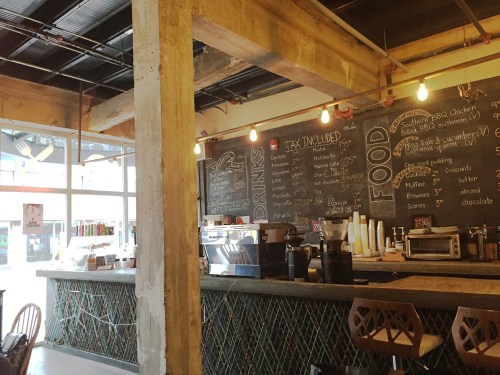
Most coffice spaces have windows on the street where you can watch people go by from one thing to another. All coffice spaces have the little windows of people’s screens showing the infinite depth and infinite flatness of their work and online amusement. But some coffice spaces also have other windows. Black Rock Coffee has a window on people building up their lives through climbing. Continue reading

Moher

When people come to Ireland, they see the towns, of course. Dublin, naturally. Galway or Cork, perhaps. A few others. But many people want to see more. In particular, they want to see Moher.

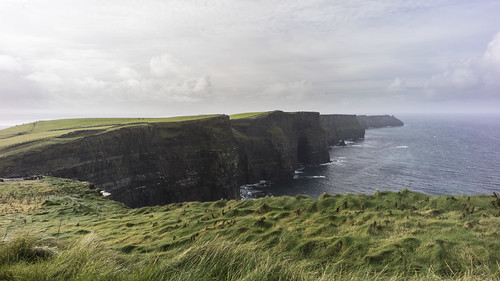
What is Moher? The mother of all cliffs – all Irish cliffs, anyway. The western edge of the emerald isle, breaking off and tumbling into the sea. Up top it may be coated with a mossy mohair of grass that has moo-ers for mowers, but the drop-off gets to 214 metres (702 feet), straight into the waters of the Atlantic. And of course someone (named O’Brien) built a stone tower on top of the highest point just to get a better view. Or to impress people. Continue reading

Galway

I’ve just gotten back from a week in Ireland with Aina, in case you were wondering where I’d gotten to. We saw a lot of the country and I took a lot of pictures. And the first county and city we unpacked our bags in was Galway. Continue reading

AGO Espresso Bar

IMG_8640

A different set of people around here

Listen to the audio version of this coffice space review on Patreon.

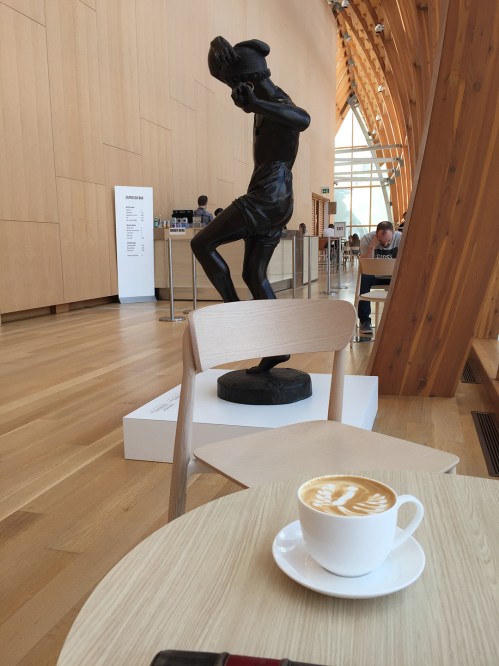
This coffice space is special. Continue reading

simulacrum

The very appearance of this word gives the impression of erudition. It may have an almost-complete lack at its heart, braced between mu (either Zen emptiness or Greek microscopy) and um (hesitation, inchoate incoherence), but it opens with si, an eternal ‘yes’ or an eternal ‘if’ or both. And it presents itself as Latin, a dead language that is the badge of a live intellect… or an undead one, anyway. Continue reading

cunctolimen

A cunctolimen is a kind of place that many of us hate to pass through, but nearly all of us do pass through several times a day. And some of us linger there. Which is why many of us hate to pass through it.

You know. You’re going through a door and someone ahead of you has stopped right there, checking out the surroundings or finishing texting on their phone. Or some people have chosen the spot right where the theatre lets into the lobby to have a conversation circle. Or you step into the subway train and the person in front of you stops right at the door rather than moving in to all that room in front of you, buddy. Or you’re at the top of some steps and someone is having their movie moment, pausing for the nonexistent camera as they survey what’s below. Or you’re getting off an escalator and the person ahead of you is not moving forward and hey! Scuse me! Sorry! Continue reading

thring

In the dark, they thring. They thring towards the blinding light. They thring against the fences, up the stairs, at the railings. They thring, arms upraised, reaching their electronic eyes in the palms of their hands towards it to see, to record, to remember.

Are they thriving? Are they thirsting? Are they furthering? Are they throwing or flinging themselves forward? They are thronging like some large multiform dark evolving thing. They are thringing. Continue reading