Monthly Archives: August 2018

karod

It’s just amazing how much money you can throw away with no return for no damn good reason.

Some of it is just lost coins in your couch, change dropped on the street, maybe a dollar you see disappearing through a sewer grate… maybe a twenty blown into the lake. Ouch.

Some of it is theatre tickets you forgot about. “When was that show?” [Checks tickets] “Um… two days ago.” Some of it is hotel or airline bookings made for the wrong day or the wrong place and not discovered until too late. Ouch!

For some people or companies, some of it is due to a misplaced comma or decimal in a contract. Now, that can really hurt. Continue reading

You know you want more!

Psst. Hey. Want something extra special?

Since 2008, I’ve posted more than 2,400 articles for free on Sesquiotica; more than a million visitors have come to read them, and more than 17,500 people have subscribed for free. They include word tasting notes, articles on grammar, serialized fiction, and my new series on coffee joints to sit and work in. I’ve also been making videos such as my pronunciation tips, which you can find here and on YouTube. But why stop at that? Continue reading

The Good Neighbour (Bloor Street)

Everyone’s here to drink coffee and do work

Listen to the audio version of this on Patreon.

There are ten two-person wooden tables in The Good Neighbour on Bloor east of Christie and, as I sit here, eight of them are occupied, each by one person, each person facing towards the window (or, in the case of the four side-facing ones, away from the wall), and all but two of them have a MacBook open – and those two are looking at phones and pads. Almost everyone has an iPhone on their table too. The music is pleasant and nondistracting (unless you strongly dislike folk or mid-century schmalz). This is a coffice space. Continue reading

versute

“The cabal of the versute gens de condition resorting to social evils necessitates some sui generis safeguards to be inherent in social laws to make up for the nether social position of the wronged person and checkmate the malengine and pravity of the powerful.” Continue reading

Let’s do the time Whorf again

Every so often, someone in a field such as economics comes up with something that seems to suggest that the language we use can affect how we think and even how we act. I’m not talking about obvious things (such as “How do you get 50 Canadians out of a swimming pool? You say, ‘Everyone please get out of the pool.’”). I mean what if, for instance, our grammar affected how we save for the future? What if our perception of time is conditioned by our language?

And all the linguists roll their eyes and say, “Whorf.” They’ve been down this road before. They reach for the mute button.

But what if both sides are overreacting a bit?

Read my latest article for the BBC:

Can language slow down time?

Balzac’s (Ryerson)

IMG_8350

(Mac)book, coffee, view.

Listen to this coffice space review (complete with ambient noise from the actual place) on Patreon.

Balzac’s is a local chain of coffee joints. They’re very popular and they make good coffee in all its wondrous forms. They have delicious snacks, too – I recommend the big peanut-butter parallelepipeds. And their locations are all nice looking, each in its own way. There are at least three of their outposts in walking distance from me, depending on what you consider walking distance. But I don’t often go to them to sit and work – especially not to the two nearest me. Continue reading

byrasa

This word came over a long time ago from Old Norse, and then we stopped using it. And then it came over again much more recently from Swedish, and it’s only beginning to catch on. And it may or may not be the same word, but yeah, I guess it is.

Well, you know, it’s like when things just somehow don’t make it from one department to another. There’s a communication breakdown. Someone in one office in your company has a great idea and has meetings and decides something should be done. And then… well, nothing actually gets done, because it never leaves there and goes to the people who could make it happen. And maybe later someone who can actually make it happen thinks of it, or something like it, and makes it happen. And you can bet the person who thought of it in the other part of the office will want some credit for it.

Sure, you could call it communication breakdown. But really it’s office breakdown. Swedish for ‘office’ is byrå, and the Swedish verb for ‘break down’ is rasa. Which, jammed together, has come to us.

Except that in Old Norse, byr meant ‘village’ or ‘farm’, and in modern Swedish, by means ‘village’. And as a real origin it makes more sense for byrasa first to have been village breakdown. You know, people who decide things decide things, and at some later time people who do things do things that at least somehow resemble the original decisions, so of course the people who decide things talk about how it was their decision, while the people who do things give them the stinkeye. Village breakdown.

In other words, byrasa is political or organizational breakdown, a communication and effect gap. Wheels spin independently of the driver. It gets to be a bit like that bit in the opening of The Simpsons where the baby appears to be driving the car. Now make that baby a boss – or a mayor or other seat-filler.

I don’t know if this word will get wings in English, though there’s certainly a use for it. It just looks a bit odd. Also, don’t ask any Swedes about it. What I said about the roots in Swedish and Old Norse is true, but I just made the word up from Scrabble tiles and backformed it. It’s a new old word. Well, someone had to do it. And someone else had to get credit for it.

Pronunciation tip: Zoltán Kodály

If you’ve never studied music, you may not have heard of Zoltán Kodály. But listen to this. He’s a Hungarian composer who can teach us something interesting about rhythm… not with his music (though that’s nice enough); with his name.

b Espresso Bar (Queen Street)

The one part of b that didn’t have any people in it at the time

Listen to me read this on Patreon.

I missed seeing b Espresso Bar for months because it’s just a half a block farther east than I normally go when I’m on Queen Street. It’s not the prettiest of blocks; the view out the windows is a parking lot across the street (also known as a future condo, because that’s what all parking lots in central Toronto are). Another block east and you’re at Moss Park. But a block west and you’re at Metropolitan United and two of the biggest and best camera stores in Toronto… plus a strip of pawn shops. Two blocks west of that is the Eaton Centre. This is not a neighbourhood “in transition”; this neighbourhood isa transition. It’s permanently between one thing and another, or maybe it’s just both and neither. Continue reading

Ongiara

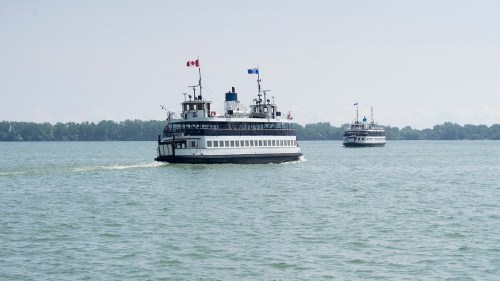
Yesterday evening, not too long before sunset, we left the beach. We balled up our towels, collapsed our fancy beach chairs, took up and shook out the big beach blanket, trudged across the sand, and took the boardwalk to the main road. Once we were off the beach and into the greenery, the air was full of the scent of a humid country summer evening, plus a bit of marijuana smoke from someone nearby. As we walked the road between the trees, we could see to the right a lagoon with a quay and several boats tied up to it; to the left, just on the other side of a tall chain fence, the airport with its turboprop planes; and ahead, above the trees, tall buildings and the CN Tower, just across the harbour. And then we got to the ferry dock and waited.

No other city I’ve ever been to has such a sylvan, bucolic retreat just across water from the heart of town. Toronto Island (and its associated smaller islands) is a gem of parkland, carefree and car-free; within a half hour from downtown, with no driving involved, you can be swimming a great lake in cottage-country surroundings. And what makes it so are the ferries.

DSC09039s

Boats that pass in the day

Continue reading