Category Archives: word tasting notes

schooner

Whence? Whither? We don’t know—
Fill up the schooner! How she schoons!
Hoist glass and sail and let us go!

The distant shore will host a show
Of distant stars and distant moons.
Whence? Whither? We don’t know!

Yes, shoes will walk, and arms will row,
But sail-ships scud across lagoons.
Hoist glass and sail and let us go!

Our breath is breeze, so let it blow;
We’ll ride our lungs like air balloons.
Whence? Whither? We don’t know!

Our lives are fluid; let them flow,
Not shine contained in silver spoons.
Hoist glass and sail and let us go!

And shall we bury treasure? No!
We’ll trade our jewels in saloons!
Whence? Whither? We don’t know…
Hoist glass and sail and let us go!

Who is not sparked to poetry by the sight of a tall ship? Or at least to imaginings? And hoistings of glasses? I set down the above villanelle just now in a libatious fraction of an hour. Here’s another poem, written a century and some ago by Richard Hovey:

The Sea Gypsy
I am fevered with the sunset,
I am fretful with the bay,
For the wander-thirst is on me
And my soul is in Cathay.

There’s a schooner in the offing,
With her topsails shot with fire,
And my heart has gone aboard her
For the Islands of Desire.

I must forth again to-morrow!
With the sunset I must be
Hull down on the trail of rapture
In the wonder of the sea.

Ah, the romance of the schooner, come from a distant past, heading to an uncertain future. Who would merely set shoe after shoe on soil who could sail a schooner on the sea?

What is a schooner? It’s a kind of ship, originally with two masts but sometimes with three or more; the foremast is shorter than the main mast. Schooners are larger than cutters, but smaller and easier to manouevre than frigates or galleons; they can move well with a small crew. They were, in their time, popular for fishing and shipping – and piracy.

One of the things schooners shipped was sherry, from Xerez in Spain. Sherry was traditionally served in two sizes of glass: a smaller glass was called a cutter, and a larger glass was called a schooner. From that, the name has transferred to beer glasses. In Australia, a schooner is a glass smaller than a pint; in Canada, it is larger than a pint (though you won’t find it everywhere).

Nowadays schooners are popular as tourist attractions. The star of Toronto’s harbour is a three-masted schooner built in Germany in 1930, originally named the Wilfried but bought in 1960 by a Danish captain and renamed Kajama after his children Kaywe, Jan, and Maria. It was bought in 1999 by a Toronto company – it is newer to this city than I am. The picture above is of the Kajama in Toronto harbour. Here’s a closer look (yes, taken with an old film camera).

The word schooner has a Dutch look to it, doesn’t it? The spelling does have a Dutch influence. But the word is not originally Dutch; it is English, or perhaps it is borrowed from Scots. The first schooner was (by some accounts) launched in 1713 at Gloucester, Massachusetts, and there is a probably apocryphal story connecting it to the Scots word scon, meaning ‘skip across the water’ (as a stone), by way of a bystander’s exclamation: “Oh, how she scoons!” We’re not really sure just how the word really came around. It was first spelled skooner or scooner, anyway. But the Dutch borrowed the word (with the ship), and made it schoener, which is kind of funny because schoen is Dutch for ‘shoe’. The current English spelling may have been influenced by that, or by school, or both.

You won’t see too many schooners these days. Unless you’re Canadian, that is. It’s true that most Canadians are not in Toronto or Nova Scotia (where other schooners may sometimes be seen), but all we need to do is look at a dime. The Canadian dime features the Bluenose, a schooner that was both a working fishing craft and a racing ship unbeaten for seven years in the 1930s. It was enough to get it onto the dime in 1937 (well, technically the image on the dime is a composite of the Bluenose and two others, but never mind), and it’s been there ever since.

But the Bluenose itself (or herself, if you hew to that usage) ended up in the Caibbean. A nice retirement? Not exactly. Fishing schooners were displaced by motorized boats in the 1930s, and the Bluenose was sold to work as a freighter. It wrecked, laden with bananas, on a reef off Haiti in 1947, just 10 years after making it onto the dime. No one died in the wreck – other than the Bluenose. You can go see a replica at Lunenburg, Nova Scotia. Or just pull out a dime, if you’re Canadian.

And if you carry cash. Many people don’t these days; coins seem to have an uncertain future (the Canadian penny has already gone under). But go to a pub and order a pint – heck, order a schooner – and hoist it to the Bluenose and other sailing ships, and while you’re doing that, look over at the bar for a glint like a star. It may be a dime, left as part of a tip, half-submerged in a lagoon of ale. Wish it a safe journey – but not a dull one.

foldbold

My dwelling is an ecosystem of sorts. Yes, it hosts two people and some gradually dying deracinated flowers, not to mention all those unpleasant little bugs in the kitchen, but there are also the many books and magazines and pieces of music and books and artworks and – did I mention the books?

Yes, they are not what is normally considered alive, although they once were parts of various trees (among other things). But they have a living traffic of words, images, and ideas to and from the minds that inspect them. And words that appear one way in one of them appear another way in another. Also, they move.

Don’t believe me? Look at this stack of books on a stool (currently doubling as a side table). Obviously they belong on the bookshelf, right?

So if they belong on the bookshelf, how did they get onto the stool?

OK, fine, I put them there. Because I’m not done with them. I pulled them off the shelf to look at and have not achieved emotional closure with that liaison. Or I forgot to put them back. Or I acquired them and have yet to put them on the bookshelf for the first time because I’m still reading them (ones that I haven’t started reading yet may be on the floor), or I’m done reading but I want to refer to them or lend them to someone else. I have not made so bold as to return them to the fold.

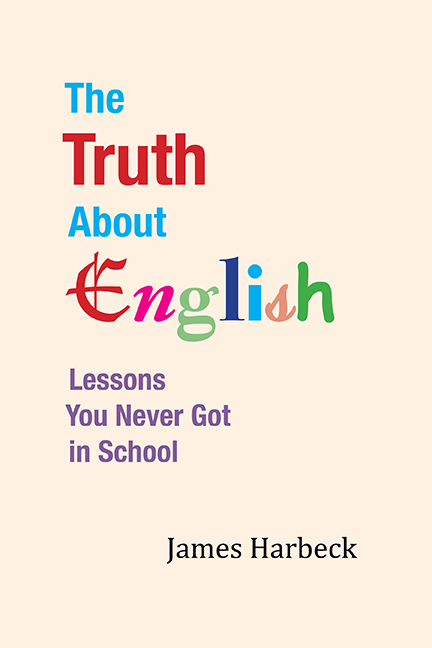
Like this one on top. Here, let me show you the cover.

Its author, David Lukas, is a naturalist, a bird specialist, who became enchanted by the world of words. O brave new world, that has such creatures in it! (Yes, I know that’s not quite the original quote. Words can move around in living minds.) Such beautiful, sensual things, wild and free, shaped by the mental ecosystem, the community of minds, flying and landing, and reproducing and evolving. And, on the other hand, words and word parts are like tools, tools that we can use to touch the further world, tools that we can fashion from parts available to us.

So he wrote this book. It is at the top of this stack because I have been diving into it like a forest pool every so often since I got it. (I acquired my copy from the hand of the author, but you can get yours at www.languagemakingnature.com.)

Lukas looks at the materials available to us, and he looks at how we can put them to use. I have a special fondness for Old English, and he gives a nice list of words from Old English that he feels are worth reviving.

At the top of page 82, I see foldbold, “an earthly dwelling.”

(I also see, slightly farther down, lustgrin, “a snare set by pleasure,” which is, in its own way, another word for an earthly dwelling. Its closest modern equivalent would probably be honey trap.)

Foldbold. This seems like a name for a house of letters. Fold like paper, bold like print. If I were to name my dwelling as many in England have traditionally named theirs, Foldbold would suit it well. It’s such a savoury word, too. It has two syllables that rhyme with each other – and with so many other words, old, mold, cold, sold, but also gold, hold, told, bankrolled – and it has stops, liquids, a soft fricative; it uses the lips, the teeth, the tip and back of the tongue, the whole bodily home (or halfway house) of words.

This is a word seen in Beowulf. I looked it up. That’s why that Guide to Old English is there in the pile. Here’s the section.

Beowulf has Grendel by the arm, and will not let go; the struggle threatens the mead-hall they are in, which the poet gives the epithet fæger foldbold. That word faæger, which was pronounced like how we now say fire, meant ‘fair’; the glossary in the Guide defines it as “building,” but Lukas’s “eathly dwelling” is more likeable. The fold in foldbold means ‘earthly’, after all. (Yes, the language has changed quite a bit in the intervening millennium-and-some; language evolves more quickly than the bodies that speak it.)

So. My shelves and stools are fair foldbolds for my books; this book is a fair foldbold for this word. Or is it the book that is its home? How about the mouth? No, the mouth is a way-point, a transporter beam sending it to the receiving ear so that it may occupy another mind (without leaving the first one, however – language is, perhaps, more accurately called a virus). The foldbold of a word is a mind, or the community of minds that share it and keep it current and evolving. But is a mind earthly? A brain is, if I may be so bold as to fold the one into the other (a conflation I must confess I do not necessarily hold to invariably). And brains walk the world in bodies – bodies that dwell in houses and carry books from place to place, servants of their ostensible tool, language. We move them, because they move us.

bombastic [video]

I’m not normally going to do more than one word review in a week. But my last one was kind of long and full of words, so I thought I’d throw in a short, punchy one… ironic, given the word I’m reviewing.

professional [video]

I’ve made another word review video. This one is longer – 14 minutes – because I have a lot to say about the word. I promise future ones will generally be more like 5 minutes. Also, I decided to see how it would come across if I did it without a script. I’ll tell you this: it takes a lot more time! You’re watching take number 6. Because a professional needs to do what it takes to get it right.

ruins

A few months ago I talked about the disconnects that resulted in – and from – the closure of the waterpark at Ontario Place. It was being taken down, dismantled. As the summer has gone by, I have seen it from afar, the stair tower standing forlorn, the water gone, the slides gone.

Yesterday I got to see it up close. I got to walk among the ruins. It was nostalgia; it was picturesque as ruins can be; it hurt to see it so, too – I can never quite be inured to loss. I wandered, ruing the decision that led to its ruin, remembering what it was a mere four years ago. It seemed so much longer gone than that. You will see.

Ruins are picturesque, of course. The detritus of superseded civilization: Greek ruins, Roman ruins, medieval ruins: all decaying testaments to decadence, decline and fall. To decline and fall was, in Latin, ruere. That is what gave English – and many European languages – the word ruin, noun and verb. And the plural noun is now what we use for a set of things that have declined and fallen, collapsed into heaps of rubble. We look on these architectural mementi mori with a cultural nostalgia and a sense of the triumph of wild nature. What humans build falls, and plants overtake it. But we don’t always picture the life that went on in these places when they were in their full vigour. We weren’t there.

But I was there. This waterpark: I was there yesterday, looking, remembering when I was there so few years ago, in my swim trunks, grabbing tubes and running up the stairs to slide down curvy couloirs and land with a splash in these…

…now-fetid sloughs filled with not lively joy but inert smithereens.

How did I happen to be there yesterday? There was a run in Ontario Place. I won’t call it a race, because it was not officially timed, and the distance was really 4.3 km, not the nominal 5. But the start-and-finish area was in the open plaza that was just outside the waterpark. We gained entry as participants.

You could see the waterpark ruins right there.

And there was time to wander around before the run. There was even more time after: there was a beer festival associated with the run, and so we could fill our mugs and relax or wander around.

So before the run I wandered over toward the waterpark entrance. It was not blocked off. There were no signs prohibiting entrance, no fences, no dogs, no guards.

Apparently they relied on the fact that that whole area of Ontario Place is normally closed and inaccessible. But yesterday it was not. We had been given access.

After looking briefly, I went over to the start area and, soon enough, ran. The run was as enjoyable as a hilly 5k on a warm, muggy day can be. It was very interesting to see all around Ontario Place again. Most of it is closed but unchanged; it is not in ruins, dismantled, disconnected. They did, I noticed, remove the log that could be swung to ring the large bell. I did not take a picture. I was running.

Back at the beer festival, I knew no one, so I wandered over to look some more.

I went to the splash pool of what had been named the Hydrofuge but was informally called the Toilet Bowl: you slid down a short chute into a big bowl, swirled around a few times, and fell through a hole in the bottom into this pool.

There were a couple of kids climbing on the stairs there. A man and his wife were watching them – their kids. The man told me of the irony of the circumstance: his job was in construction safety. And here was all this out in the open and unsecured, the tractor, the acetylene torch on the landing, the myriad places to fall and be hurt. A checklist of what not to do.

He called the boys down and they went back to the festival. I wandered in farther.

Past the stairs to the path to the stair tower.

To the pool the tubes landed you in. You can see the cutaways in the concrete where the slides sat. You dumped into the water, splashed, gasped, grabbed your tube, walked up and out and handed the tube to an assistant or kept it and ran back up for another go.

It’s all gone down the tubes now.

Some other people were wandering around, taking pictures. One of them offered to take a picture of me using my phone.

Yes, my phone – these are all taken with my iPhone. You didn’t think I ran races with a good camera on me, did you?

That bulge on my left hip is a water bottle in my pocket, by the way.

There’s a taller tower in the background you can see and probably recognize. The two towers in the picture, both entertainment attractions, have another thing in common: my wife has worked at both of them.

I continued on.

The big family-size tubes that went down a big chute landed in their own pool:

NO DIVING. No falling into oblivion and wet entropy.

That warning comes too late. It’s all ruined now.

Reflect on that. From the dry heights we come to the wet depths, but when we look down we see the heights.

I walked up the hill.

At the base of the tower, I looked over and saw that other tower, its observation deck temporarily effaced by a cloud, its continuity maintained by memory and assumption – and physical persistence.

As I adjusted and saved these photos this evening I was playing Led Zeppelin’s BBC Sessions, some rescued and remastered recordings from 45 years ago. Just as I was working on these few, a live performance of “Stairway to Heaven” started playing.

“There’s a lady who’s sure all that glitters is gold, and she’s buying a stairway to heaven.” But all that glitters is not gold, and not all gold glitters. And stairways that can be bought can be ruined. And you can climb for all eternity and not be any closer to heaven. Or any farther away from it.

I did not climb the tower stairs. I walked back down the hill.

I saw a few others sitting in the ruins. Beyond, the festival: beer and sweaty runners.

Concrete that has weathered not the assaults of decades and centuries but just of jackhammers and similar heavy equipment.

Nearby is the Billy Bishop Toronto City Centre Airport. I could look up and see planes flying away, taking others to new places, slipping for a short time the tangled vines of the earth – but as inviting as the sky is, they all decline eventually, coming back in their gracefully controlled falls.

As I walked out and back towards the beer, I took one last look and one last photo.

And my iPhone informed me that I had run out of room. It had no more memory available; it was too full of memories – and the present ruins.

muggy

I wore the wrong shirt today, I’ll tell you that right away.

You know how sometimes some people will say “Well, dressed like that, you were asking for trouble”? I’m not generally sympathetic to these judgements, but oh boy, today it was real for me. That thin cotton shirt decorated with a riot of colourful tropical flora was… a bad idea.

I got mugged.

By the weather.

OK, I got outside and found the weather was muggy. Very muggy. I wound up as soaked and woozy as a sot, and my shirt stuck to me like so much muck. Yuck. A rolling stone gathers no moss, perhaps, but a walking son of rock in a floral shirt may be a fecund site for flora to take root.

Why would anyone make a tropical shirt in a clingy fabric? I have a few others that are made with coarse weaves, and they’re fine (yes, coarse is fine). This one has a high thread count and when the weather is humid it’s like wearing tissue paper. Gah. I had to change my shirt before going for a stroll along King Street to inspect the crowds assembled for the film festival angling to see stars mugging. So much for looking like a movie mogul. I would have been more like a moggie, mouillé.

But why do we call humid weather muggy?

The adjective seems to be derived from a word mug that is not the coffee cup but a word for mist, drizzle, or damp atmosphere. Other Germanic languages (in particular the Scandinavian ones) have a related word, usually spelled mugg, for similar gross and close climatic conditions. It is related to muck and probably to mucus.

Does that disgust you? Have a drink. Only don’t leave yourself feeling muggy – in the sense ‘tipsy’ or ‘groggy’, also related to muzzy, which means ‘gloomy’ or ‘tedious’ but also ‘muggy’ as in weather, which may come from mosy, which means ‘furry’ or ‘decayed’ or ‘befuddled’ or ‘muggy’, and which seems to be related to or derived from mossy.

All of which, mushy and fuzzy and confusing as they are, suit well such weather as conduces to lolling about hazy-headed and sweating in tropical shirts, quenching the thirst with beverages that only aggravate the turbid mind and torpid mug… wasting away in Muggaritaville.

syllabub

I was going to taste this before I tasted syllabus. But I decided I should taste syllabub before tasting the word syllabub. Well, now I have.

I have for many years been aware of this as a thing one might eat or drink. It always had the air of a treat for the smart set of the later 19th century, the sort of thing one might have after the mulligatawny or subgum and the roast (or perhaps the bubble-and-squeak) when one is not having Eton mess. A thing for the glee club to sing over. I had a vague idea of its being some kind of intersection of a nog and a pousse-café. I recalled speculation that its name may have referred to a sort of syllabification of the ingredients in vertical strata.

When I set out to make syllabub, I looked up recipes. I don’t recall seeing quite such a diversity of recipes for one thing any time recently. The methods vary, and the making time can be a few hours (or even less, somehow) or a couple of days. There is even lore about it: supposedly, it was originally made with milk squeezed fresh from the cow into the mix – an assertion I find dubious, given the nature of the results.

I’m not the only one to find that assertion questionable, on the level with Kiplingesque accounts of spatchcock. One of the best articles I’ve seen on syllabub (though without a recipe as such) is Alan Davidson’s short piece in The Oxford Companion to Food, and he references experiments by Vicky Williams and Ivan Day that rather put paid to the notion of milking a cow right into the jug. Davidson tells us that Day, in his essay (which the curious about syllabubs must read), “acknowledges … help received (presumably on the particular question of direct milking) from cow 53 at Thrimby Manor Farm, Cumbria.”

Davidson also tells us that syllabub is “a sweet, frothy confection which was popular in Britain from the 16th to the 19th centuries, and has since been revived in a small way as a dessert.” (We learn from Day in his essay that Shakespeare’s godson mentions it.) Davidson expands: “Originally syllabub was a drink with a foamy head, but the foamy part was the object of chief interest and later became the main element.”

But that’s as much detail as Davidson gives on the recipe. Well, luckily, Ivan Day has made – well more than a decade ago, by the look of it – a site on historic food, and he presents us with historical recipes. Can I just say that I find reading historical recipes as relaxing and euphoric as drinking historical alcoholic beverages? I feel that I must present you these two, as relayed by Day:

To make a very fine Sillibub
Take one Quart of Cream, one Pint and an half of Wine or Sack, the Juice of two Limons with some of the Pill, and a Branch of Rosemary, sweeten it very well, then put a little of this Liquor, and a little of the Cream into a Basin, beat them till it froth, put that Froth into the Sillibub pot, and so do till the Cream and Wine be done, then cover it close, and set it in a cool Cellar for twelve hours, then eat it.
From Hannah Wooley, The Queen-like Closet (London:1674)

To make whipt syllabubs
Take a quart of thick cream, and half a pint of sack, the juice of two Seville oranges, or lemons; grate in the peel of two lemons; half a pound of double-refined sugar, pour it into a broad earthen pan, and whisk it well; but first sweeten some red wine, or sack, and fill your glasses as full as you chuse; then as the froth rises take it off with a spoon, and lay it carefully into your glasses, till they are as full as it will hold.
From Charles Carter, The London and Country Cook (London: 1749)

Really, just reading those recipes gave me much the same soft, glowing, pink nerve endings that consuming a goodly syllabub lately has. O salubrious libation!

Now. Whence cometh this word syllabub? The act of articulating its sibilant and liquid causes a lapping such that one might take the beverage sublabially with it. It has an obvious resemblance to syllabus and syllable. But, as Davidson says, “The origin of the word ‘syllabub’ is a mystery. Lexicographers find no compelling reason to accept any of the explanations offered so far.” The Oxford English Dictionary directs our attention to the existence of the alternate form sillibucke or sillibouk, dating from the 1500s (though not appearing before solybubbe). There are also forms in the line of sullibib and selybube, as though the treat were known to sully the bibs of slobbering silly bibbers.

Bearing in mind, of course, that silly comes originally from a word meaning ‘blessed’ (its modern German cousin is selig). Those who have syllabub are surely among the blessed, and if they have enough they will equally be among the silly. Somewhere in there, their rate of syllables may increase.

As mine have. I made a goodly quantity – hmm, let’s see, 3 ounces of Marsala (I think I would use a different sweet wine next time), an ounce of brandy, 3 ounces of sugar, nearly an ounce of lemon juice, some lemon rind, let sit for two hours; a cup of cream, whipt to stiffness; blend A with B and pour into large glasses; let them sit in the fridge, covered, for an hour or two. I happen to have divided it between just two glasses, as there are two of us. I do think I had to help Aina a little with her portion.

I can attest to the liquor settling to the bottom. Syllabub may be a solution to many things, but not all of its parts are mutually soluble, it seems. So you use a spoon to eat the top and to help you drink the bottom. Though it may leave you feeling a bit heavy, it is light and enlightening, and as I finish it to flashes of lightning from outside, I feel positively sibylline.

estivation

“Happy estival season,” Laurence Senelick (Fletcher Professor of Oratory) said to me as we passed on a walkway between Professors Row and the library at Tufts University some score of years ago. He said it because he knew I would understand it – and he liked nicely turned words. (He still does; he still holds the same post, and while I am 20-some years older, he seems to be the same age as he was then.)

I did understand it, of course, but it was not until later that day – ah, esprit de l’escalier – that I formulated what I ought to have said in reply: “It is my estimation that there will be an estival festival followed by estivation.” Which was not mere assonance; there was a summer party coming up, followed by a duration of dormancy for much of campus life, to be disturbed by the return of students in the fall.

And here we are again. Today has been Labour Day (for the Americans reading: not u). Aina and I went for one last swim in the suddenly crowded Sunnyside pool before they pulled the plug at 5 pm (literally: as we walked past at 5:15 – after drinks and food at the boardwalk café – the level was already perceptibly down, though not so far that the lifeguards couldn’t throw each other in). It has been a swelter of a summer, one suited for sundry sultry activities and inactivities and not for excessive exertion. I have been besporting myself within the constraints of heat and humidity, and I have not written any books or otherwise launched my desk chair like a Goddard rocket. Well, the sun has set on that, and while technically summer persists until the equinox, I am awakening from my estivation. As it were.

What is estivation? You have likely figured it out – and, for that matter, you may have seen the word once or twice already this summer, as I have – but if you want clarity, it is the counterpoise to hibernation. Where hibernation is sleeping through the winter, estivation is sleeping (or being sluggish at least) through the summer. (No word on whether anything sleeps specifically through spring or fall, but by analogy that would be vernation and autumnation. However, vernation in current use refers to the inflorescence of spring; I guess everything is waking up then, even those things that take a nap once it gets hot.) But it is also used to refer to the slightly more wakeful thing that many humans do: pass the summer in torpor somewhere, or anyway retire to a place or go on vacation to place. Why say “We summer in Iqaluit” when you can say “We estivate in Anguilla”?

Estivation looks like a v-necked estimation, perhaps as done by Emilio Estevez. But whereas estimation is related to esteem, there is no word esteev (or esteeve). The verb is estivate, to match estimate. And, of course, the adjective is estival, which really is made to be used much more than it is – if millions of poetasters can rhyme June with moon, we ought to see more estival with festival. The Latin origin is æstivus, which is the attributive form of æstas, ‘summer’, which French polished down to été (don’t miss the relation between French hiver ‘winter’ and hibernate either). This means that æstivate is also an acceptable form of this word, especially in England – for the set who like not only encyclopædia but also anæmia, œstrogen, and diarrhœa.

Which would not include Laurence, by the way, since he’s American through and through (and besides, who really likes anæmia and diarrhœa?). But, Professor Senelick, should you happen on this lexico-gustatory peregrination: Happy autumnal season… Sleepers awake!

syllabus

Classes are starting. Universities are reawakening from their estivation. For the first September in a long time, I am not a registered student at a university. My time is subject to my own dictates. I have no textbooks to buy, no classes to attend, no papers to write, no syllabus to read.

Ah, the syllabus. Apparently it often goes unread. I don’t understand how students have any idea what books to buy and what to read for what class without looking at it, but professor after professor can be seen (for instance on Twitter) complaining that the students don’t read the syllabus.

Are the students afraid of it? Perhaps it has the aspect of a sharp-toothed monster that may devour them if they come too close. But in the odyssey that is a course, if you avoid the Scylla-bus monster, you head to the whirlpool of Charybdis and go down the drain. (As indeed some of them do.)

Not that we ought to lay the blame altogether on the students. Syllabuses are subject to many silly abuses by the professors too. One professor I had (within the last decade) hand-wrote everything on lined paper and photocopied it, which could lead to misreadings. Another one gave us a nice, tidy printed-out syllabus; I read it thoroughly, assembled my readings for each week and did them as listed, and a few weeks in discovered that there was a reading we were to discuss that I had not read. The professor, it turns out, had revised the syllabus after handing it out and had unceremoniously posted the revision online.

But many students don’t get even that far. They’ll glance at it, sure, to find just what they need – next week’s reading, or the due date for the assignment (though of course the professor might change either of those later). But read the whole thing?

And yet they’re university students. Reading is a central competency; you can assume a decent percentage of them actually even like reading. Could it be that, in at least some cases, the syllabus actively repels the reader? And that the standard expectations of the genre, from the perspective of the creators of the syllabi, require a pharaonic level of dusty desiccation?

It could be, yes. But I don’t need to go into depth on that, or on the remedy for it; Iva Cheung had a conversation with others on Twitter about it, and adduced some resources, and she has put together the whole thing in a readable form at storify.com/IvaCheung/course-syllabi. You should read it there.

My task here, rather, is to taste this word syllabus. You will already have noticed (if you have read all the words to this point) that it has two viable plurals: the English-form syllabuses and the Latinate syllabi. But if you stop and look at this word and think about it for a moment, you may make a syllogism based on the first syllable: it has a y in it; Latin used y just in words borrowed from Greek; syllabus must be borrowed from Greek; the –us ending in Latin words taken from Greek was generally a conversion of the Greek –os ending; the plural of –os in Greek is, as a rule, –oi; thus there should be a syllaboi option.

Ah, alas, silly boy! (Or silly girl! Or man or woman!) This Jenga of assumptions has a faulty one we must take out, and then the whole tower collapses. The assumption is that the Latins read the Greek carefully, without making any unwarranted leaps of their own.

The Latin syllabus, as it turns out, seems to have been based on a misreading of σιττύβας. The Greek that they (or at least one of them) thought they had seen was σύλλαβος. Easy enough to see the difference here, but remember that this was all hand-copied in someone’s idiosyncratic handwriting (or hand-printing, anyway). The actual Greek, σιττύβας, was a plural of σιττύβα (sittuba), meaning ‘parchment label’ or ‘book title-slip’. But if it had come from σύλλαβος, that word in turn would have come from the verb συλλαμβάνειν ‘put together’ – which was the origin of the word συλλαβή, which became Latin syllaba, and now exists in English as syllable.

You can see how easy the assumption would be to make. Indeed, that assumption seems to have guided the usage of the word, so that we could say it traces as much to the (unattested in Greek) σύλλαβος as to its actual etymon. After all, a syllabus is not simply a rubric or title; it is rather an assembly of the titles of all the sessions of a course (or similar set of things), and, in the modern university, a statement of the required readings, assignments, office hours, and other such pertinent information. And so we might say that the word was not only misread but partially revised mid-course.

cumdach

Every bookkeeper needs a bookcase, right?

If you’re keeping a book that was kept by a saint, then surely you’ll want a case for that, at least. Given the pure rareness and preciousness of the work – a holy relic, sure as the hair on the saint’s head (after all, books fill the space under the hair) – if you wish to argue for armored and bejewelled protection, you have a case.

Especially if you want to carry that book into battle (perhaps on a chain around your neck) as a talisman for troops. A mighty fortress is our God, but saints can make do with a parallelepiped of armor. Anyway, if a commitment to battle is binding, why not commit to a battle with a binding? You want to provide your warriors some hard cover – there’s no respect for a paperback rider.

So what is this book-shaped armour – which can also carry other relics of the saint, such as the aforementioned hair or some bones or skin? It’s called a cumdach. That’s with the ch pronounced hard (as in ach and loch), and the m not pronounced at all – apparently that little book of a letter has been bundled away somewhere.

Actually, it hasn’t. The letter that’s been absconded with is h. The Irish word that we stole away is cumhdach; the h was for a long historical period written as a superscript dot over the m (so much easier to purloin like a loose jewel). That mh can, depending on the word and the dialect of Irish, be said like “v” or “w” or not much of anything, but generally nasalized one way or the other. So the first syllable of this word would sound, in casual speech, not much different from the first syllable of coondog. If you just say it /ˈkuːdəx/ as the Oxford English Dictionary suggests, you’ll be the one stealing away a phoneme.

Cumdachs aren’t available in quantity. The vogue for them is almost a millennium in the past (especially the carrying into battle part); some of them have had their contents stolen, and others have themselves been stolen – ornamented as they typically are with precious stones. But, given that, I see no reason not to bring the word to the present for an expanded sense. If you happen to own a book that’s been hollowed out for holding precious relics of your own life (jewelry or documents, say), or if you happen to have a nice-looking box in which to carry a book of value, why not call it a cumdach? I have two nice boxes that are fashioned to look just like books. They hold my ties. They may not be saintly, but they are formal, and anyway, blest be the ties that are in a binding, right?

If you want to know more or see pictures, have a look at medievalfragments and medievalbooks.